Building a website used to mean hiring a designer, briefing a copywriter, and waiting weeks for a first draft. Now, with the right ChatGPT prompts, you can plan your site structure, write your copy, map out your UX, and create a conversion strategy in an afternoon.
The keyword here is “right prompts.” A vague prompt gives you generic, unusable content. A specific, structured prompt gives you output you can actually build on.
This guide is your complete library of ChatGPT prompts for building websites — organized by business type, page type, and purpose. Copy them, customize them, and use them.
Can ChatGPT Build a Website?
Yes and no — and the distinction matters.
What ChatGPT can do:
- Plan your site structure and page hierarchy
- Write compelling copy for every page
- Generate design and layout recommendations
- Create conversion-focused headlines and CTAs
- Suggest color palettes and typography
- Write HTML, CSS, and JavaScript code
- Audit your existing website and suggest improvements
What ChatGPT cannot do alone:
- Host your website
- Publish code to a live server
- Connect to your CMS or website builder directly
- Replace a professional developer for complex functionality
Think of ChatGPT as your website strategy partner. It handles the thinking, planning, and writing. You (or a developer) handle the publishing.
The best workflow: use ChatGPT to build the blueprint and content, then use tools like WordPress, Webflow, Wix, or Shopify to bring it to life.
The Best ChatGPT Prompt to Build a Website
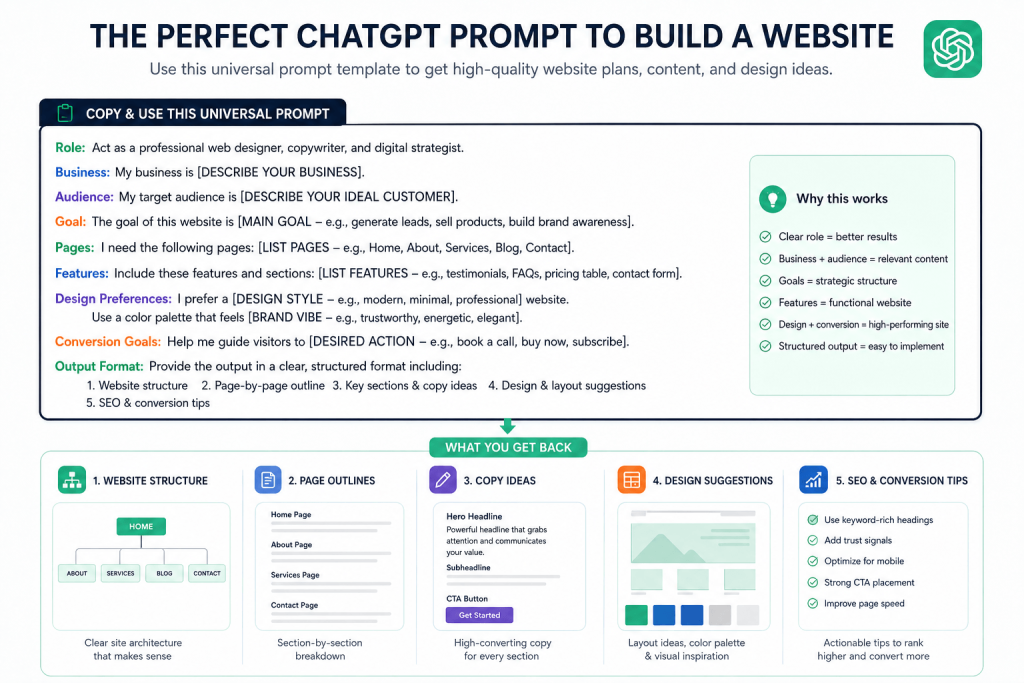
If you only use one prompt from this article, use this one. It covers everything ChatGPT needs to give you a complete, actionable website plan.
The Universal Website-Building Prompt
You are an expert website strategist and conversion copywriter.

I need help building a website for my business. Here are the details:

Business name: [Your Business Name]
Business type: [e.g., local service company, SaaS, ecommerce store, consulting firm]
What I do: [Describe your product or service in 2–3 sentences]
Target audience: [Who are your ideal customers? Be specific — age, profession, pain points, goals]
Main website goal: [e.g., generate leads, sell products online, showcase a portfolio, build email list]
Pages I need: [e.g., Home, About, Services, Pricing, Blog, Contact]
Tone: [e.g., professional, friendly, bold, luxury, approachable]
Competitors: [List 2–3 competitor websites for reference]
Key differentiator: [What makes you different or better than competitors?]
Primary CTA: [What action do you want visitors to take? e.g., Book a call, Buy now, Get a free quote]

Please create:
1. A complete site map with page names and brief purpose for each
2. A homepage wireframe outline (sections and content for each)
3. A homepage headline and subheadline
4. 3 suggested CTAs for the homepage
5. Key trust signals and social proof elements to include
6. A content checklist for each page
Why This Prompt Works
It gives ChatGPT the full context it needs to stop guessing and start solving your specific problem. No vague instructions. No generic output.
When to use it: At the very start of any website project — before you touch a page builder or write a word of copy.
How to customize it: Swap in your actual business details. The more specific you are, the more usable the output. If you’re building for a client, fill in everything from the client brief.
The Website Prompt Formula Professionals Use
Most people write bad prompts without knowing it. Here’s the framework that separates amateur prompts from professional ones:
ROLE + BUSINESS + AUDIENCE + GOAL + FEATURES + OUTPUT FORMAT
Let’s break each piece down.
- ROLE — Tell ChatGPT who it should behave as. “You are a senior UX strategist” produces very different output than “help me with my website.”
- BUSINESS — What you do, how you do it, what makes you different.
- AUDIENCE — Who you’re talking to. Age, profession, problem they’re trying to solve.
- GOAL — What should the website accomplish? Leads? Sales? Trust? Signups?
- FEATURES — What specific deliverables do you need? A headline? A sitemap? A full page?
- OUTPUT FORMAT — Should the output be a bullet list? Paragraph? Table? H1/H2 structure?
Prompt Quality Comparison
Bad prompt:
Write my website homepage.
Result: Generic filler that could belong to any business.
Better prompt:
Write a homepage for my cleaning company in Dallas. Our customers are busy homeowners.
Result: More relevant, but still missing tone, CTA, and key differentiators.
Professional prompt:
You are a conversion copywriter specializing in local service businesses.

Write a homepage for SparkClean, a residential cleaning company in Dallas, Texas. Our clients are busy professionals aged 30–50 who value reliability and trust. We've been in business 8 years, are fully insured, and offer a happiness guarantee.

The homepage should include:
- A headline focused on peace of mind, not just cleaning
- A subheadline with a specific benefit
- 3 feature blocks (trust, speed, guarantee)
- A primary CTA: "Get Your Free Quote"
- Social proof section (mention 500+ happy clients and 4.9-star average)

Tone: Warm, professional, reassuring. No clichés.
Result: Copy you can actually use.
The difference is specificity. Every element of context you add eliminates one more guess ChatGPT has to make.
ChatGPT Prompts for Business Websites
Local Business Website
Prompt
You are a local SEO specialist and website copywriter.

Create a complete website outline for [Business Name], a [type of business] serving [city/region]. Our ideal client is [describe customer]. Our main goal is to generate phone calls and quote requests.

Deliver:
1. A 5-page sitemap with purpose of each page
2. Homepage sections and content outline
3. Services page structure
4. 3 headline options for the homepage
5. A local trust-building section (what to include and why)
6. Suggested schema markup types for local SEO
What It Does
Plans the full local business site with SEO and conversion built in from the start — not bolted on after.
Example Use Case
A plumber in Austin wants a site that ranks locally and converts visitors into calls. This prompt produces a structured plan that serves both goals.
Pro Tip
Add “Include geo-specific keywords naturally throughout the content outline” to get location-optimized suggestions from the start.
Agency Website
Prompt
You are a brand strategist and B2B copywriter.

Build a website strategy for [Agency Name], a [type of agency — design, marketing, dev, etc.] that works with [target clients — e.g., funded startups, enterprise SaaS companies]. Our differentiator is [what makes you different].

Create:
1. A sitemap for a 6–8 page agency website
2. Homepage messaging hierarchy (what to say first, second, third)
3. Case study page structure
4. Services page outline with suggested service descriptions
5. About page narrative framework
6. 3 homepage headline options targeting our ideal client's biggest pain point
What It Does
Builds a client-acquisition machine for agencies, focusing on positioning and social proof rather than just listing services.
Example Use Case
A UX design studio wants to move upmarket and attract funded startups. This prompt helps them position properly and structure their site to build credibility fast.
Pro Tip
Tell ChatGPT which clients you don’t want. “We don’t work with solopreneurs or businesses under $1M revenue” helps it sharpen the positioning.
Consultant Website
Prompt
You are an authority-positioning consultant and conversion copywriter.

Create a website strategy for [Your Name], an independent consultant who helps [target clients] achieve [specific outcome] through [your methodology or approach].

Deliver:
1. A 5-page website structure
2. Homepage sections focused on authority and outcomes (not just biography)
3. "Work with me" page framework
4. Speaking/media page outline (if applicable)
5. Lead magnet ideas to build the email list
6. 3 homepage headlines that position me as the go-to expert, not just another consultant
What It Does
Positions the consultant as a trusted authority, not a commodity. Shifts the website from “here’s my CV” to “here’s why you need me.”
Example Use Case
A leadership coach transitioning from corporate employment to consulting needs a site that builds credibility and generates discovery call bookings.
Pro Tip
Include 2–3 client transformation stories in your prompt. ChatGPT will use them to create outcome-focused copy rather than process-focused fluff.
Service Business Website
Prompt
You are a sales-focused website copywriter.

Create a conversion-optimized website plan for [Business Name], which provides [services] to [target clients]. Our average project value is [$ amount]. Clients typically find us via [referral/Google/social].

Build:
1. A sitemap prioritizing service pages for SEO
2. Service page template (sections, content, CTA placement)
3. Objection-handling FAQ section
4. Pricing page strategy (show price vs. hide price — recommend based on our situation)
5. Trust signal checklist
6. 3 CTA variations for the main contact form
What It Does
Structures the website around the buyer’s journey — from awareness to decision — and removes friction at every stage.
Pro Tip
State your average project value. It changes ChatGPT’s recommendations significantly. A $500 project and a $50,000 project need very different website strategies.
ChatGPT Prompts for Ecommerce Websites
Shopify Store
Prompt
You are a Shopify ecommerce strategist and conversion rate optimization expert.

Help me build a high-converting Shopify store for [Brand Name], which sells [product category] to [target audience]. Our price point is [price range]. Our main competitors are [competitor URLs or names].

Deliver:
1. Homepage layout with section-by-section content outline
2. Navigation structure (main menu + footer menu)
3. Collection page naming strategy
4. Announcement bar copy options (3 variations)
5. Trust badge placement recommendations
6. Abandoned cart email sequence outline (3 emails)
7. Recommended Shopify apps for conversion (explain each recommendation)
What It Does
Gives you a conversion-focused Shopify build plan, not just a pretty store. Covers copy, structure, UX, and post-purchase.
Example Use Case
A skincare brand launching its first direct-to-consumer store needs a launch plan that drives sales from day one.
Pro Tip
Share your top-selling product in the prompt. ChatGPT will design the store around your hero product instead of treating everything equally.
Product Pages
Prompt
You are a product copywriter who specializes in ecommerce conversion.

Write a high-converting product page for: [Product Name]

Product details:
- What it does: [explain]
- Key features: [list]
- Main benefit: [the #1 outcome customers get]
- Target buyer: [describe in detail]
- Common objections: [what stops people from buying?]
- Price: [$]
- Shipping/delivery: [details]

Include:
1. Product title (SEO + conversion optimized)
2. Short description (under 50 words)
3. Long description (benefit-led, 150–200 words)
4. 5 bullet points (feature + benefit format)
5. FAQ section (5 questions with answers)
6. Social proof callout
7. Urgency/scarcity element (if appropriate)
What It Does
Transforms basic product information into persuasive copy that handles objections and drives add-to-cart clicks.
Pro Tip
Paste in 3–5 real customer reviews and ask ChatGPT to use the customers’ own language in the copy. It dramatically increases resonance.
Category Pages
Prompt
You are an SEO content strategist for ecommerce.

Write a category page for [Category Name] on [Store Name]. The category contains [number] products in the [product type] space. Target keyword: [main keyword].

Deliver:
1. Category page title (H1)
2. Short intro paragraph (100–150 words, SEO-focused, customer-benefit-led)
3. Subcategory structure suggestions
4. Filter/sort options to include
5. Internal linking opportunities
6. Schema markup recommendation for this category type
What It Does
Builds category pages that rank organically and help shoppers find what they need — both important for SEO and conversion.
Pro Tip
Always ask for the intro paragraph last. Category page copy should focus on helping the shopper first and search engines second.
Ecommerce Homepage
Prompt
You are a DTC brand strategist and homepage conversion expert.

Design the homepage strategy for [Brand Name], a [product category] brand targeting [customer profile]. Our brand voice is [describe: bold, minimal, playful, premium, etc.]. Our best-seller is [product name].

Create:
1. Hero section (headline, subheadline, CTA, background suggestion)
2. Social proof bar (what to include — reviews, press logos, stats)
3. Best-seller product section layout
4. Brand story section (what to say in 3–4 sentences)
5. UGC/lifestyle imagery section recommendation
6. Email capture section (hook and incentive options)
7. Footer structure
What It Does
Sequences your homepage so it tells a story: who you are, why you’re different, what others say about you, and what to do next.
Pro Tip
Give ChatGPT your brand’s Instagram handle and ask it to consider your visual identity when making copy and layout recommendations.
ChatGPT Prompts for Portfolio Websites
Freelancer Portfolio
Prompt
You are a personal brand strategist for creative freelancers.

Build a portfolio website strategy for [Your Name], a freelance [your skill — writer, designer, developer, etc.] who specializes in [niche]. Target clients: [describe ideal client]. Desired project value: [$].

Create:
1. A 4–5 page portfolio site structure
2. Homepage messaging (position me as specialist, not generalist)
3. Portfolio/work page layout options
4. "Hire me" or services page framework
5. About page narrative (what to include and what to leave out)
6. 3 homepage headlines that attract high-value clients
What It Does
Shifts the portfolio from “look at my work” to “here’s why you should hire me.” Attracts better clients at higher rates.
Pro Tip
Specify the type of client you don’t want. It helps ChatGPT sharpen the positioning toward the clients who value your work most.
Designer Portfolio
Prompt
You are a creative director who helps designers build their personal brand.

Create a portfolio site strategy for [Name], a [UI/UX/graphic/brand] designer with [X years] experience. Portfolio highlights: [list 3–4 key projects]. Dream clients: [types of companies].

Deliver:
1. Site structure
2. Case study page template (what to include in each case study)
3. Homepage hero section
4. Process/approach page outline
5. Recommended way to present work (categories, industries, tools)
6. Contact page with qualifying questions to filter leads
What It Does
Presents your work in context, not just as pretty screenshots. Clients see your thinking, not just your output.
Pro Tip
Ask ChatGPT to write a case study template that includes “the problem, the process, the decision, and the result.” This structure converts better than standard portfolio galleries.
Developer Portfolio
Prompt
You are a career strategist for software developers.

Build a portfolio website strategy for [Name], a [frontend/backend/full-stack] developer specializing in [tech stack]. Career goal: [freelance clients / full-time job / open source visibility]. Target: [type of company or client].

Create:
1. Site structure (keep it lean — 3–4 pages max)
2. Homepage sections focused on skills and impact
3. Projects page layout (what to highlight for each project)
4. Skills presentation strategy (avoid boring lists)
5. GitHub/LinkedIn integration recommendations
6. 3 headline options that differentiate from generic "I build things" copy
What It Does
Helps developers communicate value clearly, not just list technologies. Differentiates you from the hundreds of identical developer portfolios.
Pro Tip
Provide one specific project with measurable results (e.g., “reduced page load time by 60%”). ChatGPT will build the homepage narrative around that result.
Creative Portfolio
Prompt
You are a creative consultant helping artists and creators attract clients and commissions.

Build a portfolio website for [Name], a [photographer / illustrator / filmmaker / animator] whose work focuses on [style or theme]. Dream clients: [brands, agencies, publications]. Goal: [commissions, licensing, brand collaborations].

Deliver:
1. Site structure (visual-first)
2. Gallery/work page organization strategy
3. Homepage hero approach (full-bleed image vs. video vs. grid)
4. Bio page that reads like a story, not a resume
5. Licensing/commission inquiry page structure
6. Pricing presentation strategy (show vs. hide)
What It Does
Builds a portfolio site that feels like the work — not a corporate page with images bolted on.
Pro Tip
Tell ChatGPT your top three brand dream clients. It will calibrate the tone and positioning to attract exactly that type of buyer.
ChatGPT Prompts for SaaS Websites
SaaS Homepage
Prompt
You are a SaaS positioning expert and conversion copywriter.

Create a homepage strategy for [Product Name], a [category] tool that helps [target user — job title or type] to [achieve specific outcome] without [main pain or frustration].

Pricing model: [freemium / subscription / per seat]
Stage: [early-stage / growth / enterprise]
Main competitors: [list 2–3]
Key differentiator: [what makes you 10x better or different]

Deliver:
1. Hero section (headline, subheadline, CTA, social proof hook)
2. Problem/agitation section
3. Solution/feature section (how to present features as outcomes)
4. Social proof section strategy
5. Pricing section teaser
6. Final CTA section
7. 3 hero headline variations (different angles: outcome, pain, category)
What It Does
Builds a homepage that takes the visitor from “what is this?” to “I need to try this” in under 30 seconds.
Pro Tip
Use the formula “We help [WHO] to [DO WHAT] so they can [ACHIEVE WHAT]” as your foundation. Share it with ChatGPT and ask it to build the homepage messaging around it.
Features Page
Prompt
You are a SaaS product marketer.

Write a features page for [Product Name]. The page should present features as customer outcomes, not technical specs.

Features to cover: [list your top 5–7 features]
Target user: [describe]
Primary benefit each feature delivers: [match each feature to a business result]

For each feature, create:
- Feature name (short, clear)
- Outcome-focused headline
- 2–3 sentence description (written for the buyer, not the engineer)
- The specific pain it solves
- A supporting stat or proof point placeholder
What It Does
Translates your product’s capabilities into business value your buyers actually care about.
Pro Tip
Ask ChatGPT: “Rewrite each feature description from the perspective of a CFO, not a power user.” You’ll get copy that justifies the purchase at the executive level.
Pricing Page
Prompt
You are a SaaS pricing page strategist.

Design a pricing page for [Product Name]. Here are our plans:
- Plan 1: [Name], $[price]/mo — includes [features]
- Plan 2: [Name], $[price]/mo — includes [features]
- Plan 3: [Name], $[price]/mo — includes [features]

Target buyer for each plan:
- Plan 1: [who buys this]
- Plan 2: [who buys this]
- Plan 3: [who buys this]

Deliver:
1. Pricing page headline and subheadline
2. Plan names (suggest better names if ours are generic)
3. Feature comparison table structure
4. FAQ section (5 questions that reduce pricing objections)
5. Risk-reversal copy (guarantee, free trial, cancellation policy)
6. "Most popular" or recommended plan strategy
What It Does
Reduces pricing anxiety and purchase hesitation. The right pricing page can lift trial signups by 20–40% with no changes to the product.
Pro Tip
Include your churn data or common cancellation reasons. ChatGPT will address those exact fears in the FAQ and guarantee copy.
Landing Page
Prompt
You are a direct-response copywriter specializing in SaaS landing pages.

Create a high-converting landing page for [Campaign Name]. This page is promoting [offer — free trial, demo, ebook, webinar].

Target audience: [describe in detail]
Traffic source: [Google Ads / Meta / email / organic]
Primary CTA: [what you want them to do]
Key message: [one-sentence reason they should convert now]
Objections to address: [list 3–5 common hesitations]

Deliver:
1. Above-the-fold section (headline, subheadline, CTA, trust signal)
2. Benefits section (3–5 key outcomes)
3. Social proof section (format depends on what you have)
4. How it works section (3-step simple explanation)
5. Final CTA with urgency
6. Form fields recommendation (fewer = higher conversion)
What It Does
Builds a focused, distraction-free page engineered to convert paid or email traffic into signups or demos.
Pro Tip
Specify the traffic source. A landing page for cold Google Ads traffic needs much more education than one for warm email subscribers.
ChatGPT Prompts for Website Copywriting
Homepage Copy
Prompt
You are a conversion copywriter.

Write complete homepage copy for [Business Name]. Here's the context:

What we do: [explain clearly]
Who we serve: [target audience]
Biggest customer pain: [what problem keeps them up at night]
Our solution: [how we solve it]
Why us vs. competitors: [key differentiator]
Proof: [stats, testimonials, clients, awards]
Primary CTA: [desired action]

Write:
- H1 headline (outcome or curiosity-led, not welcome message)
- Subheadline (expands on H1, adds specificity)
- 3-line hero description
- 3 feature/benefit blocks with headlines
- Social proof callout
- Secondary CTA section
- Footer tagline
What It Does
Produces a complete, ready-to-use homepage draft in one pass. Faster than briefing a copywriter and easier to revise.
Pro Tip
After the first draft, ask: “Rewrite the headline 5 more times — try pain-led, result-led, curiosity-led, question-led, and specificity-led angles.”
About Page
Prompt
You are a brand storyteller.

Write an About page for [Business/Person Name]. This page should build trust, show personality, and explain why we exist — not just when we were founded.

Key information:
- Founding story: [what led to starting this business]
- Mission: [why you do what you do]
- Team: [size, key people, culture]
- Values: [what you stand for]
- Client results: [a few key outcomes or milestones]

Write a narrative About page (not bullet points). Around 300–400 words. End with a CTA to explore services or contact us.
What It Does
Turns a dry “we were founded in 2018” page into a trust-building story that connects emotionally with the right client.
Pro Tip
Add “Make it sound human, not corporate. Use contractions. Write like a person talking, not a press release.” You’ll get copy that actually sounds like you.
Services Page
Prompt
You are a B2B copywriter focused on service business websites.

Write a services page for [Business Name]. We offer the following services: [list them].

For each service write:
1. Service name (clear and searchable)
2. Who it's for (1 sentence)
3. What's included (3–5 bullet points)
4. Main outcome or transformation
5. Starting price or pricing approach (optional)
6. CTA specific to this service

Overall page intro: 2–3 sentences explaining our services philosophy.
What It Does
Creates a services page that sells — not just describes. Each service is framed around the buyer’s outcome, not your process.
Pro Tip
Ask for a “Is this right for you?” section at the bottom of each service. It qualifies leads before they contact you.
Contact Page
Prompt
You are a UX writer focused on reducing friction.

Write the copy for a contact page for [Business Name]. Our goal is to get qualified leads to reach out — and pre-qualify them so we don't waste time on bad-fit inquiries.

Include:
1. Page headline (not just "Contact Us")
2. 2–3 sentence intro that sets expectations
3. What to expect after submitting (response time, next step)
4. 3–4 form field recommendations with labels and placeholder text
5. Alternative contact options (phone, email, social)
6. An FAQ about working with us (2–3 quick questions)
What It Does
Reduces the abandonment rate on contact pages and sets the right expectations before the first conversation.
Pro Tip
Replace “Contact Us” as your H1 with something specific like “Let’s Talk About Your Project” or “Get Your Free Quote Today.”
FAQ Page
Prompt
You are a conversion copywriter who specializes in objection handling.

Write a FAQ page for [Business Name]. Our target customer is [describe]. The most common questions and objections we hear are: [list 8–10 questions].

For each FAQ:
1. Question (written exactly how a real customer would ask it)
2. Answer (clear, confident, 2–4 sentences — remove doubt, not just answer)
3. Internal link suggestion (where to send them for more info)

Also include 3 questions we should be asked but aren't (preemptive objection handling).
What It Does
Handles objections before sales calls, reducing friction and improving lead quality. Also excellent for SEO (People Also Ask targeting).
Pro Tip
Ask ChatGPT to “write the FAQ from the perspective of someone who almost didn’t buy.” It produces much more honest, useful answers.
ChatGPT Prompts for Website Design and UX
Color Palette Generation
Prompt
You are a brand designer and UX specialist.

Suggest a complete color palette for [Business Name], a [business type] targeting [audience]. Brand personality: [e.g., bold and innovative, calm and trusted, playful and energetic].

Deliver:
- Primary color (HEX code + rationale)
- Secondary color (HEX code + rationale)
- Accent color (HEX code + rationale)
- Background color (light mode)
- Text color
- Error/success colors
- How to use each color across the site (CTA buttons, headers, backgrounds)
- Contrast accessibility notes (WCAG AA compliance)
What It Does
Creates a cohesive, accessible color system grounded in brand psychology — not just picking colors that look nice.
Pro Tip
Share competitor colors and ask: “Don’t use colors that look like [Competitor A] or [Competitor B]. We want to stand apart visually.”
Website Layout Ideas
Prompt
You are a senior UX designer.

Recommend a layout approach for [page type — homepage, product page, about page] for [Business Name].

Audience: [describe]
Goal of this page: [main conversion action]
Content we have: [list what you have — photos, videos, testimonials, icons, etc.]

Deliver:
1. Recommended layout pattern (name it and explain why)
2. Section order with reasoning for each placement
3. Above-the-fold recommendation (exactly what should appear in the first viewport)
4. Whitespace and visual hierarchy guidance
5. What NOT to put on this page (common mistakes for this page type)
What It Does
Gives you a structured, conversion-focused layout plan before you open your page builder.
Pro Tip
Ask for “layout ideas used by high-converting websites in [your industry]” to get industry-specific UX patterns.
User Experience Recommendations
Prompt
You are a UX auditor and conversion rate optimization specialist.

Review the following website structure and give me UX improvement recommendations:

Current pages: [list them]
Current main navigation: [list items]
Current homepage sections: [list them]
Biggest drop-off point we know of: [where do visitors leave?]
Current conversion rate: [if known]

Deliver:
1. Top 5 UX issues based on best practices
2. Navigation improvements
3. Page speed and technical UX recommendations
4. Trust and credibility improvements
5. Mobile UX considerations
6. Priority order for fixing issues (quick wins first)
What It Does
Gives you an actionable UX audit without paying for an agency to run one.
Pro Tip
Paste your actual navigation and homepage content into the prompt for a more specific audit.
Mobile-First Design Suggestions
Prompt
You are a mobile UX strategist.

Give me mobile-first design recommendations for [Business Name]'s website. Our primary traffic source is [mobile / desktop / mixed]. Most visitors arrive from [Google / Instagram / email / direct].

Deliver:
1. Navigation approach for mobile (hamburger, sticky bar, bottom nav?)
2. Hero section recommendations for small screens
3. CTA button placement and sizing guidance
4. Image and media optimization recommendations
5. Form optimization for mobile (field count, keyboard type, etc.)
6. Page speed priorities for mobile
7. Touch target and readability standards to hit
What It Does
Ensures your website is designed for how people actually browse — on their phones, often with one thumb.
Pro Tip
Share your Google Analytics or Search Console device breakdown in the prompt. ChatGPT will tailor recommendations to your actual audience split.
Common Mistakes When Using ChatGPT to Build a Website
1. Vague Prompts
“Help me build a website” tells ChatGPT nothing. It produces generic, one-size-fits-none content that helps nobody.
Fix: Use the ROLE + BUSINESS + AUDIENCE + GOAL + FEATURES + OUTPUT FORMAT framework every time.
2. Missing Audience Information
If you don’t tell ChatGPT who you’re talking to, it writes for everyone — which means it resonates with no one.
Fix: Describe your ideal customer in 3–5 sentences. Include their job, their pain, their goal, and what they care about most.
3. Ignoring Conversion Goals
Many people ask ChatGPT to “write copy” without specifying what the copy should make the reader do. Pretty words that don’t drive action are expensive decorations.
Fix: Always include your primary CTA and the one action you want visitors to take.
4. Not Requesting Structured Outputs
Asking ChatGPT to “write my homepage” results in a wall of text. Asking for “write my homepage in sections with H2 headers, bullet points, and a table for the feature comparison” gives you something you can actually use.
Fix: Always specify format. Tell ChatGPT exactly how you want the output structured.
5. Copying Without Reviewing
ChatGPT can produce plausible-sounding content that’s factually wrong, tonally off-brand, or missing key details about your business that only you know.
Fix: Treat every ChatGPT output as a first draft. Review, edit, and add specifics before publishing.
Best Practices for Getting Better Website Results From ChatGPT
Be specific, not general. Every specific detail you add is one fewer assumption ChatGPT has to make. Assumptions produce generic output.
Define your audience precisely. “Small business owners” is not an audience. “Female founders of service businesses doing $100K–$500K in revenue who feel too busy to market themselves” is an audience.
Explain business goals explicitly. Tell ChatGPT whether you want leads, sales, signups, or brand awareness. Each goal requires a different website strategy.
Request output formats. Bullet points, tables, H1/H2 structures, numbered steps — ask for the format you need, not just the content.
Ask for revisions and variations. After your first output, ask: “Give me 5 alternative headlines,” or “Rewrite that section with more urgency,” or “Make this sound less formal.”
Test multiple prompt variations. The first prompt is rarely the best. Run the same brief with 2–3 different angles and compare the outputs.
Build in your constraints. Tell ChatGPT what you don’t want. “No jargon. No long paragraphs. No bullet points that start with action verbs.” Constraints dramatically improve output quality.
ChatGPT vs Website Builders
| Feature | ChatGPT | WordPress | Wix | Shopify | Webflow |
|---|---|---|---|---|---|
| Ease of use | High (no tech skills needed for prompts) | Medium | High | High | Low–Medium |
| Design flexibility | Ideas only (no visual output) | High | Medium | Medium | Very high |
| Content generation | Excellent | None built-in | None built-in | None built-in | None built-in |
| Website hosting | None | Self-hosted or managed | Included | Included | Included |
| Ecommerce | Strategy only | Via plugins | Basic | Best-in-class | Via integrations |
| Code generation | Yes (HTML/CSS/JS) | No | No | Liquid (themes) | No |
| Cost | $20/mo (ChatGPT Plus) | $0–$50+/mo | $17–$35/mo | $39–$399/mo | $14–$212/mo |
| Best for | Planning, copy, strategy | Blogs, content sites | Simple sites | Online stores | Design-forward sites |
The verdict: ChatGPT isn’t a website builder. It’s a website planner and writer that makes every other platform faster to use. Use ChatGPT for strategy and content, then build on whichever platform fits your needs.
Frequently Asked Questions
Can ChatGPT build a complete website?
No — ChatGPT cannot host, publish, or visually design a website. However, it can plan your site structure, write all your copy, generate HTML/CSS code, create UX recommendations, and produce a complete blueprint. You still need a platform like WordPress, Shopify, or Webflow to bring it online.
What is the best ChatGPT prompt to build a website?
The best prompt combines ROLE + BUSINESS + AUDIENCE + GOAL + FEATURES + OUTPUT FORMAT. Include your business type, target audience, website goals, required pages, preferred tone, and what you want ChatGPT to deliver. The more specific you are, the more usable the output.
Can ChatGPT generate website code?
Yes. ChatGPT can write HTML, CSS, JavaScript, PHP, and other web languages. For simple pages and landing pages, the code is often production-ready with minor tweaks. For complex functionality, treat it as a starting point that a developer can refine.
Can ChatGPT write website copy?
Yes — this is one of ChatGPT’s strongest use cases. With the right prompt, it can write homepage copy, about pages, service descriptions, product descriptions, CTAs, FAQs, and more. Always review and personalize the output with specific details ChatGPT wouldn’t know.
Can ChatGPT help with website design?
ChatGPT can recommend color palettes, layout structures, UX patterns, and design direction in text form. It cannot produce visual mockups or images. For visual output, combine ChatGPT’s design brief with tools like Figma, Midjourney, or a professional designer.
Conclusion
ChatGPT is one of the most powerful tools available for anyone building a website — but only when you use it with intention.
The difference between a useful ChatGPT session and a waste of time comes down to prompt quality. A vague prompt produces vague output. A specific, structured prompt produces a website plan you can act on immediately.
Use the prompts in this guide as your starting point. Customize them for your business, your audience, and your goals. Then treat every output as a first draft — review it, add your specific details, and refine it until it sounds like you.
The best websites aren’t built by AI. They’re built by people who know how to use AI to think faster, write better, and start stronger. That’s the real superpower here.
Start with the Universal Website-Building Prompt, fill it in for your business, and see what’s possible.