If you run a Shopify store, you already know the real bottleneck isn’t building the store — it’s writing everything that goes on it. Homepage copy, product descriptions, meta titles, FAQs, cart abandonment emails. It piles up fast.
That’s where ChatGPT comes in. Used well, it can cut your content workload in half. Used badly, it spits out generic copy that sounds like every other store on the internet.
The difference comes down to one thing: your prompt.
This guide gives you copy-paste ChatGPT prompts built specifically for Shopify — for store planning, homepage copy, product descriptions, SEO, and sales content. No theory, just prompts you can use today.
Can ChatGPT Help Build a Shopify Website?
Yes — ChatGPT can meaningfully speed up building and improving a Shopify website, as long as you treat it as a copywriting and planning tool, not a website builder.
Here’s where it actually helps:
- Store planning — page structure, navigation, niche positioning
- Homepage copy — headlines, hero sections, value propositions
- Product descriptions — benefit-driven copy at scale
- SEO content — meta titles, descriptions, collection page copy
- Sales copy — CTAs, promotions, abandoned cart messaging
- Customer experience — FAQs, shipping policies, size guides
Where it falls short: ChatGPT can’t touch Shopify’s theme code, install apps, or configure checkout settings. It also doesn’t know your real customer data, your actual margins, or your brand history unless you tell it. The output is only as good as the input.
If you haven’t seen the broader framework this is built on, check out our ChatGPT prompt to build a website guide — this article applies that same approach specifically to Shopify.
The Best ChatGPT Prompt for Shopify Website Creation
Start every project with one master prompt that gives ChatGPT full context. This becomes the foundation for every other prompt you use later.
Prompt:
Act as an experienced Shopify ecommerce consultant and conversion copywriter.

I'm building a Shopify store. Here are the details:

Store niche: [e.g., sustainable activewear]
Products: [list main products or categories]
Target audience: [age, interests, pain points, buying motivation]
Brand voice: [e.g., bold and energetic / calm and premium / friendly and casual]
Store goals: [e.g., grow first-time customer sales, build email list, increase AOV]
Required pages: [Homepage, About, Product pages, FAQ, Contact]

Based on this, suggest:
1. A homepage structure with section-by-section content recommendations
2. Key messaging themes I should use across the store
3. A content priority list (what to write first)

Keep recommendations practical and specific to my niche, not generic ecommerce advice.
Why It Works
It front-loads everything ChatGPT needs — niche, audience, voice, goals — instead of making it guess. Specific inputs produce specific, usable outputs.
When To Use It
Use this at the very start of a new store build, or when relaunching an existing store with a new brand direction.
How To Customize It
Swap in real details about your actual customers (not assumptions), and be specific about goals. “Increase sales” is vague. “Increase first-time purchase conversion from Instagram traffic” gives ChatGPT something to work with.
Shopify Prompt Formula for Better Results
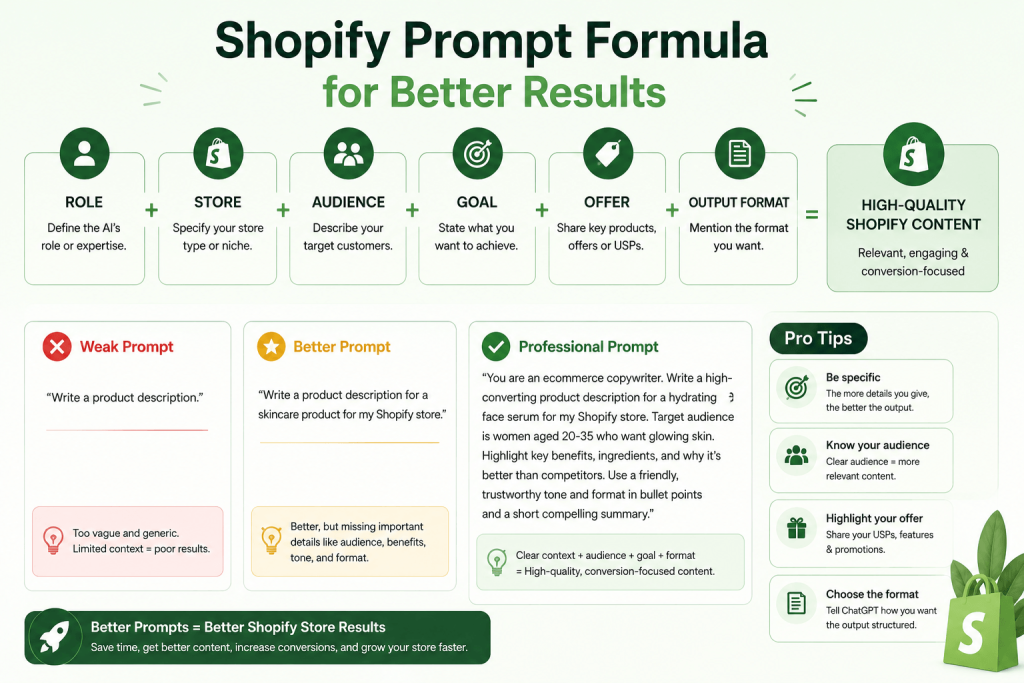
Most weak Shopify prompts are missing structure. Use this formula every time:
ROLE + STORE + AUDIENCE + GOAL + OFFER + OUTPUT FORMAT
- Role — Who should ChatGPT act as? (copywriter, SEO strategist, consultant)
- Store — What’s the niche and product?
- Audience — Who’s buying, and why?
- Goal — What should this content achieve?
- Offer — What’s the specific product, promo, or value prop?
- Output format — Length, tone, structure (bullets, paragraph, headline)
Here’s the same request written three ways:
Weak Prompt Example
Write a product description for my candle.
This gives ChatGPT almost nothing to work with — expect generic, forgettable copy.
Better Prompt Example
Write a product description for a soy candle in lavender scent for a calming home fragrance brand.
Better, but still missing audience and goal — the output will be serviceable, not persuasive.
Professional Prompt Example
Act as a Shopify conversion copywriter. Write a product description for a hand-poured soy candle in lavender scent, sold by a calming home fragrance brand. The audience is women aged 28-45 who care about clean ingredients and self-care rituals. The goal is to drive add-to-cart from Instagram traffic. Output: 100-120 words, warm and sensory tone, end with a soft CTA.
Same product, dramatically different output quality. The formula does the heavy lifting.
ChatGPT Prompts for Shopify Homepage Content
Your homepage has seconds to convince someone to stay. These prompts target the sections that matter most.
Prompt — Hero Section
Act as a Shopify copywriter. Write a hero section for a [niche] store selling [main product]. Target audience: [audience]. Include a headline (under 10 words), a one-line subheadline, and a CTA button text. Tone: [brand voice].
What It Does: Generates the first thing visitors see — the make-or-break section above the fold.
Pro Tip: Ask for 5 headline variations and A/B test the top two using Shopify’s built-in analytics.
Prompt — Homepage Headline
Write 8 homepage headline options for a Shopify store selling [product] to [audience]. Each should be under 8 words, lead with a benefit or outcome, and avoid generic phrases like "best quality" or "shop now."
What It Does: Gives you a bank of headline options instead of forcing one weak draft.
Pro Tip: The best headline usually names a specific outcome, not a feature. “Sleep better tonight” beats “Premium memory foam pillows.”
Prompt — Value Proposition
Write a value proposition section for a Shopify store selling [product]. Explain in 3 short bullet points why a customer should buy from us instead of a competitor. Focus on [your real differentiators: e.g., shipping speed, materials, guarantee].
What It Does: Clarifies why you’re worth choosing — most stores skip this entirely.
Pro Tip: Feed ChatGPT your actual differentiators. If you don’t have real ones yet, that’s a business problem no prompt can fix.
Prompt — Featured Products Section
Write short, punchy captions (under 12 words each) for a "Best Sellers" homepage section featuring these products: [list 3-4 products]. Each caption should highlight a benefit, not just describe the item.
What It Does: Turns a plain product grid into something that actually sells.
Pro Tip: Pair this with real customer language pulled from reviews — ChatGPT can rework it into punchier captions.
ChatGPT Prompts for Shopify Product Descriptions
Product pages are where browsers become buyers. These prompts cover the main styles you’ll need.
Prompt — SEO Product Description
Write an SEO-optimized product description for [product name], a [short product description]. Primary keyword: [keyword]. Include the keyword naturally in the first sentence. Length: 150-180 words. Include a short bullet list of key features.
What It Does: Balances search visibility with readable, persuasive copy.
Pro Tip: Don’t stuff the keyword more than twice — Google and your customers both notice.
Prompt — Benefit-Focused Description
Write a benefit-focused product description for [product]. For each feature listed, translate it into a customer benefit. Features: [list features]. Audience: [audience]. Avoid listing features without explaining why they matter.
What It Does: Forces ChatGPT to answer “so what?” for every feature — the core of persuasive product copy.
Pro Tip: Ask ChatGPT to format this as a feature-to-benefit table first, then turn it into flowing copy.
Prompt — Luxury Product Description
Write a premium, understated product description for [product], priced at [price range]. Audience values craftsmanship and exclusivity over discounts. Avoid exclamation points, urgency language, or casual tone. Length: 120-150 words.
What It Does: Keeps tone restrained and aspirational — luxury copy that oversells reads cheap.
Pro Tip: Explicitly tell ChatGPT what to avoid (urgency, exclamation points). It defaults to hype unless you restrict it.
Prompt — High-Converting Product Copy
Act as a direct-response copywriter. Write a product description for [product] using this structure: a hook sentence, 3 benefit-driven bullets, a brief objection-handling sentence, and a closing CTA. Audience: [audience]. Tone: [brand voice].
What It Does: Adds a proven copywriting structure instead of a flat description.
Pro Tip: The objection-handling line is the one most stores skip — it’s often the difference between a browse and a buy.
ChatGPT Prompts for Shopify SEO
Shopify SEO content needs to satisfy both search engines and shoppers. These prompts handle the technical and on-page basics.
Prompt — Meta Titles
Write 5 SEO meta titles for a Shopify product page selling [product]. Primary keyword: [keyword]. Max 60 characters. Include the brand name [brand] where it fits naturally.
What It Does: Produces clickable, keyword-relevant titles within Google’s display limit.
Pro Tip: Front-load the keyword in at least 2-3 versions — it carries more SEO weight near the start.
Prompt — Meta Descriptions
Write 3 meta descriptions for a Shopify product page about [product]. Max 155 characters. Include the keyword [keyword] and a soft call-to-action.
What It Does: Improves click-through rate from search results, which indirectly supports rankings.
Pro Tip: Avoid duplicate meta descriptions across similar products — ChatGPT can generate unique variations fast.
Prompt — Product SEO
Optimize this product description for SEO without changing the tone: [paste existing description]. Target keyword: [keyword]. Suggest where to naturally place the keyword and recommend an SEO-friendly product title.
What It Does: Improves existing content instead of starting from zero.
Pro Tip: Always ask ChatGPT to preserve your existing tone — generic SEO rewrites often strip out brand personality.
Prompt — Collection Page SEO
Write SEO content for a Shopify collection page for [collection name, e.g., "Men's Running Shoes"]. Include a 150-word intro paragraph above the product grid, targeting the keyword [keyword]. Explain what the collection includes and who it's for.
What It Does: Adds the indexable text content collection pages usually lack.
Pro Tip: Place this content above the product grid, not below — it gets more SEO and user value there.
Prompt — FAQ Generation
Write 5 FAQ questions and answers for a Shopify product page about [product]. Base the questions on common customer concerns: shipping, sizing, returns, durability, and usage. Keep answers under 40 words each.
What It Does: Builds out FAQ schema content, which can also surface in Google’s People Also Ask results.
Pro Tip: Pull real questions from your customer service inbox first — ChatGPT writes better answers when you supply real questions.
ChatGPT Prompts for Shopify Sales and Conversions
These prompts focus directly on moving people from browsing to buying.
Prompt — Product Benefits
List the top 5 customer benefits of [product], written for [audience]. Focus on outcomes and feelings, not just features. Each benefit should be one sentence.
What It Does: Surfaces the emotional and practical reasons people actually buy.
Pro Tip: Use this output to build out bullet points across product pages, ads, and email.
Prompt — Calls-to-Action
Write 8 CTA button variations for a Shopify [product type] store. Avoid generic phrases like "Buy Now" or "Add to Cart." Make each one specific to the product or outcome. Max 4 words each.
What It Does: Replaces flat, generic buttons with copy that adds a little extra pull.
Pro Tip: Test these against your default Shopify CTA — small wording changes can move conversion rate more than people expect.
Prompt — Promotional Offers
Write 3 versions of a promotional banner for a [discount type, e.g., 20% off] sale on [product category]. Audience: [audience]. Keep each version under 15 words and create urgency without sounding pushy.
What It Does: Generates promo copy for banners, pop-ups, and homepage announcements.
Pro Tip: Real urgency (an actual end date) always outperforms manufactured urgency — feed ChatGPT the real deadline.
Prompt — Cart Abandonment Messaging
Write a 3-email cart abandonment sequence for a Shopify store selling [product]. Email 1: gentle reminder, sent 1 hour after abandonment. Email 2: address a common objection, sent 24 hours later. Email 3: offer a small incentive, sent 48 hours later. Keep each email under 100 words.
What It Does: Builds a complete recovery sequence instead of a single generic reminder email.
Pro Tip: Save the discount for the final email only — leading with a discount trains customers to always abandon their cart first.
Frequently Asked Questions
Can ChatGPT create content for Shopify websites?
Yes. ChatGPT can write homepage copy, product descriptions, SEO content, and sales copy for Shopify stores. It can’t build the actual site or install Shopify themes — it’s a content tool, not a development tool.
What is the best ChatGPT prompt for Shopify?
The best prompt includes your store niche, products, target audience, brand voice, and specific goal, plus a clear output format. Generic prompts produce generic results — specificity is what separates a strong Shopify prompt from a weak one.
Can ChatGPT write Shopify product descriptions?
Yes. ChatGPT can write SEO-friendly, benefit-focused, or premium product descriptions when given the product features, target audience, and desired tone. The more detail you provide, the more usable the description will be.
Can ChatGPT improve Shopify SEO?
Yes. ChatGPT can write meta titles, meta descriptions, collection page intros, and FAQ content optimized around target keywords. It can’t access live ranking data, so pair it with Shopify’s SEO apps or Google Search Console for full optimization.
Is ChatGPT useful for Shopify store owners?
Yes, particularly for speeding up content creation — homepage copy, product descriptions, SEO content, and email sequences. It works best as a drafting and ideation tool, with a human doing final review and edits before publishing.
Conclusion
Shopify store owners use ChatGPT because content is the bottleneck most stores never solve — and a good prompt turns hours of writing into minutes of editing.
The quality of what you get back depends entirely on the quality of what you put in. Vague prompts produce vague copy. Specific prompts — with real audience details, brand voice, and goals — produce copy you can actually publish.
Start with the master prompt at the top of this guide, then work through the homepage, product, SEO, and sales prompts as you build out your store. Copy them, fill in your details, and you’ll have usable content in minutes instead of hours.