Every day, thousands of people sit with a business idea they don’t know how to start. They have the ambition, maybe even a little capital, but they’re stuck staring at a blank page wondering where to begin.
That’s exactly where ChatGPT comes in.
In the last two years, entrepreneurs have quietly started using AI not just to brainstorm names or write emails — but to run entire phases of building a business. Market research, customer personas, pricing models, sales scripts, launch plans — all of it, done faster and cheaper than hiring consultants or agency teams.
This guide is different from most you’ll find on this topic. You won’t get a single “magic prompt” and a pat on the back. You’ll get a complete business-building system — prompts for every stage from idea to growth — so you can use ChatGPT like a business partner who never sleeps and never sends an invoice.
Let’s get into it.
Can ChatGPT Help You Build a Business?
Yes and more than most people realize.
ChatGPT can’t sign customers, manage your cash flow, or make phone calls on your behalf. But it can do almost everything that comes before and around those actions. Here’s an honest breakdown:
What ChatGPT can genuinely help with:
- Business idea generation — surfacing opportunities based on your skills, interests, and market gaps
- Market research — analyzing industries, identifying trends, and sizing audiences
- Customer research — building personas, mapping pain points, and simulating customer conversations
- Business planning — structuring your model, pricing, and financial assumptions
- Branding — business names, taglines, positioning statements, and brand voice
- Marketing — content strategies, email sequences, social media plans, and ad copy
- Sales — scripts, objection handling, pitch decks, and funnel design
- Operations — SOPs, workflows, hiring plans, and process documentation
- Growth strategy — scaling frameworks, partnership ideas, and retention tactics
What ChatGPT can’t do:
- Replace real customer conversations and feedback
- Guarantee the accuracy of market data (always verify)
- Make decisions for you
- Execute anything — only you can do that
The people who get the most out of ChatGPT treat it like a brilliant generalist consultant: incredibly useful for frameworks and drafts, but always needing your judgment and real-world input to refine.
The Best ChatGPT Prompt to Build a Business
If you want one comprehensive prompt to start your business-building process, this is it.
The Master Business Builder Prompt
You are an experienced startup strategist and business consultant. I want to build a business and need your help thinking through the entire process.

Here is my situation:
- My skills and background: [describe your skills, experience, and expertise]
- My available time: [hours per week you can dedicate]
- My starting budget: [your approximate budget]
- Industries I'm interested in: [list industries or leave blank for open exploration]
- Problems I've noticed: [describe problems you've observed or experienced]
- Target customer type: [consumers, small businesses, enterprises, or leave open]

Please help me:
1. Identify 5 viable business opportunities that match my situation
2. For each opportunity, explain: the customer problem, target market, potential revenue model, estimated startup cost, and your confidence in market demand
3. Recommend the single best opportunity for me and explain why
4. Outline the first 10 steps I should take to move from idea to first paying customer
5. Flag any risks or assumptions I should validate before investing time or money

Be direct, practical, and specific. Avoid generic advice. Treat me as a capable adult who can handle honest feedback.
Why This Prompt Works
Most business prompts are vague. They ask ChatGPT to “give me business ideas” and get a list of 20 things anyone could find with a Google search.
This prompt works because it gives ChatGPT context. The more context you give, the more tailored and actionable the output. By describing your skills, budget, time, and interests, you’re essentially hiring a consultant who knows your situation — not just a generic idea generator.
When To Use It
Use this prompt when you’re starting from scratch or reconsidering your current direction. It’s designed to be your starting gun — the prompt that sets the direction for everything that follows.
How To Customize It
- If you already have an idea, replace the open-ended questions with your specific concept and ask ChatGPT to stress-test it instead.
- If you’re pivoting an existing business, describe what you currently do and what’s not working.
- If you’re a freelancer looking to productize, mention your current client work and ask for productized service or SaaS opportunities.
The Business Building Framework Professionals Use
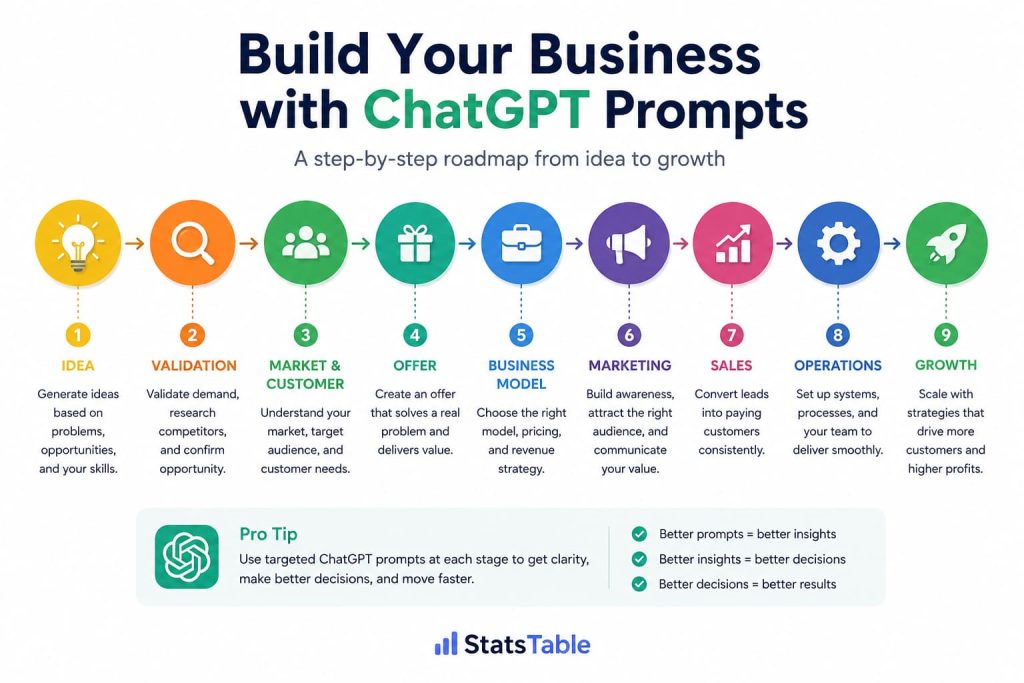
Before diving into specific prompts, it helps to understand the stages of building a business. Most people skip straight to marketing and wonder why nothing works. Here’s the framework that every stage of this guide follows:
| Stage | What It Covers |
|---|---|
| Idea | Identifying real opportunities worth pursuing |
| Market | Understanding the landscape you’re entering |
| Customer | Knowing exactly who you’re serving and why they’ll pay |
| Offer | Packaging your solution so it sells itself |
| Model | Structuring how you make money |
| Marketing | Getting your offer in front of the right people |
| Sales | Converting interest into revenue |
| Operations | Running the business without burning out |
| Growth | Scaling what’s working |
Each stage builds on the one before it. Skip the customer stage and your marketing will miss. Skip validation and you’ll build something nobody wants. Use the prompts below in order, and you’ll have a business built on solid foundations.
ChatGPT Prompts for Business Idea Generation
Finding Business Ideas
Prompt
I have [X years] of experience in [your field/industry]. Based on this background, suggest 7 business ideas I could realistically start with [your budget] and [your available hours per week]. For each idea, include: the core customer problem it solves, how I'd make money, estimated time to first revenue, and one reason it could fail. Rank them from most to least viable.
What It Does
Forces ChatGPT to give you ideas grounded in your actual experience, not fantasy businesses. The ranking and risk flag make the output immediately actionable.
Example Use Case
A 10-year HR professional with $5,000 and 15 hours per week could use this to surface ideas like an HR consulting service for startups, an employee handbook template business, or an online course on hiring.
Pro Tip
Run this prompt twice — once focused on service businesses and once focused on digital products. Compare the results and look for overlap between both lists.
Solving Problems
Prompt
Here is a problem I've personally experienced or observed: [describe the problem in detail].

Who else likely experiences this problem? How frequently? How much does it cost them in time or money? What solutions currently exist, and why are they inadequate? What kind of business could solve this problem better? Give me three different business model angles I could pursue.
What It Does
Takes your raw observation and transforms it into a structured opportunity analysis. This is how many successful businesses are actually born — from frustration, not brainstorming.
Example Use Case
A freelance designer frustrated by vague client briefs could use this to explore a client onboarding template business, a project management tool for creatives, or a brief-writing coaching service.
Pro Tip
The more specific your problem description, the better. Don’t say “businesses struggle with hiring.” Say “small restaurants spend 12+ hours per week on job postings and still get unqualified applicants.”
Identifying Market Gaps
Prompt
I'm interested in the [industry] space. Analyze this industry and identify:
1. Three underserved customer segments
2. Three problems that existing solutions handle poorly
3. Emerging trends that create new opportunities in the next 2–3 years
4. The types of businesses that are most profitable in this space and why

Be specific. Use examples of real companies where possible.
What It Does
Gives you a competitive map of an industry before you enter it, surfacing the white space that incumbents are leaving unaddressed.
Example Use Case
Someone exploring the wellness industry could discover that corporate wellness programs for remote teams, or personalized sleep coaching, are dramatically underserved compared to generic gym-membership benefits.
Pro Tip
Follow up by asking ChatGPT to search for customer complaints about existing solutions in this space. The complaints are your product roadmap.
Matching Ideas to Your Skills
Prompt
Here are my core skills and strengths: [list your top 5–7 skills].
Here are things I genuinely enjoy doing: [list what energizes you].
Here are constraints I'm working with: [budget, time, location, lifestyle needs].

Which business models are the best fit for someone like me? Which types of businesses should I avoid and why? Give me 5 specific business concepts that would play to my strengths and create real market value.
What It Does
Prevents the trap of chasing a “hot” business idea that doesn’t fit your actual situation. Sustainable businesses are built on your strengths, not someone else’s template.
Example Use Case
A teacher with strong communication skills but minimal tech experience and a $2,000 budget should be steered toward consulting, coaching, or content — not SaaS development.
Pro Tip
After running this prompt, ask ChatGPT to show you real examples of people with similar backgrounds who built successful businesses. The examples build confidence and reveal paths you hadn’t considered.
ChatGPT Prompts for Business Validation
Demand Validation
Prompt
I want to validate whether there's real demand for [your business idea]. Help me design a lean validation plan that:
1. Identifies the riskiest assumption I'm making
2. Suggests 3 ways to test that assumption with zero or minimal spending
3. Defines what "success" looks like for each test
4. Recommends the fastest path to getting my first 10 potential customers to tell me whether they'd pay for this

I want to validate before I build anything.
What It Does
Stops you from building in a vacuum. Real validation means getting signal from actual people — not just ChatGPT agreeing your idea sounds good.
Example Use Case
Someone planning to launch a meal prep service for postpartum mothers could test demand by posting in parenting Facebook groups, running a simple Google Forms survey with a $50 gift card incentive, or offering a free consultation to 10 potential customers before building anything.
Pro Tip
Don’t ask ChatGPT whether your idea is good. ChatGPT will be polite. Ask it to steelman the case against your idea — to give you the strongest arguments for why it will fail. That’s the useful output.
Competitor Research
Prompt
My business idea is [describe your idea]. Who are the main competitors in this space — both direct (same product/service) and indirect (alternative ways customers solve the same problem)?

For each competitor, tell me:
- What they do well
- Where they're weak or getting criticized by customers
- What pricing model they use
- What customer segment they seem to prioritize

Where is the opening for a new entrant like me?
What It Does
Maps the competitive landscape and reveals positioning opportunities. The weakness analysis is the most valuable part — complaints about competitors are your differentiation strategy.
Example Use Case
Someone launching a bookkeeping service for e-commerce sellers might discover that the major players are priced for 7-figure businesses, leaving a huge gap for sellers doing $50K–$300K annually.
Pro Tip
After this prompt, ask ChatGPT to search for 1-star reviews of the top competitors. Patterns in those reviews are gold.
Customer Pain Point Discovery
Prompt
My target customer is [describe them in detail: demographics, job/role, lifestyle, goals].

Help me understand their world deeply:
1. What are their top 3 daily frustrations related to [your problem area]?
2. What have they already tried to solve this problem?
3. What's the emotional cost of the problem — stress, embarrassment, wasted time?
4. What would their life look like if this problem was completely solved?
5. What language do they use when describing this problem?

Write this as a detailed profile I can use to shape my messaging and offer.
What It Does
Builds deep customer empathy that turns into marketing copy that converts. The language they use is particularly powerful — it should appear word-for-word in your messaging.
Example Use Case
A business coach targeting burned-out corporate managers learns that their customer doesn’t call themselves “burned out” — they say things like “I haven’t had a weekend in six months” or “I’m running on empty.” That language becomes your headline.
Pro Tip
Run this prompt for 2–3 different customer types and compare. You’ll quickly see which customer you understand best — that’s usually your best starting segment.
Opportunity Analysis
Prompt
I'm considering entering the [market/niche]. Based on what you know about this market:
1. How large is the total addressable market?
2. What macro trends are creating tailwinds or headwinds?
3. What are the typical margins in this space?
4. How long does it typically take to reach profitability for a new entrant?
5. What are the 3 biggest barriers to entry?
6. What would a new business need to do exceptionally well to win in this market?
What It Does
Gives you the macro context before you go micro. Some markets are structurally hard for newcomers. Knowing this before you start saves years of frustration.
Pro Tip
Always verify market size claims with real sources. ChatGPT can estimate, but pull actual industry reports for anything you’re presenting to investors or using for financial planning.
ChatGPT Prompts for Market Research
Target Audience Research
Prompt
I'm building a business that serves [describe your target customer and problem]. Help me build a detailed audience profile including:
- Demographics (age range, income, location, education)
- Psychographics (values, lifestyle, motivations, fears)
- Buying behavior (how they research, what influences their decisions, where they spend money)
- Media consumption (platforms, publications, influencers they follow)
- Objections (top reasons they might not buy)

This profile will be used to shape my marketing strategy and messaging.
What It Does
Builds the research foundation your entire marketing strategy sits on. Most business owners skip this and then wonder why their content gets no traction.
Pro Tip
After building this profile, ask ChatGPT: “Where would this customer go online to find a solution to their problem?” That answer tells you where to spend your marketing energy.
Customer Persona Creation
Prompt
Based on this target audience: [paste your audience profile or describe briefly], create 2 detailed customer personas. For each persona include:
- A fictional name and photo description
- Background story (who they are, what their life looks like)
- Primary goal related to my business
- Biggest frustration my business addresses
- Decision-making process (how they evaluate options)
- Preferred communication style
- A direct quote that captures how they'd describe their problem

Name each persona and make them feel like a real person.
What It Does
Transforms abstract research into human beings you can write to. It’s much easier to write a compelling email when you’re writing to “Maria, 38, overwhelmed solo founder” than to “female small business owners aged 35–45.”
Pro Tip
Print your top persona and put it near your desk. Refer to them whenever you’re writing copy or making product decisions.
Industry Research
Prompt
Give me a structured overview of the [industry] industry as of [current year]. Cover:
1. Current market size and growth rate
2. Key players and their market positions
3. Major trends reshaping the industry
4. Regulatory or compliance considerations a new entrant should know
5. Technology changes affecting this space
6. Common business models and revenue structures
7. The biggest unsolved problems in this industry

Format this as an executive briefing I could share with a co-founder or investor.
What It Does
Gets you up to speed on an industry quickly. This is especially useful if you’re entering a space you’re new to, or preparing for investor conversations.
Pro Tip
Always cross-reference key claims with real industry reports from sources like IBISWorld, Statista, or trade publications. Use ChatGPT’s output as a starting framework, not a primary source.
SWOT Analysis
Prompt
I'm planning to launch [describe your business idea] targeting [your customer segment] in [your geography or market].

Conduct a detailed SWOT analysis for this business:
- Strengths: What advantages do I have going in?
- Weaknesses: What gaps or liabilities should I address?
- Opportunities: What external conditions favor this business right now?
- Threats: What could derail this business — competition, market shifts, regulation?

Be brutally honest. Don't flatter the idea. Tell me what I actually need to know.
Pro Tip
Ask ChatGPT to weight each threat by likelihood and impact. A low-likelihood, high-impact threat (like a Google algorithm change for an SEO business) needs a contingency plan. A high-likelihood, low-impact threat just needs monitoring.
ChatGPT Prompts for Business Models
Revenue Models
Prompt
My business idea is [describe it]. What are all the possible ways I could generate revenue from this business? For each revenue model, explain:
- How it works in practice
- The pros and cons for my situation
- Typical margins
- How quickly I could start generating revenue
- A real-world example of a company using this model

Recommend the best 1–2 models for my stage and resources.
What It Does
Reveals revenue paths you may not have considered. Many businesses leave money on the table because they only thought of one way to charge.
Example Use Case
A fitness coach might discover they can monetize through 1:1 coaching, group programs, digital products, affiliate partnerships, a membership community, and corporate wellness contracts — and that a digital product + group coaching hybrid is the most scalable for their situation.
Pro Tip
Ask follow-up: “What’s the fastest path to $5,000 per month with this model?” Speed to revenue matters early on.
Pricing Strategies
Prompt
I'm launching [describe your product or service]. Help me develop a pricing strategy by:
1. Explaining 3–4 pricing models I could use (e.g., value-based, cost-plus, tiered, freemium)
2. Recommending what competitors in this space typically charge
3. Helping me calculate a pricing floor based on my costs and desired margin
4. Suggesting a price I should test first and why
5. Outlining how I should frame and communicate this price to reduce sticker shock

My target customer is [describe them]. My costs per customer or per unit are approximately [your cost estimate].
Pro Tip
Pricing anxiety is the #1 reason new business owners underprice. Ask ChatGPT to help you build the value case for a price 30% higher than what you were planning. You’ll often discover you were leaving revenue on the table.
Subscription Models
Prompt
I want to build a recurring revenue stream for my business: [describe your business]. Design a subscription model for me including:
- What customers would get at each tier (basic, pro, premium)
- Suggested pricing for each tier
- What would make customers upgrade from basic to pro
- How to reduce churn — what would make people stay month after month
- How to structure the free trial or onboarding to maximize conversion to paid
Pro Tip
The key to a sticky subscription is making the product more valuable over time — not just keeping people locked in. Ask ChatGPT to help you identify what would make your service genuinely harder to leave.
Service-Based Models
Prompt
I want to build a service-based business in [your area of expertise]. Help me design a productized service offering including:
- A core service package with clear deliverables, timeline, and price
- An upsell or premium tier
- A retainer model for ongoing clients
- A pricing structure that creates predictable income
- What to include in a client proposal that converts

My target client is [describe them]. My goal is to reach [your monthly revenue goal] within [your timeframe].
Pro Tip
Productized services outperform custom engagements for scalability. The more you can define exactly what you deliver, the easier it is to sell, deliver, and eventually hire help for.
ChatGPT Prompts for Branding
Business Names
Prompt
I'm starting a business that [describe what it does, for whom, and what makes it different]. Help me brainstorm 15 potential business names.

For each name:
- Explain why it works
- Note the tone it conveys (professional, playful, authoritative, etc.)
- Flag any potential issues (hard to spell, too generic, sounds like a competitor)

Then shortlist your top 5 with a clear recommendation and reasoning.

The name should be: [memorable / easy to spell / domain-friendly / convey expertise — choose what matters most to you].
Pro Tip
After generating names, ask ChatGPT to check for any negative connotations in your target market or culture. A name that sounds great in English might mean something entirely different elsewhere.
Brand Positioning
Prompt
Help me develop a clear brand positioning statement for my business.

Here's the context:
- What I do: [describe your product or service]
- Who I serve: [your target customer]
- The main problem I solve: [the core pain point]
- What makes me different: [your key differentiator]
- My competitors: [list main competitors]

Write a positioning statement in this format:
"For [target customer] who [problem/need], [business name] is the [category] that [key benefit] unlike [competitor alternative]."

Then explain why this positioning is defensible and how I should express it across my website, social media, and sales conversations.
Unique Selling Propositions
Prompt
My business is [describe it]. My main competitors are [list them]. My target customers are [describe them].

Help me develop 3 different Unique Selling Proposition options. For each USP:
- Write the USP in one clear sentence
- Explain what makes it credible and defensible
- Suggest how I'd prove this claim to a skeptical customer
- Rate its strength as a differentiator (weak / moderate / strong)

Then recommend which USP I should lead with and why.
Pro Tip
A strong USP is specific, provable, and meaningful to your customer. “We’re better” is not a USP. “We deliver your first project in 48 hours or it’s free” is.
Brand Messaging
Prompt
I need to develop core brand messaging for [your business]. Create a messaging framework that includes:
1. Tagline (under 8 words, captures the core benefit)
2. Mission statement (1–2 sentences, why you exist)
3. Elevator pitch (30-second version, 2–3 sentences)
4. Homepage headline and subheadline
5. "About Us" opening paragraph (3–4 sentences)

Tone: [choose — professional, approachable, bold, warm, authoritative]
Audience: [describe your customer]
Core differentiator: [your main advantage]
ChatGPT Prompts for Marketing
Marketing Plans
Prompt
I need a 90-day marketing plan for [describe your business and offer]. My target customer is [describe them]. My budget is [your marketing budget]. My goal is [specific goal — e.g., 50 paying customers, $10K revenue, 1,000 email subscribers].

Create a practical marketing plan that includes:
1. Top 2–3 channels I should focus on and why
2. Week-by-week action plan for the first 30 days
3. Content themes and formats for each channel
4. Key metrics to track
5. What success looks like at 30, 60, and 90 days

Prioritize high-ROI activities over vanity metrics.
Content Marketing
Prompt
I'm building a content marketing strategy for [your business] targeting [your audience]. My goal is to [attract leads / build authority / rank on Google — specify].

Create a 3-month content plan including:
1. 10 blog post or article topics with titles, target keywords, and the main angle for each
2. A content distribution strategy (where to share, how to repurpose)
3. A content calendar template for Month 1
4. Tips for making each piece rank and convert, not just get written

My niche: [your niche]. My expertise: [your background].
Pro Tip
Ask ChatGPT to cluster your content topics around a pillar page. This is the content architecture Google rewards with authority and rankings.
Social Media Marketing
Prompt
Help me build a social media strategy for [your business]. My target audience is [describe them]. The platform I want to focus on first is [platform].

Create a strategy that includes:
1. Content pillars (3–4 themes I'll consistently post about)
2. Content formats that perform best on this platform for my audience
3. A posting cadence I can realistically maintain
4. 10 specific post ideas I can execute this week
5. How to grow followers and engagement organically in the first 90 days
Email Marketing
Prompt
I'm building an email list for [your business]. My audience is [describe them]. I want to use email to [nurture leads / sell products / build community — specify].

Help me create:
1. A lead magnet idea that would attract my ideal customer
2. A 5-email welcome sequence (subject lines + outline for each email)
3. An ongoing email cadence strategy
4. 3 newsletter content formats I can rotate to keep subscribers engaged
5. Best practices for keeping my list clean and deliverability high
Lead Generation
Prompt
I need to generate leads for [your business]. My ideal customer is [describe them]. My offer is [describe your service or product]. My budget for lead generation is [your budget].

Give me 5 specific lead generation strategies I can start this month, including:
- What to do exactly
- What it will cost (time and money)
- How to qualify leads
- Realistic conversion expectations
- The one strategy you'd prioritize first and why
ChatGPT Prompts for Sales
Sales Scripts
Prompt
I need a sales script for [your product or service]. My target customer is [describe them]. The price is [your price point]. The main problem I solve is [describe it].

Write a complete discovery + pitch script for a 30-minute sales call, including:
1. Opening (how to build rapport and set the agenda)
2. Discovery questions (to understand their situation before pitching)
3. Pitch framework (how to present your solution)
4. The close (how to ask for the sale naturally)
5. How to handle silence after you state the price

Write the actual script language — not just an outline. Make it feel human, not pushy.
Pro Tip
After running this prompt, ask ChatGPT to roleplay as a skeptical prospect so you can practice before real calls.
Lead Qualification
Prompt
I sell [your product or service] to [your target customer]. Not every lead is a good fit for me.

Help me build a lead qualification framework:
1. The 5 questions I should ask every prospect before spending time on a full sales call
2. The signals that indicate a great-fit customer
3. The red flags that suggest I should disqualify or deprioritize a lead
4. A simple scoring system (1–10) I can apply to each inbound inquiry
5. Scripts for politely disqualifying a poor-fit prospect without burning the relationship
Sales Funnel Creation
Prompt
Help me design a sales funnel for [your business and offer]. My customer's journey starts with [how they find you] and ends with [your core sale].

Map out the complete funnel including:
1. Awareness stage (how they first discover you)
2. Interest stage (what keeps them engaged)
3. Consideration stage (what helps them evaluate you)
4. Decision stage (what pushes them to buy)
5. The specific assets I need at each stage (landing pages, emails, content, etc.)
6. The biggest leakage points and how to fix them
Objection Handling
Prompt
I sell [your product or service] at [your price point]. The most common objections I hear are [list 3–5 real objections you've heard or expect].

For each objection:
1. Explain the real concern behind the objection (it's rarely the surface reason)
2. Give me a script for responding that doesn't feel defensive
3. Suggest a reframe that turns the objection into a buying signal
4. Write a follow-up email I can send if the prospect goes silent after this objection

Make the responses feel like a confident conversation, not a rebuttal.
ChatGPT Prompts for Business Operations
SOP Creation
Prompt
I need to create a Standard Operating Procedure for [specific process in your business — e.g., client onboarding, content publishing, customer support].

Write a complete SOP that includes:
1. Overview: what this process is and why it matters
2. Step-by-step instructions (numbered, in plain language)
3. Tools required for each step
4. Who is responsible for each step
5. Common mistakes and how to avoid them
6. Quality check: how to confirm the process was done correctly

Write it so that someone new to my business could execute this perfectly on their first attempt.
Workflow Optimization
Prompt
Here is a process I currently do in my business: [describe it in detail, including every step].

Analyze this workflow and tell me:
1. Which steps are unnecessary or could be eliminated
2. Which steps could be automated (and what tools to use)
3. Which steps could be batched or reordered to save time
4. How to reduce the time this process takes by at least 30%
5. What an optimized version of this workflow looks like

Be specific about tools and methods.
Team Planning
Prompt
My business currently does [describe what you do] and generates [your current revenue or volume]. I'm the only person running it.

Help me plan my first hires or contractors:
1. What are the tasks I'm doing that I should delegate first?
2. What type of role should I hire first (VA, specialist, generalist)?
3. How should I structure compensation for early-stage hires?
4. What does a 6-month hiring roadmap look like as I grow?
5. What do I need to have in place before I bring on my first person?
Hiring Strategies
Prompt
I need to hire a [role/position] for my business that does [describe what you do]. The role will involve [key responsibilities]. My budget is [what you can pay].

Help me:
1. Write a job description that attracts the right candidate
2. List the 5 most important qualities to screen for
3. Create 5 interview questions that reveal character and competence (not just experience)
4. Outline a simple test project I can use to evaluate candidates
5. Suggest where to post the role to find strong applicants quickly
ChatGPT Prompts for Business Growth
Scaling Plans
Prompt
My business currently [describe your current state: revenue, customers, team, offer]. I want to scale to [your target: revenue, customers, geography, etc.] within [timeframe].

Help me build a scaling plan that includes:
1. The biggest constraints limiting my growth right now
2. What I need to fix before I scale (scaling broken things makes them worse)
3. The highest-leverage growth moves for my type of business
4. What I need to invest in (people, systems, marketing, product)
5. A phased roadmap: what I do in months 1–3, 4–6, and 7–12

Be honest about what's realistic.
Expansion Opportunities
Prompt
My business currently [describe your core offer and customer]. Help me identify expansion opportunities:
1. What adjacent products or services could I offer my existing customers?
2. What new customer segments could I serve with minimal changes to my offer?
3. What geographic or market expansions make sense?
4. Are there platform or channel opportunities I'm not using?
5. Rank these opportunities by: ease of execution, revenue potential, and strategic value
Strategic Partnerships
Prompt
My business is [describe it]. I want to grow through strategic partnerships.

Help me identify:
1. The types of businesses that share my target customer but don't compete with me
2. Specific examples of companies I could approach for referral partnerships
3. What I should offer a partner (why would they send me customers?)
4. A cold outreach message I could send to a potential partner
5. How to structure a simple partnership agreement
Customer Retention
Prompt
My business sells [your product or service]. My average customer buys [once / monthly / annually]. My biggest retention challenge is [describe it].

Help me build a customer retention strategy including:
1. The top 3 reasons customers likely leave (even if they don't tell you)
2. A post-purchase experience that makes customers feel great immediately
3. A loyalty or referral program I could implement with minimal cost
4. Email or communication sequences to re-engage lapsing customers
5. How to measure retention and set meaningful targets
Best Practices for Building a Business With ChatGPT
Always give context before asking for output Start every important conversation with your situation, goals, constraints, and what you’ve already tried. The more context ChatGPT has, the more tailored and useful the output.
Iterate, don’t accept first drafts The first response is a starting point. Ask follow-up questions: “Make the third option more specific.” “What’s the biggest risk with option 2?” “Rewrite the pricing section for a customer who’s extremely price-sensitive.”
Use ChatGPT for frameworks, your judgment for decisions ChatGPT is brilliant at generating options, structures, and drafts. You are the one who knows your market, your relationships, and your risk tolerance. The frameworks inform your decisions — they don’t replace them.
Keep a master prompt document Create a document where you store your best prompts, your customer personas, your positioning statement, and your key business data. Paste this context into new ChatGPT conversations so you don’t start from scratch every time.
Pair AI research with human conversation For every ChatGPT-generated customer profile, validate it with 5 real conversations. For every competitive analysis, actually visit the competitor’s website and read their reviews. AI accelerates research — it doesn’t complete it.
Track what works When a prompt produces exceptional output, save it. When a prompt misses, note what was missing from your brief. Over time you’ll build a personal prompt library that gets better with every use.
Frequently Asked Questions
Can ChatGPT help start a business?
Yes. ChatGPT can help with every phase of starting a business — from idea generation and market research to writing your business plan, designing your offer, and creating your marketing strategy. It’s most powerful when you use it as a thinking partner who helps you develop and stress-test ideas, not as a replacement for real customer validation and execution.
What is the best ChatGPT prompt to build a business?
The most effective approach is a master context prompt that describes your skills, budget, timeline, and interests, then asks ChatGPT to identify viable business opportunities, evaluate them against your situation, and outline the first concrete steps to your first paying customer. From there, use the stage-specific prompts in this guide to move through idea, validation, marketing, sales, and growth.
Can ChatGPT create a business plan?
Yes. ChatGPT can create comprehensive business plans including executive summary, market analysis, competitive landscape, revenue model, financial projections, and operational plan. For the best results, provide as much context as possible about your specific business, market, and financial situation, and always review AI-generated financial projections critically.
Can ChatGPT do market research?
ChatGPT can help structure and accelerate market research — identifying target audiences, mapping competitors, building customer personas, and analyzing industry trends. However, it should be used alongside primary research (customer interviews, surveys) and verified data sources rather than as a standalone research tool.
Can ChatGPT validate business ideas?
ChatGPT can help you design a validation strategy and identify the assumptions that most need testing. It can also simulate customer objections and surface reasons an idea might fail. But real validation requires real signal from real people — ChatGPT alone cannot tell you whether customers will actually pay for your idea.
Conclusion
Building a business is one of the hardest things most people will ever attempt. The research, the planning, the self-doubt, the pivots — it’s a lot. ChatGPT doesn’t remove any of that. But it does give you a thinking partner available at 2am, a first-draft machine that never gets tired, and a framework generator that can compress weeks of research into hours.
The prompts in this guide are a system, not a shortcut. Work through them in order. Customize them for your situation. Iterate on the output. Pair every AI insight with real-world validation.
The businesses that win aren’t the ones with the best AI prompts. They’re the ones that use AI to move faster, think clearer, and execute better than the competition.
You have the tools. Now go build something.