Market research used to take weeks. Surveys, focus groups, competitor audits, industry reports—each piece of the puzzle required serious time and budget.
ChatGPT changes that. Not by replacing good research, but by compressing the exploratory phase from days into hours. You can stress-test a business idea, map out your competitors, and profile your ideal customer before you’ve spent a dollar.
This guide gives you the best ChatGPT prompts for market research—organized by purpose, with examples and tips for getting useful output every time. If you’re using these as part of building a new venture, our guide on ChatGPT prompts to build a business covers the full process from idea to launch.
Can ChatGPT Help With Market Research?
Yes—significantly. But not in the way most people expect.
ChatGPT is trained on a massive body of text: industry reports, business books, forums, news, case studies. That makes it genuinely useful for:
- Customer research — understanding pain points, motivations, and buying behavior by segment
- Competitor analysis — mapping the competitive landscape, identifying positioning gaps
- Industry research — getting oriented in an unfamiliar market fast
- Market opportunity discovery — finding underserved niches and unmet needs
- Audience segmentation — building detailed buyer personas from behavioral and demographic inputs
Where it falls short: ChatGPT doesn’t have real-time data. It can’t pull last quarter’s market share numbers or tell you what your competitor’s conversion rate is right now. And it can hallucinate specifics—exact figures, company names, stats—if you’re not careful.
Use it to think, structure, and explore. Then validate what matters with real data sources.
The Best ChatGPT Prompt for Market Research
Here’s a single prompt that can give you a comprehensive picture of any market:
Prompt:
“I’m researching the [industry/market] industry for a potential business opportunity. I’m considering targeting [target audience] with [product/service concept]. Please analyze this market by covering: (1) market size and growth trends, (2) key customer segments and their pain points, (3) top competitors and their positioning, (4) gaps or underserved needs in the market, and (5) major risks or barriers to entry. Be specific and practical. Highlight where the real opportunities are.”
Why It Works
It gives ChatGPT five clear tasks instead of one vague question. Each dimension feeds into a real business decision—who to target, how to position, where to compete.
When To Use It
Use this at the very beginning of a new business idea, before you’ve committed time or resources. It’s also useful when entering a new vertical or expanding to a new customer segment.
How To Customize It
- Replace
[industry/market]with your specific niche (e.g., “B2B SaaS for accounting firms”) - Replace
[target audience]with your assumed customer (e.g., “small accounting firms with 2–10 employees”) - Replace
[product/service concept]with your idea (e.g., “automated client onboarding software”)
Pro Tip
Run this prompt, then ask: “Which of these five areas has the highest uncertainty for my business idea? What questions should I be asking to reduce that uncertainty?” This turns the output into a research roadmap.
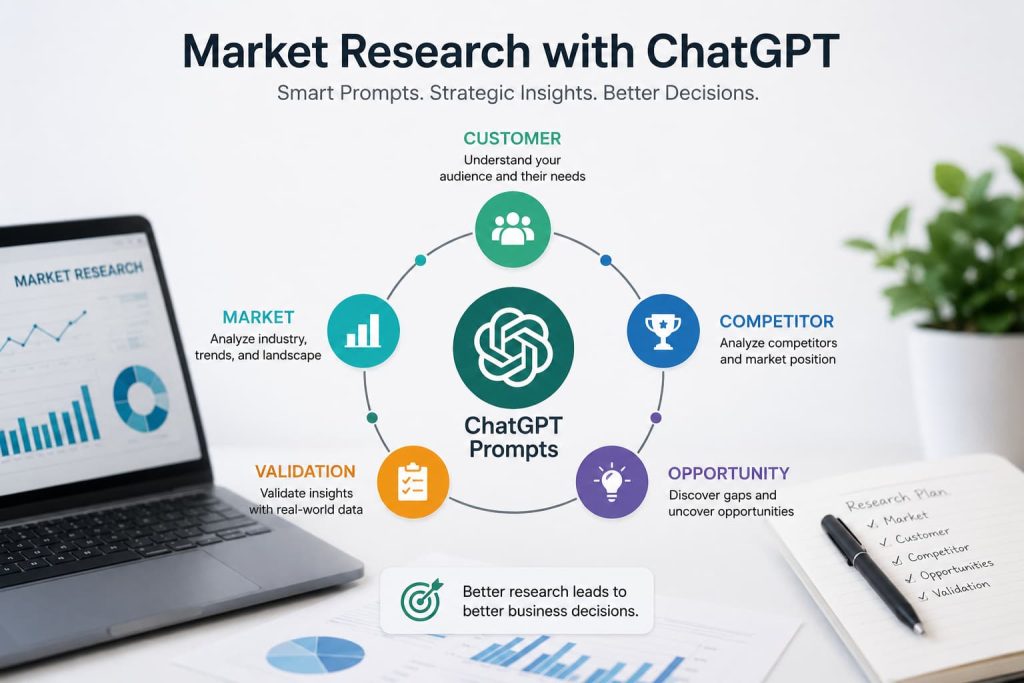
The Market Research Framework Professionals Use
Before diving into individual prompts, here’s the framework that ties everything together:
MARKET → CUSTOMER → COMPETITOR → OPPORTUNITY → VALIDATION
Market: How big is the space? Is it growing or contracting? Who are the major players?
Customer: Who specifically has this problem? How painful is it? How are they solving it today?
Competitor: Who else is competing for this customer? Where are they weak? What’s missing from their offer?
Opportunity: What does the gap look like? Is there a beachhead segment you can own? Is the opportunity big enough to build a business on?
Validation: What does real-world evidence say? Customer interviews, search volume, spending behavior, waitlist signups—these are the checks on everything ChatGPT tells you.
Every prompt in this article maps to one of these five stages. Use them in order when you’re researching a new idea from scratch.
ChatGPT Prompts for Industry Research
Industry Overview
Prompt
“Give me a comprehensive overview of the [industry] industry. Include: market size, key segments, major players, how revenue is typically generated, and where the industry is heading over the next three to five years.”
What It Does
Orients you in an unfamiliar market quickly. Good for consultants entering a new sector or founders evaluating ideas outside their expertise.
Example Use Case
A founder considering a SaaS product for independent insurance agents uses this prompt to understand the insurance distribution landscape before talking to any brokers.
Pro Tip
Follow up with: “What are the biggest misconceptions outsiders have about this industry?” The answer often reveals where generic business ideas go wrong.
Market Trends
Prompt
“What are the most significant trends shaping the [industry] industry right now? For each trend, explain: what’s driving it, which customer segments it affects most, and what business opportunities it creates.”
What It Does
Surfaces macro forces you can build with rather than against. Trend-aligned businesses are much easier to grow.
Example Use Case
A consultant pitching digital transformation services to mid-market manufacturers uses this to build a credible market perspective for their deck.
Pro Tip
Ask: “Which of these trends is most likely to be overhyped? Which is most underestimated?” Forces ChatGPT to pressure-test its own analysis.
Emerging Opportunities
Prompt
“In the [industry] industry, what emerging needs or underserved segments are being overlooked by mainstream players? What does the evidence suggest about where demand is shifting?”
What It Does
Points you toward whitespace—areas where demand exists but supply hasn’t caught up.
Example Use Case
An entrepreneur exploring the mental health space uses this to find segments beyond the saturated general therapy market.
Pro Tip
Pair this with Google Trends and Reddit searches to validate what ChatGPT surfaces.
Industry Challenges
Prompt
“What are the hardest problems currently faced by businesses operating in the [industry] industry? Include regulatory, operational, and competitive challenges. Which problems seem to have no good solution yet?”
What It Does
Reveals pain points that could become product opportunities, and risks you’ll face if you enter.
Example Use Case
A fintech founder uses this to understand compliance burdens before designing an MVP.
Pro Tip
Problems without solutions are your best starting point. Ask: “Which of these challenges is most likely to get worse before it gets better?”
ChatGPT Prompts for Customer Research
Customer Pain Points
Prompt
“I’m building a product for [target customer]. Describe the top five frustrations they experience with how this problem is currently being solved. Be specific about what causes each frustration and what it costs them—in time, money, or stress.”
What It Does
Surfaces the emotional and practical drivers behind purchase decisions. Good for positioning and messaging.
Example Use Case
A SaaS founder targeting HR managers at startups uses this before writing their landing page copy.
Pro Tip
After getting the list, ask: “Which of these frustrations is most likely to make someone actively switch to a new solution?” That’s your lead pain point.
Customer Needs Analysis
Prompt
“For [target customer segment], what are their functional needs, emotional needs, and social needs when it comes to [problem area]? What does success look like for them?”
What It Does
Goes beyond features to understand what the customer actually values—critical for product design and sales.
Example Use Case
A B2B consultant building a proposal tool for freelancers uses this to understand why speed and professionalism matter differently to different freelancer types.
Pro Tip
Link this output to your value proposition. Every need you identify should map to a specific feature or claim.
Buyer Personas
Prompt
“Create three detailed buyer personas for a [product/service] targeting [market]. For each persona include: demographics, job role, key responsibilities, daily frustrations, buying triggers, objections to purchasing, preferred information sources, and what they need to see before they buy.”
What It Does
Builds realistic profiles you can use to align marketing, sales, and product development. For a deeper dive, see our guide on [ChatGPT Prompt for Customer Persona].
Example Use Case
A marketing agency uses this to brief their content team on three distinct B2B buyer types before building a campaign.
Pro Tip
Ask ChatGPT to rank the three personas by purchase urgency and willingness to pay. That tells you who to target first.
Customer Journey Mapping
Prompt
“Map out the customer journey for [target customer] solving [problem]. Cover: how they become aware of the problem, how they research solutions, what they evaluate when comparing options, what triggers a purchase decision, and what happens post-purchase. Include where they get stuck or frustrated at each stage.”
What It Does
Reveals friction points across the buying process—useful for content strategy, sales enablement, and product design.
Example Use Case
An e-commerce founder uses this to identify why customers abandon at the comparison stage and what content would help convert them.
Pro Tip
Focus on the friction points. That’s where your marketing, product, or sales process has the highest leverage.
ChatGPT Prompts for Competitor Analysis
Competitor Research
Prompt
“Who are the main competitors in the [market/niche] space targeting [customer segment]? For each competitor, describe their core offer, primary positioning, pricing model (if known), target customer, and what they do well and poorly.”
What It Does
Builds a competitor map fast. For more depth, see our dedicated guide on [ChatGPT Prompt for Competitor Analysis].
Example Use Case
A founder building a project management tool for architects uses this to understand how Asana, Monday, and niche players like Buildertrend are positioned.
Pro Tip
Always verify competitor details independently. ChatGPT may have outdated or incomplete information on specific companies.
SWOT Analysis
Prompt
“Conduct a SWOT analysis of [competitor name] as a competitor in the [market]. Be specific about their actual strengths and weaknesses based on their positioning, product, and market reputation. For opportunities and threats, focus on what matters most to a new entrant.”
What It Does
Turns a competitor into a strategic reference point. Useful for finding where you can win.
Example Use Case
A startup building an alternative to Mailchimp uses this to identify where Mailchimp’s complexity and pricing create openings.
Pro Tip
Run this for your top two or three competitors, then ask: “Based on these SWOTs, where is the most defensible positioning for a new entrant?”
Competitive Advantages
Prompt
“What would it take for a new entrant to build a sustainable competitive advantage in the [market]? What advantages are hardest to copy? Which competitors have the weakest moats?”
What It Does
Forces strategic thinking about differentiation—not just features, but durable advantages.
Example Use Case
A founder evaluating two business ideas uses this to compare how defensible each would be at scale.
Pro Tip
Ask: “If I had to compete on something other than price and features, what would that be in this market?”
Market Positioning Analysis
Prompt
“In the [market], how are the main competitors positioned along key dimensions like price, target customer size, ease of use, and breadth of features? Where are the gaps in positioning that a new entrant could occupy?”
What It Does
Creates a mental map of the competitive landscape. Reveals whitespace.
Example Use Case
A SaaS founder uses this before writing their positioning statement to ensure they’re not accidentally mimicking an existing player.
Pro Tip
After this analysis, ask: “Which positioning gap is most aligned with where customer demand is growing?”
ChatGPT Prompts for Market Opportunity Analysis
Market Gap Discovery
Prompt
“In the [market/industry], what problems or customer needs are clearly present but poorly addressed by existing solutions? What evidence suggests these are real, painful, and large enough to build a business on?”
What It Does
Identifies specific opportunities, not just vague whitespace.
Example Use Case
A consultant exploring vertical SaaS ideas uses this to find segments where generic tools fail specific professional groups.
Pro Tip
Push further: “Which of these gaps is most likely to be addressable by a small team with limited resources?”
Untapped Audience Research
Prompt
“Who in the [market] is currently underserved or completely ignored by mainstream players? Describe their specific situation, why they’re underserved, and what a solution would need to look like to work for them.”
What It Does
Points you toward beachhead segments—often the best starting point for new businesses.
Example Use Case
An edtech founder uses this to identify professional segments that need upskilling content but aren’t being served by mainstream platforms.
Pro Tip
Underserved doesn’t always mean small. Sometimes it means a big segment that the incumbents have de-prioritized.
Product Opportunity Analysis
Prompt
“I’m considering building [product concept] for [target market]. What evidence suggests this is a real opportunity? What are the biggest reasons it might fail? What would need to be true for this to be a strong business?”
What It Does
Forces honest evaluation of an idea before you build. Acts like a devil’s advocate.
Example Use Case
A founder stress-tests their idea for an AI-powered legal document tool for freelancers before starting development.
Pro Tip
This is the prompt to run before pitching investors or committing to building. The answer to “what would need to be true” becomes your validation checklist.
Business Opportunity Scoring
Prompt
“Evaluate this business opportunity on a scale of 1–10 across five dimensions: market size, customer pain intensity, competitive intensity (lower is better), ease of reaching customers, and founder-market fit for someone with [your background]. Summarize the total opportunity score and flag the biggest risk.”
What It Does
Gives you a structured way to compare multiple ideas or evaluate a single one against key criteria.
Example Use Case
An entrepreneur with three potential business ideas uses this to rank them before deciding where to focus.
Pro Tip
Customize the dimensions to match your priorities. If capital efficiency matters most to you, add it as a dimension. If you’re bootstrapping, weight “ease of reaching customers” higher.
Common Mistakes When Using ChatGPT for Market Research
Asking vague questions. “Tell me about the health tech market” gets you a Wikipedia summary. The more specific your context, the more useful the output.
Accepting AI answers as facts. ChatGPT will occasionally invent statistics, misremember market dynamics, or describe competitors inaccurately. Always verify data that will influence a real decision.
Skipping competitor research. Founders love the customer and opportunity sections and rush past competitors. The competitive analysis tells you where to fight—and where not to.
Ignoring customer feedback. ChatGPT gives you a hypothesis, not a verdict. Real customers—especially ones who’ve tried similar solutions—will tell you things the model can’t.
Failing to validate findings. Use ChatGPT to generate hypotheses. Use actual data (search volume, interviews, landing page tests) to validate them.
Best Practices for Better Market Research With ChatGPT
- Give detailed context upfront. The more specific your situation—industry, customer, geography, stage—the sharper the output.
- Ask follow-up questions. Treat it like a conversation. “Why?” and “What’s the biggest exception to this?” often surface the most useful insights.
- Compare multiple markets. Run the same prompt across two or three adjacent markets to find where conditions are most favorable.
- Verify important information. Treat any specific figures (market size, company revenue, growth rates) as directional until confirmed from a primary source.
- Combine AI research with real feedback. Use ChatGPT to prepare better questions for customer interviews, not to replace them.
- Iterate on your prompts. If an answer feels generic, add more constraints: customer size, geography, budget level, use case.
Frequently Asked Questions
Can ChatGPT do market research?
Yes. ChatGPT can help with customer research, competitor analysis, industry overviews, audience segmentation, and opportunity discovery. It’s best used for rapid exploratory research—generating hypotheses and frameworks—rather than for sourcing verified data or real-time statistics.
What is the best ChatGPT prompt for market research?
The most versatile prompt asks ChatGPT to analyze a market across five dimensions: market size and growth, customer segments and pain points, competitor positioning, underserved gaps, and key risks. Customizing this prompt with your specific industry, target customer, and product concept will produce the most useful output.
Can ChatGPT analyze competitors?
Yes. ChatGPT can map a competitive landscape, conduct SWOT analyses on specific competitors, compare positioning across players, and identify weaknesses in existing solutions. Always verify company-specific details independently, as this information may be outdated.
Can ChatGPT create buyer personas?
Yes. With the right prompt, ChatGPT can generate detailed buyer personas including demographics, pain points, motivations, objections, and buying triggers. These work best as hypotheses to be tested and refined through actual customer conversations.
Is ChatGPT market research accurate?
ChatGPT provides directional accuracy—useful for orientation and hypothesis generation—but is not a substitute for verified data. Treat specific statistics and company claims as starting points for further research. It’s highly reliable for qualitative frameworks, strategic analysis, and identifying the right questions to ask.
Conclusion
Market research is how you find out whether your business idea deserves to exist. It’s not a formality—it’s the work that separates founders who build products people want from those who don’t.
ChatGPT compresses the exploratory phase dramatically. In a few hours, you can develop a clear picture of your market, your customer, and your competition—the foundation for everything from your [ChatGPT Prompt for Business Plan] to your go-to-market strategy.
But the model gives you hypotheses, not answers. The next step after any AI research session is always the same: talk to real people, check real data, and test your assumptions before you build.
Start today. Run the universal market research prompt at the top of this guide on your current idea. Then follow it through the framework: market, customer, competitor, opportunity, validation.
That’s how you build a business on evidence, not assumptions.