Most businesses don’t have a marketing problem. They have a clarity problem.
They’re not sure who they’re talking to, what to say, or which channels to focus on. That confusion leads to scattered campaigns, wasted budgets, and content that doesn’t convert.
ChatGPT won’t replace your marketing judgment — but it can help you think faster, build frameworks, and generate strategies worth testing. In this guide, you’ll get the prompts to make that happen.
Can ChatGPT Help Create a Marketing Strategy?
Yes — meaningfully, if you use it right.
ChatGPT can help you with audience research, positioning, messaging frameworks, content planning, campaign development, and customer acquisition. It’s especially strong at structuring thinking, generating options, and surfacing angles you might have missed.
What it can’t do: replace real customer data, validate assumptions, or guarantee any strategy will work. It doesn’t know your specific market, your competitors’ pricing, or how your audience actually behaves. That’s your job.
Use ChatGPT to build a draft strategy. Then test it against reality.
The Best ChatGPT Prompt for Marketing Strategy
Here’s a high-leverage, all-in-one marketing strategy prompt:
Act as a senior marketing strategist. I'm building a marketing strategy for [business name], a [type of business] that helps [target customer] with [core problem]. Our product/service is [brief description]. Our main competitors are [list 2–3 competitors]. Our current marketing channels are [list channels]. Our budget is [budget range].

Create a complete marketing strategy that includes:
1. Ideal customer profile with demographics, psychographics, and pain points
2. Positioning statement and unique value proposition
3. Core marketing messages for each audience segment
4. Recommended channels with rationale
5. A 90-day content and campaign calendar
6. Top 3 customer acquisition tactics for our stage of growth
7. Key metrics to track for each channel

Be specific and actionable. Prioritize tactics that generate results within 90 days.
Why It Works
It gives ChatGPT the context it needs to move past generic advice. Most weak outputs come from weak inputs — this prompt forces you to define your business before the model starts generating.
When To Use It
Use it at the start of a new quarter, when launching a product, or when your current marketing isn’t producing results.
How To Customize It
Swap in your actual business details. The more specific your inputs — real competitors, real budget ranges, real customer descriptions — the more useful the output.
Pro Tip
Run this prompt twice with slightly different framings and compare the outputs. You’ll often surface angles from the second run that the first missed.
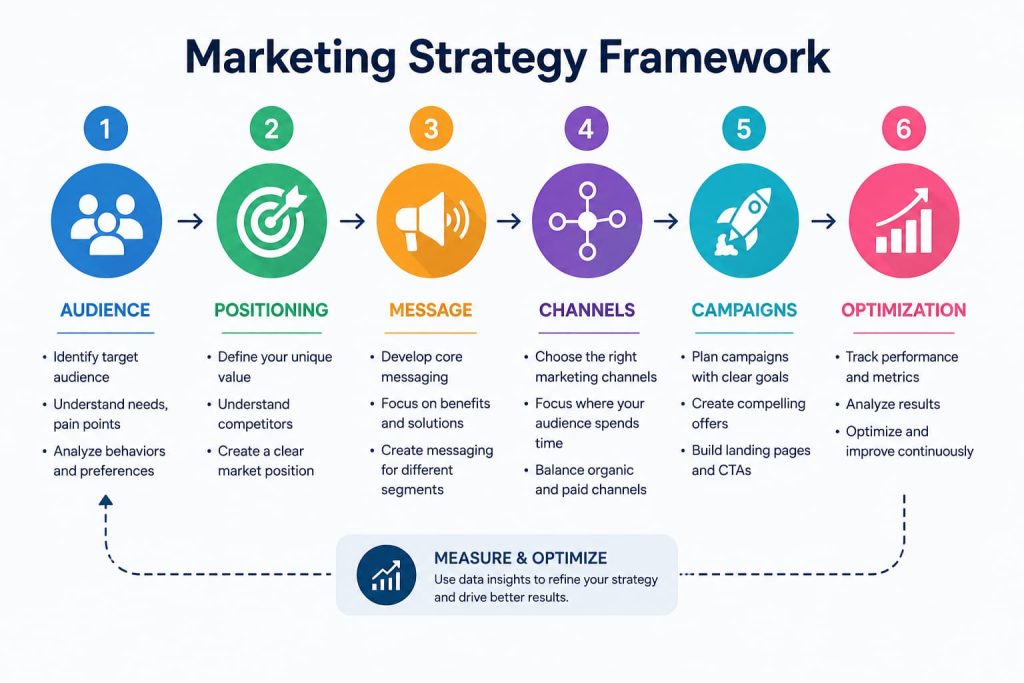
The Marketing Strategy Framework Professionals Use
Before diving into individual prompts, understand the framework underneath them:
AUDIENCE → POSITIONING → MESSAGE → CHANNELS → CAMPAIGNS → OPTIMIZATION
- Audience: Who you’re targeting and what they actually care about
- Positioning: Where you sit in the market and why you’re different
- Message: What you say and how you say it across every touchpoint
- Channels: Where you show up — organic, paid, email, social, partnerships
- Campaigns: The specific initiatives that bring everything together
- Optimization: What you measure and how you improve over time
Every prompt in this article maps to one of these stages. Work through them in order and you’ll have a complete strategy — not just a list of tactics.
ChatGPT Prompts for Audience Research
Customer Personas
Prompt
Act as a market research expert. Create a detailed customer persona for [business type] targeting [describe audience]. Include: demographics, job title or life stage, primary goals, biggest frustrations, preferred content formats, purchase triggers, and objections to buying. Make the persona feel like a real person, not a data profile.
What It Does
Turns vague audience descriptions into specific, usable profiles that guide every marketing decision.
Example Use Case
A SaaS founder creating personas for both their primary buyer (the CMO) and their end user (the marketing manager) who influences the purchase.
Pro Tip
Create 2–3 personas and ask ChatGPT to show where their needs conflict. That tension often reveals your most important messaging trade-offs.
Customer Pain Points
Prompt
Act as a customer insights researcher. List the top 10 pain points for [target customer] trying to [accomplish goal]. For each pain point, explain: what triggers it, how it makes them feel, what they've tried to fix it, and why those solutions fell short.
What It Does
Reveals the emotional and practical frustrations your marketing needs to address.
Example Use Case
A fitness app company mapping the pain points of busy professionals who keep abandoning workout routines.
Pro Tip
Feed these pain points back into your messaging prompts. The language your audience uses to describe their problems is often better copy than anything you’d write from scratch.
Audience Segmentation
Prompt
I sell [product/service] to [broad audience]. Help me segment this audience into 3–4 distinct groups based on their needs, behaviors, and stage of awareness. For each segment, describe: who they are, what they need most, how they prefer to buy, and what message would resonate with them.
What It Does
Breaks a broad audience into targetable segments with distinct messaging needs.
Example Use Case
A B2B consulting firm separating enterprise clients from fast-growth startups — two audiences that need completely different pitches.
Pro Tip
Ask ChatGPT which segment is most likely to convert fastest with limited resources. Use that as your primary focus.
Buying Behavior Analysis
Prompt
Analyze the typical buying journey for [target customer] purchasing [product/service]. Map each stage: awareness, consideration, decision, and post-purchase. Describe what they're thinking, researching, and feeling at each stage, and what marketing touchpoints would be most effective.
What It Does
Aligns your marketing touchpoints with how customers actually make decisions.
Example Use Case
An e-commerce brand identifying where customers drop off between product discovery and purchase.
Pro Tip
Pair this with your analytics data. If ChatGPT’s hypothetical journey doesn’t match your actual conversion funnel, the gap tells you where your marketing has friction.
ChatGPT Prompts for Positioning and Messaging
Unique Value Proposition
Prompt
Act as a brand strategist. Help me write a unique value proposition for [business name]. We help [target customer] achieve [desired outcome] by [key differentiator]. Our top 3 competitors are [list them]. Write 5 different UVP variations — one focused on speed, one on simplicity, one on outcomes, one on trust, and one on price-to-value.
What It Does
Generates testable UVP options across different positioning angles.
Example Use Case
A new project management tool competing against Asana and Monday, looking for a positioning angle that doesn’t require competing on features alone.
Pro Tip
Test your top two UVPs in paid ad headlines before committing. Real click-through data beats internal debate every time.
Brand Messaging
Prompt
Create a brand messaging guide for [business name]. Include: brand voice description (3–5 attributes), tone guidelines for different contexts (sales vs. support vs. social), headline formulas that fit our brand, and 3 sample taglines. Our brand should feel [describe desired personality — e.g., confident but approachable, expert but not corporate].
What It Does
Establishes consistent voice and tone across all marketing channels.
Example Use Case
A fintech startup that wants to sound knowledgeable without being intimidating to first-time investors.
Pro Tip
Share the output with your team and ask them to rate each element. Messaging consistency requires buy-in, not just documentation.
Competitive Differentiation
Prompt
I need to differentiate [business name] from [competitor 1], [competitor 2], and [competitor 3]. Analyze what each competitor emphasizes in their marketing and identify 3 gaps or underserved angles I could own. For each gap, suggest a positioning statement and the type of content that would reinforce it.
What It Does
Identifies white space in the market where you can own a distinct narrative.
Example Use Case
A marketing agency looking to stand out in a crowded market by focusing on a vertical — say, positioning exclusively for professional services firms.
Pro Tip
This works best when you feed ChatGPT actual competitor messaging (copy-paste from their homepage or ads). Vague competitor descriptions produce vague differentiation advice.
Core Marketing Messages
Prompt
Write a core messaging matrix for [business name]. For each of our 3 customer segments — [segment 1], [segment 2], [segment 3] — provide: the primary message, the supporting proof points, the emotional hook, and a sample headline for a landing page or ad.
What It Does
Creates a structured reference document so every channel speaks to the right audience with the right message.
Example Use Case
A HR software company targeting both HR managers (who want compliance and ease) and CFOs (who want cost efficiency and ROI).
Pro Tip
Turn this matrix into a shared Google Doc your marketing team references before creating any content. Consistency at scale starts here.
ChatGPT Prompts for Content Marketing Strategy
Content Planning
Prompt
Act as a content strategist. Create a 3-month content plan for [business name] targeting [audience]. We want to build authority in [topic area]. Include: pillar topics, supporting cluster topics, recommended content formats for each, suggested publishing frequency, and how each piece of content supports a business goal (awareness, leads, retention).
What It Does
Builds a structured content calendar tied to business objectives, not just publishing volume.
Example Use Case
A B2B SaaS company building topical authority around workflow automation to attract organic search traffic.
Pro Tip
Feed this plan into a separate prompt asking ChatGPT to prioritize by search volume potential vs. production effort. Focus on high-leverage topics first.
Blog Strategy
Prompt
I want to build a blog for [business name] that attracts [target audience] searching for [topic area]. Generate 20 blog post ideas organized by funnel stage: top-of-funnel (awareness), middle-of-funnel (consideration), and bottom-of-funnel (decision). For each idea, suggest a working title and the search intent behind it.
What It Does
Maps blog content to the full buyer journey instead of publishing at random.
Example Use Case
A legal tech startup building content for small business owners who need contract management software but don’t know it yet.
Pro Tip
Cross-reference the ideas with a keyword tool like Ahrefs or Semrush before writing. ChatGPT generates good topic ideas but can’t verify actual search volume.
Social Media Content
Prompt
Create a 30-day social media content plan for [business name] on [platform — LinkedIn/Instagram/X]. Our audience is [describe audience]. Our goals are [awareness/engagement/leads]. Include: post type for each day (educational, story, promotion, engagement), sample captions for 5 posts, and best times to post based on our audience.
What It Does
Turns social media from random posting into a structured, goal-driven effort.
Example Use Case
A freelance consultant building a personal brand on LinkedIn to attract inbound consulting clients.
Pro Tip
Ask ChatGPT to write 3 hook variations for your top 5 posts. The first line is everything on social — test multiple versions.
Email Marketing Content
Prompt
Design a 7-email welcome sequence for new subscribers of [business name]. Our audience is [describe them]. The goal is to move them from interested to ready-to-buy. For each email include: subject line, preview text, main message, call-to-action, and send timing. The tone should be [conversational/professional/friendly].
What It Does
Automates your early relationship-building with new leads without sacrificing personalization.
Example Use Case
An online course creator nurturing new email subscribers toward a $497 course purchase over 2 weeks.
Pro Tip
Ask ChatGPT to write subject line A/B test pairs for each email. Small improvements in open rates compound significantly over time.
ChatGPT Prompts for Customer Acquisition
Lead Generation
Prompt
Suggest 10 lead generation strategies for [business name] targeting [audience]. For each strategy include: the channel, the offer or hook, the estimated effort (low/medium/high), and the expected time to see results. Focus on strategies that work for a [early-stage/growth-stage] business with [budget range].
What It Does
Generates a prioritized menu of acquisition tactics matched to your stage and resources.
Example Use Case
A bootstrapped SaaS startup identifying low-cost, high-intent lead gen tactics before scaling paid acquisition.
Pro Tip
Ask ChatGPT to rank these by customer intent signal. High-intent leads (people actively searching for your solution) are almost always worth more than high-volume, low-intent traffic.
Funnel Creation
Prompt
Design a complete marketing funnel for [business name] selling [product/service] to [audience]. Include: top-of-funnel awareness tactics, a lead magnet idea, a nurture sequence, a conversion mechanism (demo, trial, offer), and a retention or upsell path post-purchase. Explain what content or asset lives at each stage.
What It Does
Maps your full acquisition-to-retention flow so nothing leaks.
Example Use Case
A coaching business moving from referral-only clients to a repeatable digital acquisition funnel.
Pro Tip
This is where ChatGPT and your ChatGPT Prompt to Build a Business work intersect — your business model shapes your funnel design.
Paid Advertising Ideas
Prompt
Generate 10 paid advertising campaign ideas for [business name] on [Google Ads/Meta Ads/LinkedIn Ads]. Our audience is [describe them]. Our budget is [amount per month]. For each idea include: campaign type, targeting approach, ad angle, offer or hook, and expected outcome.
What It Does
Gives your paid team or agency a starting brief instead of a blank page.
Example Use Case
A B2B software company launching its first LinkedIn campaign targeting VP-level buyers in the healthcare industry.
Pro Tip
Ask ChatGPT to generate 5 different ad angles for your best campaign idea. Different angles (pain, aspiration, social proof, fear of loss, curiosity) often perform very differently with the same audience.
Referral Marketing Strategies
Prompt
Design a referral marketing program for [business name]. Our product is [describe it] and our customers are [describe them]. Include: referral incentive structure, how the program is promoted to existing customers, the referral flow (how it works step by step), and the messaging to recruit advocates. Suggest 3 different program models we could test.
What It Does
Turns your happiest customers into an acquisition channel.
Example Use Case
A subscription box company reducing CAC by building a structured refer-a-friend program with tiered incentives.
Pro Tip
The best referral programs make referring feel generous, not transactional. Ask ChatGPT to frame your program around what referring says about the customer — not just what they get.
ChatGPT Prompts for Campaign Planning
Product Launch Campaigns
Prompt
Create a product launch campaign plan for [product name] by [business name]. The product helps [target customer] with [problem]. Launch date is [date]. Include: pre-launch hype strategy (4 weeks out), launch week tactics, post-launch momentum plan, and the key message for each phase. Suggest the top 3 channels to prioritize.
What It Does
Structures your launch so you’re building anticipation before the release, not scrambling after it.
Example Use Case
A SaaS company launching a new feature to existing customers while simultaneously using it to acquire new ones.
Pro Tip
Ask for a “launch risk” section — common launch mistakes for your product type. Prevention planning is underrated.
Seasonal Campaigns
Prompt
Create a seasonal marketing campaign for [business name] around [holiday/event — e.g., Q4/Black Friday/New Year]. Our audience is [describe them] and our offer is [product/service]. Include: campaign theme, promotional offer structure, timeline with key dates, content needed for each channel, and the primary call-to-action.
What It Does
Builds a complete seasonal campaign brief you can hand to your team or execute solo.
Example Use Case
An e-commerce brand planning a Black Friday campaign 6 weeks in advance with a clear offer hierarchy.
Pro Tip
Ask ChatGPT to suggest a “value campaign” alternative — one that builds brand equity rather than just discounting. Not every seasonal moment needs a price promotion.
Promotional Campaigns
Prompt
Design a promotional campaign for [business name] to drive [specific goal — e.g., 100 new trials, 50 demo bookings, $20K in sales] within [timeframe]. Include: the offer, urgency mechanism, promotional channels, ad copy angles, email sequence, and success metrics. Assume our current audience is [size/description].
What It Does
Builds a performance-focused campaign around a specific, measurable goal.
Example Use Case
A consulting firm running a limited-time offer to fill spots in a new program before the quarter ends.
Pro Tip
Ask ChatGPT to identify the single biggest conversion lever in the campaign — the one element most likely to determine success or failure. Focus your energy there.
Brand Awareness Campaigns
Prompt
Create a brand awareness campaign strategy for [business name] targeting [audience] in [market]. We want to become known for [core positioning]. Include: campaign concept, content pillars, distribution channels, partnership or PR opportunities, and how we'll measure brand lift without direct response metrics.
What It Does
Builds a long-game brand strategy that supports performance marketing over time.
Example Use Case
A fintech startup investing in awareness before launching paid acquisition, so warm traffic performs better when campaigns go live.
Pro Tip
Brand awareness campaigns are harder to measure but easier to explain through share of voice, search volume growth, and direct traffic trends. Ask ChatGPT to help you build a simple brand tracking dashboard.
Frequently Asked Questions
Can ChatGPT create a marketing strategy?
Yes. ChatGPT can generate audience research, positioning frameworks, messaging guides, content plans, campaign briefs, and customer acquisition strategies. It works best when you provide detailed business context. The output is a strong starting draft — real-world testing and validation are still required.
What is the best ChatGPT prompt for marketing strategy?
The most effective marketing strategy prompt gives ChatGPT your business type, target customer, core problem you solve, competitors, current channels, and budget. Then ask for an ideal customer profile, positioning statement, core messaging, channel recommendations, 90-day campaign plan, and key metrics to track.
Can ChatGPT help with customer acquisition?
Yes. ChatGPT can generate lead generation strategies, funnel designs, paid advertising concepts, referral program structures, and acquisition campaign briefs. It’s especially useful for identifying which acquisition channels fit your stage of growth and budget.
Can ChatGPT create marketing campaigns?
Yes. You can use ChatGPT to plan product launches, seasonal promotions, brand awareness campaigns, and performance campaigns. Provide your goal, timeline, offer, audience, and channels — and ask for a complete campaign brief including messaging, content needs, and success metrics.
Is ChatGPT useful for small business marketing?
Absolutely. ChatGPT levels the playing field for small businesses by providing access to strategic thinking that previously required expensive consultants or agencies. It’s particularly valuable for solopreneurs and small teams who need to move fast, generate options quickly, and execute across multiple channels with limited resources.
Conclusion
Marketing strategy is where most businesses either accelerate or stall. Without it, you’re producing content that goes nowhere, running campaigns that don’t convert, and spending money on channels that don’t fit your audience.
ChatGPT gives you a thinking partner that helps you move faster — from audience clarity to positioning to campaigns. But the prompts in this guide are a starting point, not a finish line. Your market will tell you what actually works.
Pick one section above, run the prompts with your real business details, and get something in market this week. Refinement comes from testing — not from planning more.
Next step: If you haven’t defined your business model yet, start with the ChatGPT Prompt to Build a Business before building your marketing strategy. Strategy built on a shaky business foundation rarely holds.