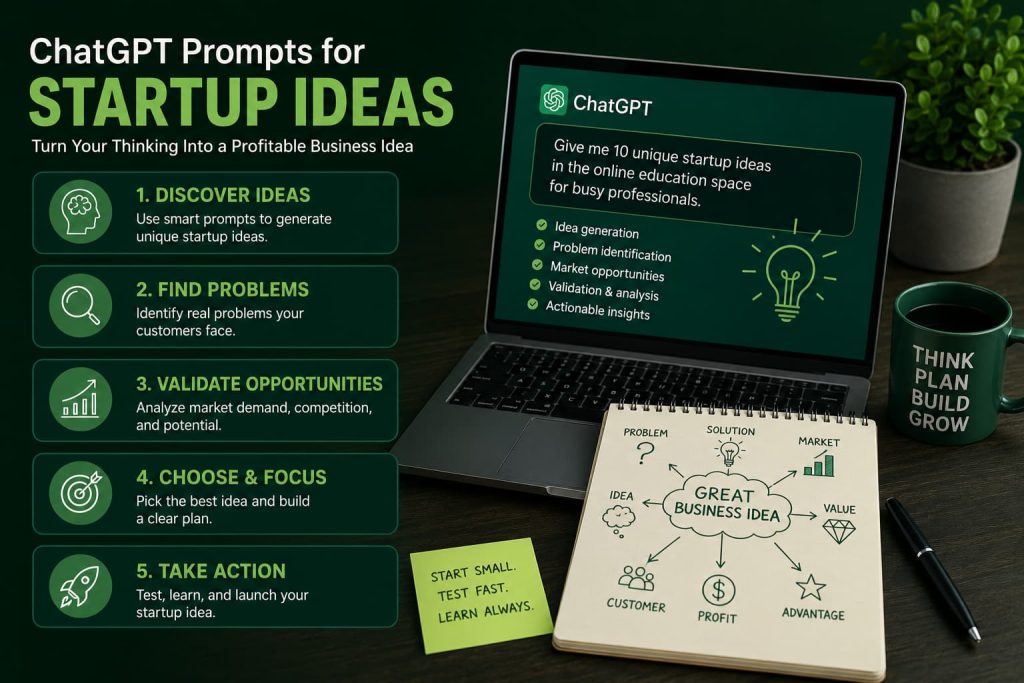
You want to start a business. You’re motivated. Maybe you have some savings, a skill set, or just a burning desire to build something of your own. The problem? You have no idea what to build.
That’s not a character flaw. It’s actually the most common place founders get stuck.
Here’s the good news: ChatGPT is genuinely useful for this part. Not because it magically hands you a million-dollar idea, but because it acts like a relentless brainstorming partner who never gets tired, never judges your half-baked thoughts, and can explore a hundred directions in the time it takes you to finish your coffee.
Let’s get into it.
Can ChatGPT Actually Help You Find Startup Ideas?
Short answer: yes. But let’s be honest about what it can and can’t do.
ChatGPT is exceptional at helping you generate volume. When you’re stuck staring at a blank page, it can instantly produce 20 startup angles based on your background, interests, or a market problem you describe. That’s genuinely powerful.
It’s also good at connecting dots you might miss, like spotting that your HR experience + your frustration with remote work onboarding + a growing market of distributed teams could be a real business opportunity.
Where human judgment still matters? Validation. ChatGPT can’t tell you if real people will actually pay for your idea. It doesn’t know your local market. It doesn’t feel what you feel talking to a potential customer.
Think of it as a thinking partner, not a decision maker.
The Best ChatGPT Prompt for Startup Ideas
Here’s a prompt that consistently surfaces high-quality, personalized startup ideas. This isn’t a generic “give me business ideas” request. It’s structured to pull from who you actually are.
Prompt:
“I want to start a business and I need your help brainstorming ideas. Here’s my background: [describe your skills, work experience, and education]. Here are my interests: [list 3–5 things you’re genuinely passionate about]. Here are frustrations I’ve personally experienced: [describe 2–3 problems you’ve faced as a customer, employee, or professional]. Given this information, generate 10 startup ideas that: (1) match my background, (2) solve real problems, (3) have a clear target customer, and (4) could be validated with under $500 and 30 days. For each idea, include the problem it solves, who the customer is, and why I might be uniquely positioned to build it.”
Why This Prompt Works
It forces the output to be about you, not generic. ChatGPT produces better ideas when it understands your unfair advantages — the skills, experiences, and frustrations that make you the right person to solve a specific problem.
When To Use It
Use this prompt at the very beginning of your ideation process, before you commit to anything. Run it at least 2–3 times with slightly different inputs.
Pro Tip
Don’t stop at the first output. After you get the list, reply: “Which 3 of these have the strongest market demand right now, and why?” Then go deeper on those.
The Startup Idea Framework Smart Founders Use
Before you run any prompt, it helps to understand the filter every good startup idea should pass through. Call it the SPMDA Framework:
Skills — What can you actually do well? Problems — What frustrations have you personally felt or observed? Market — Are there enough people who share this problem? Demand — Are people already spending money to solve it (even imperfectly)? Advantage — Why are you the right person to build this?
The magic happens at the intersection. An idea that only has two or three of these is survivable. An idea with all five? That’s where businesses get built.
ChatGPT can help you stress-test each of these — but you need to bring the raw material.
ChatGPT Prompts for Finding Business Ideas
Startup Ideas Based on Your Skills
Prompt
“I have [X years] of experience in [industry/field] and I’m skilled at [list 3–5 skills]. Generate 10 startup ideas that turn these skills into a service, product, or platform. For each idea, explain the target customer and the core value proposition.”
What It Does
Translates professional expertise into potential business models — consulting, SaaS, productized services, education, tools.
Example
A graphic designer might get ideas ranging from a brand identity service for e-commerce brands to a Canva template marketplace to a subscription design service for startups.
Pro Tip
Follow up with: “Which of these can I start with zero employees and under $1,000?”
Startup Ideas Based on Your Experience
Prompt
“I’ve worked in [industry] for [X years] and have experienced these recurring frustrations: [list 3–5 pain points you observed]. What startup ideas could solve these problems for others in the same industry?”
What It Does
Turns your insider knowledge into opportunity. You’ve seen the dysfunction from the inside — that’s valuable.
Example
A former logistics coordinator who was frustrated by manual freight tracking and communication gaps might surface ideas around automated status updates, carrier communication tools, or visibility dashboards.
Pro Tip
Ask: “Which of these problems do people currently pay money to solve, even if the current solution is bad?”
Startup Ideas Based on Your Interests
Prompt
“I’m deeply interested in [topic/hobby/passion]. I spend time reading about it, engaging with communities around it, and thinking about it unprompted. Generate 10 startup ideas at the intersection of this interest and real market demand. Include who would pay for each idea and how they’d find it.”
What It Does
Finds business opportunities where your natural curiosity becomes a sustainable competitive edge — because you’ll keep going when others quit.
Example
Someone obsessed with personal finance might land on a financial literacy community for first-generation immigrants, a debt payoff tracking app with accountability features, or a “money coach in your pocket” subscription service.
Pro Tip
The best interest-based businesses serve a community you already belong to. You already speak their language.
Startup Ideas Based on Market Trends
Prompt
“What are the biggest emerging market trends in [industry] in 2025? For each trend, identify 2–3 startup opportunities that could ride this wave, including who the early customers would be and what the business model might look like.”
What It Does
Surfaces timing-sensitive opportunities — not just what to build, but when the moment is right.
Example
Asking about the healthcare industry might surface trends around AI-assisted diagnostics, remote patient monitoring, or chronic disease management apps — each with a distinct customer and model.
Pro Tip
Trends matter, but they’re not enough. Add: “Which of these trends still has room for a new entrant, and which are already crowded?”
ChatGPT Prompts for Identifying Market Problems
Finding Customer Pain Points
Prompt
“I’m exploring startup ideas in [industry/niche]. List the 10 most common and painful frustrations that customers in this space experience. For each frustration, explain why existing solutions fail to fully solve it.”
What It Does
Identifies gaps that real businesses haven’t fully closed — which is exactly where new startups find their footing.
Pro Tip
The more specific the industry, the more useful the output. “E-commerce sellers on Etsy” beats “online sellers.”
Discovering Industry Frustrations
Prompt
“You are a veteran operator in the [industry] industry with 20 years of experience. What are the most persistent operational headaches, inefficiencies, and broken processes that insiders deal with daily but outsiders don’t see?”
What It Does
Accesses the hidden, behind-the-scenes dysfunction that only insiders know about — which is often where the highest-value B2B opportunities live.
Pro Tip
Cross-reference this with your own experience. If ChatGPT surfaces something you’ve personally lived through, that’s a strong signal.
Finding Underserved Markets
Prompt
“What groups of people, industries, or communities are consistently underserved by existing products and services? Focus on groups with real spending power who currently use workarounds or suboptimal solutions.”
What It Does
Finds customer segments that big companies ignore because they’re “too small” — but that represent a perfect beachhead for a startup.
Pro Tip
Follow up with: “Which of these groups has the most urgency to solve this problem?” Urgency is everything in early sales.
Spotting Business Opportunities
Prompt
“What products or services that exist in the US (or another developed market) don’t yet exist or are underdeveloped in [your country/region]? Which of these would translate well given local culture, infrastructure, and buying behavior?”
What It Does
Applies the “copy what works elsewhere” model — one of the most reliable startup playbooks in history.
Pro Tip
Uber, Rocket Internet, and dozens of billion-dollar companies were built on this exact model.
ChatGPT Prompts for Validating Startup Ideas
Demand Analysis
Prompt
“I have a startup idea: [describe your idea in 2–3 sentences]. Help me assess market demand by identifying: (1) who would be the first 100 customers, (2) where those customers spend time online, (3) what they currently spend money on to solve this problem, and (4) what signals would tell me demand is strong enough to build.”
Pro Tip
If ChatGPT can’t clearly identify who the first customer is, your idea may need to be more specific.
Competitor Research
Prompt
“For the startup idea [describe idea], who are the top direct and indirect competitors? For each competitor, describe their core offering, their pricing model, their main weakness, and what gap they leave in the market.”
Pro Tip
Pay attention to the weaknesses. That’s your positioning.
Opportunity Scoring
Prompt
“Score this startup idea on a scale of 1–10 across these dimensions: market size, problem urgency, competition level, founder-market fit, ease of validation, and revenue potential. Explain each score. Then tell me the single biggest risk that could kill this business early.”
Pro Tip
A low score isn’t always bad. A niche idea with low competition and high urgency often beats a broad idea with fierce competition.
Risk Assessment
Prompt
“What are the 5 most common reasons startups in [industry/niche] fail? For each reason, tell me how a new founder could mitigate or test for that risk before investing significant time or money.”
Pro Tip
This prompt is underused. The best founders think about downside before upside.
ChatGPT Prompts for Startup Trends and Opportunities
AI Startup Ideas
Prompt
“Generate 10 AI startup ideas for 2025 that: (1) solve a specific professional or personal pain point, (2) use AI in a way that creates genuine value rather than just wrapping an existing AI tool, and (3) could be built by a small team with no proprietary model. Include the target customer and business model for each.”
Pro Tip
The best AI startups aren’t about the AI. They’re about the outcome the AI enables. Keep that frame front and center.
Online Business Ideas
Prompt
“I want to start an online business that I can operate from anywhere. Generate 10 ideas with strong potential for recurring revenue, clear distribution channels, and the ability to reach first revenue within 90 days. Include who the customer is and how I’d acquire them.”
Pro Tip
Ask follow up: “Which of these can I start as a solo founder with under $500?”
Service Business Ideas
Prompt
“I want to start a service business that uses my skills in [field]. Generate 10 service business ideas where I can charge $2,000–$10,000 per client, operate with low overhead, and have a clear path to finding my first 5 clients.”
Pro Tip
Service businesses are the fastest path to first revenue. Don’t dismiss them because they don’t feel like “real” startups.
Local Business Ideas
Prompt
“I want to start a local or community-based business in [city/region]. What are the underserved needs in most mid-sized cities right now? Generate 10 ideas with clear customer demand, realistic startup costs, and a path to profitability within 12 months.”
Pro Tip
Local businesses with a digital component — think booking systems, local delivery, in-person + online hybrids — often have less competition than pure online plays.
Common Mistakes When Using ChatGPT for Startup Ideas
Chasing trends blindly. Just because AI startup ideas are hot doesn’t mean you should build one. Build in spaces where you have genuine insight.
Ignoring validation. ChatGPT is not a market. Getting excited about an idea based on AI output alone is a trap. Talk to 10 real potential customers before you believe the idea is good.
Falling in love with the first idea. Generate at least 50 ideas before you narrow down. The best idea is rarely the first one.
Skipping customer research. AI can help you brainstorm problems, but only humans can confirm them. No prompt replaces 30-minute conversations with real prospects.
Trusting AI without testing. ChatGPT will tell you your idea sounds great. It almost always does. That’s not validation — it’s encouragement. Test ideas with real dollars, real sign-ups, or real commitments from real people.
How I Would Use ChatGPT If I Were Starting a Business Today
Here’s exactly what I’d do, step by step.
Step 1: Brain dump my assets. I’d start by listing everything I’m good at, every industry I know, every frustration I’ve felt as a customer or professional, and every community I belong to. Not filtered, just raw.
Step 2: Run the master prompt. I’d use the full personalized startup idea prompt from earlier with all of that raw material. I’d run it 3–4 times with slightly different framing and collect every idea that sparks even a small reaction.
Step 3: Filter ruthlessly. I’d take the 20–30 ideas that resonated and ask ChatGPT to score each one on urgency, founder-market fit, and ease of early validation. I’d also do a quick Google search to see who’s already building in that space.
Step 4: Go narrow on 3 ideas. I’d pick the top 3 and go deep — competitor analysis, customer pain point research, demand signals. For each, I’d try to find 5 real people who match the target customer profile.
Step 5: Talk to humans. Before writing a single line of code or spending a dollar, I’d have 10 conversations with potential customers. Not to pitch — to listen. What are they currently doing? What frustrates them? Would they pay for a solution?
Step 6: Pick the one with the most pull. Not the “biggest” idea. The one where customers were most animated, most frustrated, and most likely to give me money before the product exists.
That last part — people willing to pay before you’ve built — is the only validation that counts.
Frequently Asked Questions
Can ChatGPT generate startup ideas?
Yes. ChatGPT is particularly effective when you give it context about your background, skills, and interests. Generic prompts produce generic ideas. Personalized prompts produce ideas worth exploring.
What is the best ChatGPT prompt for startup ideas?
The most effective prompt combines your skills, experience, personal frustrations, and a filter for validation speed. The master prompt in this article is a strong starting point — then iterate from there.
Can ChatGPT identify profitable business ideas?
It can help you analyze profitability factors like market size, competition, and pricing models. But “profitable” ultimately depends on execution, timing, and real customer conversations — things only you can determine.
Can ChatGPT validate startup ideas?
Partially. It can help you think through demand signals, competitor gaps, and risk factors. But real validation requires talking to real people and ideally getting real money or commitments before you build.
Should I trust startup ideas generated by AI?
Treat them as hypotheses, not conclusions. ChatGPT helps you generate and filter ideas faster — but every idea still needs to be tested with actual customers in the real world.
Conclusion
Here’s the honest truth: the best startup idea isn’t hiding somewhere on the internet waiting for you to find it. It’s at the intersection of what you know, what you care about, and a problem real people actually want solved.
ChatGPT doesn’t hand you that answer. But it can help you think faster, explore further, and stress-test your assumptions before you invest months building the wrong thing.
Start with the prompts in this article. Generate a lot. Filter ruthlessly. Talk to humans. And keep moving.
The founder who starts and iterates almost always beats the one who waits for the perfect idea.