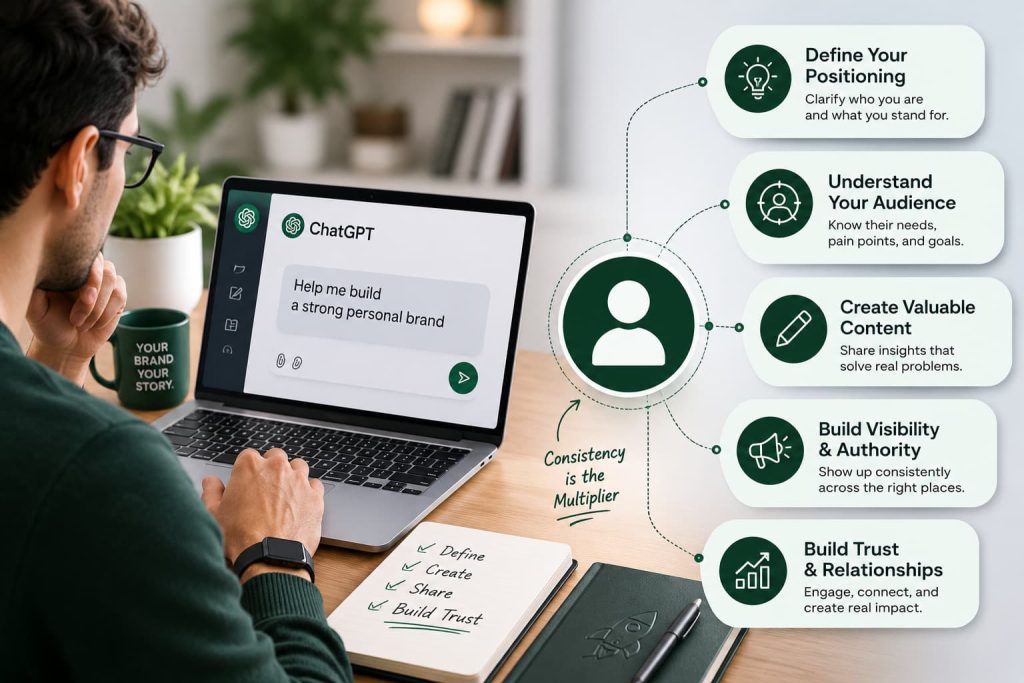
Your personal brand is probably doing more for your business than you realize. People buy from people, not logos. And right now, CEOs and founders who show up online are quietly winning deals that never even make it to a sales call.
The problem is that building a personal brand usually feels slow and messy. You know you should be posting, writing, showing up — but where do you even start?
That’s where ChatGPT comes in. It won’t build your brand for you, but it will help you figure out what to say, how to say it, and how to stay consistent without burning out. This guide walks you through the exact prompts to use, in the order that actually works.
Why Personal Branding Matters Right Now
Trust in institutions is down. Trust in people is up. Studies keep showing that consumers trust individuals — especially recognizable ones — far more than they trust faceless companies. A visible CEO can shape a huge chunk of how people feel about the whole business.
ChatGPT changes the game here because it removes the biggest barrier: time. You don’t need hours to draft a LinkedIn post or figure out your positioning anymore. You need the right prompts and a little bit of judgment to make the output sound like you.
This guide covers both. Strategy first, then the prompts, then how to actually execute without losing your voice along the way.
The Personal Brand Foundation (Before You Touch a Prompt)
Before you start generating content, you need a foundation. Skip this and you’ll end up with polished posts that don’t actually build anything.
Audit Your Current Brand
Start by looking at what already exists. Your LinkedIn, your Twitter/X, your website, any interviews or podcasts you’ve done. This is your current content footprint, whether you planned it or not.
Then ask yourself the harder question: is this how you actually want to be perceived? Most people find a gap between how they see themselves and how their online presence reads.
Act as a personal branding strategist. I’m going to describe my current online presence across LinkedIn, Twitter/X, and my website. Based on what I share, identify: 1) The three main impressions someone would form of me right now, 2) Any inconsistencies between platforms, 3) The biggest gap between how I want to be perceived and how I’m currently coming across. Here’s my current presence: [describe your bios, recent posts, and content themes]
Define Your Five Core Pillars
Every strong personal brand rests on five things: your expertise, your audience, your unique angle, your values, and the transformation you help people reach. If you’re fuzzy on any of these, your content will feel scattered.
Act as a brand strategist helping me define my personal brand pillars. Ask me questions one at a time about my expertise, the audience I want to serve, what makes my approach different from others in my field, my core values, and the transformation I help people achieve. After each answer, refine it into a single clear sentence. At the end, compile all five into a one-page brand pillar summary.
The Voice and Authenticity Test
Here’s the honest truth: ChatGPT output can sound generic if you let it. It has a default tone, and that tone is not your tone. The fix isn’t avoiding ChatGPT — it’s feeding it your actual voice so the output sounds like you wrote it on a good day.
Here are three examples of things I’ve written that sound authentically like me: [paste 2-3 samples of your writing — emails, posts, notes]. Analyze my tone, sentence rhythm, word choices, and any verbal habits or phrases I repeat. Then create a “voice profile” I can paste into future prompts so any content you generate matches how I actually talk.
A quick red flag to watch for: if your ChatGPT draft sounds like it could have been written by literally anyone in your industry, it’s too polished. Push it back through and ask for more of your voice, less of the AI default.
The Core Prompts, Organized by Phase
This is the part you’ll come back to again and again. It’s organized into four phases so you’re not trying to do everything at once.
Phase 1: Discovery (Weeks 1–2)
1. Personal Brand Statement Builder
Your brand statement is the one-liner that sums up who you are professionally. Most people either make it too vague (“helping businesses grow”) or too try-hard. This prompt fixes both.
Based on my experience in [your field/role] and my core pillars [paste your pillars from earlier], write three versions of a personal brand statement: one that’s practical and results-focused, one that’s mission-driven, and one that leads with expertise. Keep each under 20 words.
Pick the one that feels honest, not the one that sounds most impressive. Impressive wears off. Honest holds up.
2. Audience Avatar Builder
You can’t write for “everyone.” This prompt forces clarity on exactly who you’re trying to reach.
Help me build a detailed audience avatar for my personal brand. I work with/serve [describe your audience broadly]. Break this down into: their psychographics (mindset, values, aspirations), their top three pain points, what drives their decisions, and the specific objections they’d have to trusting someone new in this space.
3. Unique Value Proposition Generator
This is where you separate yourself from the ten other people saying the same thing in your industry.
I compete with people who position themselves as [describe how others in your space typically position themselves]. Here’s what makes my approach different: [list 2-3 real differentiators]. Write a clear, differentiated value proposition statement, then give me three variations I can test across different platforms.
Phase 2: Strategy (Weeks 3–4)
4. Content Pillar Strategy
Once your positioning is clear, you need to know what to actually talk about. Random topics don’t build authority. Repeated themes do.
Based on my brand pillars and audience avatar [paste both], generate 5-7 content pillars I should consistently create content around. For each pillar, explain why it matters to my audience and suggest a posting cadence across LinkedIn and Twitter/X.
5. Thought Leadership and Opinions
The accounts that grow fastest usually have a point of view. Not controversy for the sake of it — a real, considered take that makes people stop scrolling.
Based on my expertise in [your field], help me identify one strong, slightly contrarian opinion I hold that most people in my industry would disagree with or overlook. Write it as a clear opinion statement, then help me soften the delivery so it reads as confident and nuanced rather than combative.
6. Networking and Relationship Strategy
A personal brand doesn’t grow in isolation. This prompt helps you map out who to build relationships with.
Help me identify the types of people I should be building relationships with to grow my personal brand: potential mentors, peers at my level, and people who could become advocates for my work. For each category, write a short, non-salesy outreach message template I could send to start a real conversation.
Phase 3: Execution (Weeks 5–8)
7. Personal Brand Story (Golden Circle)
People remember stories, not résumés. This uses the classic Why-How-What structure to turn your background into a narrative.
Using the Why-How-What framework, help me write my personal brand story. My background: [summarize your career path and key turning points]. Start with why I do this work, then how I approach it differently, then what I actually do. Keep the final version under 90 seconds when read aloud.
8. LinkedIn Profile Optimization
Your LinkedIn headline and About section are doing more work than you think. Most people waste this real estate on a job title.
Rewrite my LinkedIn headline and About section based on my brand statement and unique value proposition [paste both]. The headline should be under 220 characters and avoid generic titles like “marketing professional.” The About section should open with a hook, not a résumé summary.
9. Blog and Thought Leadership Content System
If you want to be found in search as well as social, you need a repeatable content system, not one-off posts.
Act as a content strategist. Based on my content pillars [paste them], generate 10 blog post topic ideas optimized for both search intent and thought leadership. For each, provide a suggested title, a 5-point outline, and a one-sentence SEO angle.
10. Social Media Content Calendar
Create a 30-day content calendar for LinkedIn and Twitter/X based on my content pillars [paste them]. Mix in expertise posts, personal stories, engagement questions, and industry commentary. Keep the tone consistent with my voice profile [paste it] but adjust length and format per platform.
Once your calendar is drafted, the real challenge is keeping it filled month after month without content actually becoming a chore. That’s where having a broader system for social media content for your business alongside your personal posts pays off — the two can share themes without sounding identical.
Phase 4: Amplification and Proof (Weeks 9–12)
11. Success Stories and Testimonial Framework
Nothing builds trust faster than proof. This prompt turns raw client feedback into something worth sharing.
Turn this client feedback or result into a short case study post: [paste testimonial, result, or outcome]. Structure it as: the situation, what I did differently, and the measurable outcome. Keep it under 150 words and avoid sounding like a sales pitch.
12. Personal Brand Audit (Monthly Check-in)
Brands drift. A monthly check keeps yours honest.
Based on my brand statement and pillars [paste them], review my content and activity from this month [paste post topics/summary]. Tell me where my actions matched my stated brand, where they didn’t, and what I should stop, start, or keep doing next month.
Industry-Specific Customizations
The prompts above work for almost anyone, but a few tweaks make them hit harder depending on your field.
SaaS founders — Lean on prompts 4 and 5 to connect your personal opinions directly to product philosophy. Your personal brand should build trust in your product roadmap, not just in you.
Link builders and SEO pros — Prompt 9 is your best friend here. Thought leadership content earns the kind of backlinks that outreach emails never will.
Consultants — Prompt 3 (UVP) and prompt 11 (proof) matter most. Clear differentiation plus visible results is what lets you raise your rates without losing clients.
Coaches — Prompt 7 (your story) tends to convert better than any sales page. People hire coaches whose journey they relate to.
Freelancers — Prompt 6 (relationship strategy) is underrated. Better clients usually come through relationships, not cold applications.
Common Mistakes ChatGPT Can’t Solve For You
A few things worth watching out for, since no prompt fixes these on its own:
- Using ChatGPT to sound “professional” — this usually strips out the personality that made your voice worth following in the first place.
- Generating prompts without following through — one great post won’t build a brand. Consistency does the actual work.
- Skipping the audience definition — trying to appeal to everyone quietly means appealing to no one.
- Building a brand disconnected from your business — it looks good but doesn’t drive revenue if there’s no line back to what you sell.
- Copy-pasting AI output verbatim — always read it out loud first. If it doesn’t sound like you’d say it, edit it until it does.
Measuring What Actually Matters
Two sets of numbers matter here, and they’re not the same thing.
Brand metrics tell you if people are paying attention: reach, engagement, profile visits, follower growth.
Business metrics tell you if it’s working: inbound inquiries, pricing power, partnership requests, and how often someone says “I found you through your content” before a sales call even starts.
Based on this month’s content performance data [paste your metrics], help me build a simple personal brand scorecard. Include reach, engagement rate, and any inbound opportunities generated. Flag any content pillar that’s underperforming and suggest one adjustment for next month.
How Your Brand Evolves Over Time
Your personal brand isn’t something you set once and forget. As you grow, your expertise deepens, your audience shifts, and your positioning should move with it.
A simple habit that helps: revisit your brand pillars every year, not just when something feels off. Ask whether your current content still reflects where you actually are in your career, not where you were when you started.
If you ever feel a real pull to pivot your positioning, that’s usually a sign your expertise has outgrown your old brand statement — not a sign you did something wrong.
Wrapping Up
Building a personal brand with ChatGPT isn’t about generating more content faster. It’s about getting clear on who you are, what you stand for, and who you’re trying to reach — then using these prompts to say it consistently, in your own voice.
Start with the foundation. Move through the phases. Revisit the audit every month. That’s really the whole system.