What Is Reflection AI?
Reflection AI is an artificial intelligence research company that develops open-weight AI models, software, and infrastructure.
Its goal is to make advanced AI technology more accessible to developers, businesses, and governments. Unlike companies that keep their most powerful models entirely closed, Reflection focuses on building AI systems that organizations can inspect, customize, and deploy on their own infrastructure.
The company was founded in 2024 by Misha Laskin and Ioannis Antonoglou, two former Google DeepMind researchers.
Reflection AI initially focused on autonomous coding agents. It has since expanded its work to open-weight foundation models, enterprise AI solutions, and AI infrastructure.
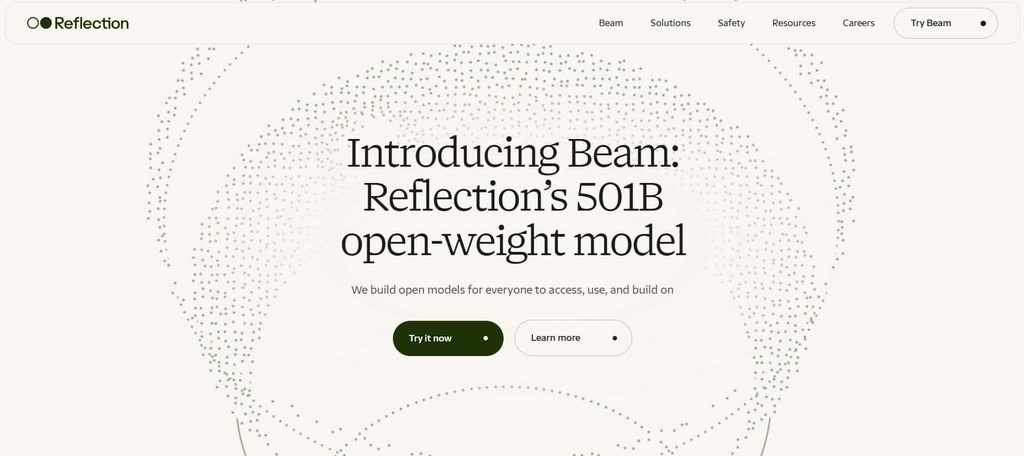
One of its most important developments is Beam, a 501-billion-parameter mixture-of-experts model designed for coding, reasoning, and agentic workloads.
Reflection’s approach gives organizations more control over how they use AI. They can customize models, manage their data, and choose where their AI systems run.
Who Founded Reflection AI?
Reflection AI was founded in 2024 by Misha Laskin and Ioannis Antonoglou.
Both founders previously worked at Google DeepMind. Their experience in advanced AI research helped shape the company’s technical direction.
Misha Laskin
Misha Laskin is the co-founder and CEO of Reflection AI.
Before starting the company, he worked as a researcher at Google DeepMind. His work included reinforcement learning and reward modeling.
He contributed to research connected to Google’s Gemini models.
His experience helped establish Reflection’s focus on building advanced AI systems that can reason and complete complex tasks.
Ioannis Antonoglou
Ioannis Antonoglou is the co-founder of Reflection AI.
He was one of the early researchers and engineers at DeepMind.
He contributed to the development of AlphaGo, the AI system that defeated world champion Go player Lee Sedol in 2016.
He also worked on other major AI projects, including AlphaZero and MuZero.
His background in reinforcement learning and AI research supports Reflection’s ambition to build increasingly capable AI systems.
How Does Reflection AI Work?
Reflection AI develops AI models and tools that businesses and developers can use to build their own applications.
Its approach revolves around three main ideas:
- Developing powerful open-weight AI models.
- Providing software that helps developers customize and deploy those models.
- Offering infrastructure for running AI systems in different environments.
Here’s how its ecosystem works.
1. Develops Open-Weight AI Models
Reflection develops foundation models that organizations can access and customize.
A foundation model is a large AI model trained on extensive datasets. It can perform different tasks, such as generating text, writing code, answering questions, and solving problems.
Reflection makes the weights of its models available.
Model weights are numerical values that determine how an AI model processes information and generates outputs.
Making these weights available allows developers to download supported models, fine-tune them, and run them in their own environments.
2. Provides Open-Source Software
A model alone isn’t enough to build a complete AI application.
Developers also need tools for customization, deployment, monitoring, and interaction.
Reflection develops open-source software to support these workflows.
Its software ecosystem includes tools for building AI applications, customizing models, and creating agentic systems.
This gives developers more flexibility when integrating AI into their products.
3. Offers AI Infrastructure
Running large AI models requires substantial computing resources.
Reflection provides access to its models through an API platform. Organizations can also deploy supported models in their own environments.
These environments may include:
- Private cloud infrastructure.
- On-premises servers.
- Air-gapped systems.
- Edge computing environments.
This flexibility is particularly useful for organizations with strict data privacy and security requirements.
4. Helps Businesses Build AI Solutions
Reflection also works directly with organizations that want to integrate AI into their operations.
Its team can help businesses design, develop, customize, and deploy AI applications.
For example, a company may want an AI system that processes internal documents without sending sensitive information to an external AI provider.
Reflection’s deployment options can help organizations build solutions around their own infrastructure and requirements.
What Is Beam AI?
Beam is Reflection AI’s first open-weight foundation model.
Introduced in October 2026, Beam is designed for coding, reasoning, and agentic workloads.
It uses a mixture-of-experts (MoE) architecture and contains 501 billion total parameters.
However, it activates only a portion of those parameters for each token.
This approach helps reduce the computational work required to generate responses.
Beam is designed for developers and organizations that need advanced AI capabilities without relying entirely on closed AI platforms.
Key Features of Beam
Here are some of Beam’s main characteristics.
1. Open-weight architecture
Reflection makes Beam’s model weights available to developers.
They can download the weights and explore deployment and customization options under the applicable model license.
2. Coding capabilities
Beam is designed to handle software development tasks.
It can support workflows involving code generation, code reasoning, and agentic software development.
3. Advanced reasoning
The model is built to process complex problems and perform multi-step reasoning.
This is useful for applications that require more than simple text generation.
4. Mixture-of-experts architecture
Beam uses a sparse mixture-of-experts architecture.
Instead of activating every model parameter for each token, it routes computation through selected expert components.
This makes the model more computationally efficient than a dense model with the same total parameter count would typically be.
5. Flexible deployment
Developers can access Beam through Reflection’s API platform or explore self-hosted deployment using its published model weights.
This provides more control over infrastructure and data handling.
Beam AI Model Specifications
| Specification | Details |
|---|---|
| Model name | Beam |
| Developer | Reflection AI |
| Total parameters | 501 billion |
| Architecture | Mixture of Experts (MoE) |
| Active parameters | 23 billion per token |
| Main focus | Coding, reasoning, agentic workloads |
| Model availability | Open weights |
| API access | Reflection API platform |
These specifications describe the model announced by Reflection. Check its official model card and technical report for updated technical details.
What Products Has Reflection AI Built?
Reflection AI has evolved from developing autonomous coding agents to building open-weight foundation models and a broader AI ecosystem.
Its products and initiatives include the following.
1. Beam
Beam is Reflection’s flagship open-weight model.
It focuses on coding, reasoning, and agentic tasks.
Developers can use it through Reflection’s API platform or explore its available model weights.
Beam represents the company’s broader strategy of making advanced AI models accessible to organizations that want more control over their technology.
2. Asimov
Asimov was one of Reflection AI’s earlier products.
Introduced in 2025, it was designed as a code-comprehension agent.
Unlike traditional coding assistants that mainly generate code, Asimov focused on helping developers understand existing software projects.
It could work with information such as:
- Source code.
- Architecture documentation.
- GitHub discussions.
- Engineering conversations.
- Existing project knowledge.
This helped developers understand unfamiliar codebases and trace how different software components interacted.
Asimov also reflected an important idea behind Reflection’s early strategy: AI agents need to understand software before they can reliably make changes to it.
3. Mirror CLI
Mirror CLI is part of Reflection’s newer developer tooling ecosystem.
It provides a terminal-based coding agent that works with Reflection’s AI models.
Developers can use terminal-based agents to interact with codebases and complete software development tasks.
This makes it possible to integrate AI assistance into existing development workflows.
4. Reflection API Platform
Reflection provides an API platform that allows developers to access its models programmatically.
An API makes it possible for different applications to communicate with an AI model.
For example, a developer can integrate Beam into a custom software application without building a foundation model from scratch.
This can help businesses develop AI-powered products and automate technical workflows.
What Is an Open-Weight AI Model?
An open-weight AI model is a model whose trained parameters are made available for others to access.
Understanding who controls an AI model is also important. Model ownership, access to trained weights, and licensing determine how much freedom developers have when building AI applications. For a deeper explanation, read our guide on who owns AI and how ownership works across the AI industry.
These parameters are called weights.
They determine how a model processes input and generates output.
Developers can use available weights to run models, customize their behavior, and build applications.
However, open-weight and open-source don’t always mean the same thing.
An open-source AI system generally involves broader access to the components needed to understand, reproduce, modify, and distribute the system.
An open-weight model makes its trained parameters available, but its training data, training code, and other components may remain private.
Reflection positions itself as an open-weight AI lab.
This distinction matters when evaluating the level of transparency and control an AI company provides.
Why Are Open-Weight Models Important?
Open-weight models offer several advantages.
More control over data
Organizations can deploy supported models within their own infrastructure. This can reduce the need to send sensitive information to external AI providers.
Customization
Developers can fine-tune models for specific industries, applications, and workflows.
Deployment flexibility
Businesses can choose infrastructure that fits their technical and security requirements.
Reduced dependency
Organizations have more options when selecting AI providers and deployment environments.
Research opportunities
Researchers can inspect model behavior and experiment with available weights.
However, open-weight models still require computing resources, technical expertise, and proper security controls.
Reflection AI vs. OpenAI
Reflection AI and OpenAI both develop advanced AI models.
However, their approaches to model access and deployment are different.
Reflection focuses heavily on open-weight models and infrastructure that organizations can control.
OpenAI offers a broader portfolio of proprietary AI models, APIs, and consumer products.
| Feature | Reflection AI | OpenAI |
|---|---|---|
| Main focus | Open-weight AI models and infrastructure | Advanced AI models and AI products |
| Model access | Publishes selected model weights | Primarily proprietary models |
| Customization | Supports customization of available open-weight models | Offers model customization options depending on product |
| Deployment | API and supported self-hosted environments | Primarily hosted API and product access |
| Main audience | Developers, enterprises, and governments | Consumers, developers, and enterprises |
| Key products | Beam and developer tools | ChatGPT, API, and other AI products |
The right choice depends on your requirements.
Reflection may appeal to organizations that prioritize model control and self-hosting.
OpenAI may be more suitable for teams that want managed AI services and a broad range of ready-to-use products.
Reflection AI vs. DeepSeek
DeepSeek is one of the major companies developing open-weight AI models.
Reflection AI shares a similar interest in making advanced AI technology more accessible.
However, the companies have different backgrounds and product strategies.
| Feature | Reflection AI | DeepSeek |
|---|---|---|
| Origin | United States | China |
| Founded | 2024 | 2023 |
| Main focus | Open-weight frontier models and enterprise AI infrastructure | Foundation models and AI applications |
| Notable model | Beam | DeepSeek model family |
| Main use cases | Coding, reasoning, and agentic workloads | Reasoning, coding, and general AI tasks |
| Deployment | API and supported self-hosted options | API and available open-weight models |
Both companies contribute to the growing open-weight AI ecosystem.
Their models should be compared using specific benchmarks, licensing terms, hardware requirements, and real-world performance rather than company descriptions alone.
Who Can Use Reflection AI?
Reflection AI is primarily designed for developers, businesses, researchers, and organizations that want to build or deploy AI systems.
It isn’t simply a consumer chatbot.
Here are some of the people who may benefit from its technology.
Software Developers
Developers can explore Beam and integrate it into software applications.
Potential use cases include code generation, debugging, code analysis, and autonomous development workflows.
AI Researchers
Researchers can access available model weights and study how the models behave.
They can also experiment with customization and model evaluation.
Startups
Startups can use Reflection’s models and infrastructure to develop AI-powered products.
This may help teams avoid building large foundation models from scratch.
Large Enterprises
Businesses can use Reflection’s deployment options to maintain greater control over their AI systems.
This can be useful when working with confidential documents, internal databases, and sensitive business information.
Government Organizations
Government organizations may require AI systems that meet strict security and deployment requirements.
Reflection’s focus on open-weight models and sovereign AI infrastructure makes this an important part of its target market.
Is Reflection AI Free?
Reflection provides access to its published model weights and offers API-based access through its platform.
However, that doesn’t mean every service is completely free.
There are several costs to consider.
Model access: Published model weights may be available for download under the applicable license.
API usage: Accessing models through an API may involve usage-based charges.
Infrastructure: Self-hosting a large model requires suitable GPUs, storage, and computing resources.
Enterprise solutions: Custom development, deployment, and infrastructure services may involve separate commercial agreements.
Before using Beam in a commercial project, review its current license and API pricing.
How to Use Reflection AI
If you want to experiment with Reflection’s technology, you can start through its official website.
Follow these steps.
Step 1: Visit the Official Website
Go to Reflection AI.
Explore its models, software, infrastructure, and developer resources.
Step 2: Explore Beam
Find the Beam section to learn about the model.
Review its technical specifications, capabilities, and intended use cases.
Step 3: Choose an Access Method
Reflection provides different ways to work with Beam.
You can explore its published model weights or use the API platform.
Choose the option that fits your technical requirements.
Step 4: Review the Documentation
Read the model card and technical report before integrating Beam into an application.
These resources explain the model’s capabilities, limitations, and technical details.
Step 5: Build Your Application
If you’re a developer, you can integrate the model into your application using the available API or deployment tools.
Start with a small test project.
Evaluate response quality, speed, accuracy, and computing requirements before using it in production.
How Does Reflection AI Make Money?
Reflection AI’s business model goes beyond selling access to a chatbot.
It focuses on providing AI models, infrastructure, and enterprise services.
There are several potential revenue sources.
1. API Usage
Developers can access Reflection’s models through its API platform.
API-based services allow the company to charge for model usage.
2. Enterprise Solutions
Large organizations may need customized AI systems.
Reflection can work with these businesses to design and deploy solutions that meet their requirements.
3. AI Infrastructure
Running advanced models requires substantial computing resources.
Infrastructure services can help organizations deploy and manage AI systems without building every component themselves.
4. Model Customization
Businesses often need AI models adapted to specific workflows.
Customization and deployment support can create additional commercial opportunities.
The broader strategy is to make the models accessible while offering paid services that help organizations use them effectively.
How Much Is Reflection AI Worth?
Reflection AI has attracted significant investor interest since its founding.
The company emerged from stealth in March 2025 with approximately $130 million in funding and a reported valuation of around $545 million.
In October 2025, it raised another $2 billion at an $8 billion valuation.
In 2026, reports placed its subsequent funding at approximately $2.5 billion, with a reported valuation of around $27.5 billion.
These figures demonstrate the level of investor interest in open-weight AI models and enterprise AI infrastructure.
However, private-company valuations are not the same as publicly traded market prices.
Reflection AI remains a privately held company, so its valuation should be understood as a reported funding-round figure rather than a live stock-market valuation.
Who Has Invested in Reflection AI?
Reflection AI has attracted investment from several well-known venture capital firms and technology companies.
Some notable investors include:
- Nvidia.
- Sequoia Capital.
- Lightspeed Venture Partners.
- CRV.
- B Capital.
- DST Global.
- Citigroup.
Nvidia is particularly notable because its investment reflects the growing relationship between advanced AI development and computing infrastructure.
The company’s large-scale model development also depends on access to powerful GPU systems.
What Makes Reflection AI Different?
Several factors distinguish Reflection from other AI companies.
Focus on Open Intelligence
Reflection believes advanced AI should be accessible to more researchers, developers, and organizations.
Its open-weight strategy gives users more opportunities to inspect and customize available models.
Experience in Frontier AI Research
The company was founded by researchers with experience at Google DeepMind.
This background gives its team experience in areas such as reinforcement learning and advanced model development.
Enterprise Deployment Options
Reflection doesn’t focus only on consumer-facing AI applications.
It also develops infrastructure for businesses and government organizations.
Model and Infrastructure Integration
Reflection combines AI models, software, APIs, and deployment solutions.
This creates a broader ecosystem for organizations that want to build and manage their own AI systems.
What Are the Limitations of Reflection AI?
Reflection’s approach has several advantages, but there are limitations worth understanding.
Hardware requirements
Large models require substantial computing resources.
Although Beam uses a sparse architecture, running a 501-billion-parameter model still requires suitable hardware and infrastructure.
Technical knowledge
Self-hosting and customizing AI models require technical skills.
Businesses without experienced AI engineers may need external support.
Licensing restrictions
Open-weight doesn’t automatically mean unrestricted commercial use.
Users should review the model’s license before deploying or redistributing it.
Model limitations
Like other AI models, Beam can generate incorrect information, make reasoning mistakes, or produce unreliable code.
Human review and proper testing remain important.
A competitive market
Reflection competes in a rapidly developing AI industry.
Companies such as DeepSeek, Meta, Mistral, OpenAI, and Anthropic are also developing advanced AI models and tools.
Frequently Asked Questions About Reflection AI
1. What is Reflection AI?
Reflection AI is an artificial intelligence research company that develops open-weight foundation models, software, and infrastructure. Its goal is to make advanced AI more accessible and customizable.
2. Who owns Reflection AI?
Reflection AI is a privately held company founded by Misha Laskin and Ioannis Antonoglou in 2024.
3. Who is the CEO of Reflection AI?
Misha Laskin is the CEO and co-founder of Reflection AI.
4. What is Beam AI?
Beam is Reflection AI’s 501-billion-parameter open-weight model. It is designed for coding, reasoning, and agentic workloads.
5. Is Reflection AI open-source?
Reflection AI focuses on open-weight models and open-source software. However, open-weight and fully open-source are different concepts. Some model components, such as training data, may not be publicly available.
6. Is Reflection AI free to use?
Reflection provides published model weights and API access. However, API usage, computing infrastructure, and enterprise services may involve costs. Always check the applicable license and pricing.
7. What is the difference between Reflection AI and DeepSeek?
Both companies develop open-weight AI models. Reflection focuses on models such as Beam and enterprise AI infrastructure, while DeepSeek develops its own family of foundation models and AI applications.
8. What is Asimov AI?
Asimov was an earlier Reflection AI product designed to help software engineers understand existing codebases, architecture documentation, and engineering discussions.
9. Can developers use Reflection AI?
Yes. Developers can explore Beam’s published model weights, use Reflection’s API platform, and build AI-powered applications.
10. Does Reflection AI have an API?
Yes. Reflection provides an API platform that allows developers to access its AI models programmatically.
11. How does Reflection AI make money?
Reflection’s business model includes API access, enterprise AI solutions, infrastructure, and model customization and deployment services.
12. Is Reflection AI a competitor to OpenAI?
Yes. Both companies operate in the advanced AI market. However, Reflection emphasizes open-weight models and deployment flexibility, while OpenAI primarily offers proprietary models and managed AI services.
13. Where is Reflection AI based?
Reflection AI is headquartered in New York, United States.
14. Is Reflection AI publicly traded?
No. Reflection AI is a privately held company. Its reported funding valuations do not represent a publicly traded stock price.
Conclusion
Reflection AI is working to make advanced artificial intelligence more open, customizable, and accessible.
Its Beam model, developer tools, and enterprise infrastructure give organizations more control over how they build and deploy AI systems.
As open-weight models become increasingly important, Reflection is positioning itself as a significant player in the future of AI development.