If you’ve ever typed a business idea, startup concept, or creative project into ChatGPT and then wondered, “Wait — could this AI actually take my idea?” — you’re not alone. This concern comes up constantly among entrepreneurs, writers, inventors, and professionals who want to use AI tools but worry about where their information goes.
The short answer is no, ChatGPT won’t steal your ideas in the way most people fear. But there are real privacy considerations worth understanding before you share sensitive information with any AI tool. This guide breaks it all down clearly so you can use ChatGPT confidently and responsibly.
The Short Answer: Will ChatGPT Steal Your Ideas?
No — ChatGPT does not steal ideas. It cannot independently take your concept, patent it, sell it, or hand it to a competitor. ChatGPT is a language model. It generates responses based on patterns learned during training, not a conscious agent with goals or motivations.
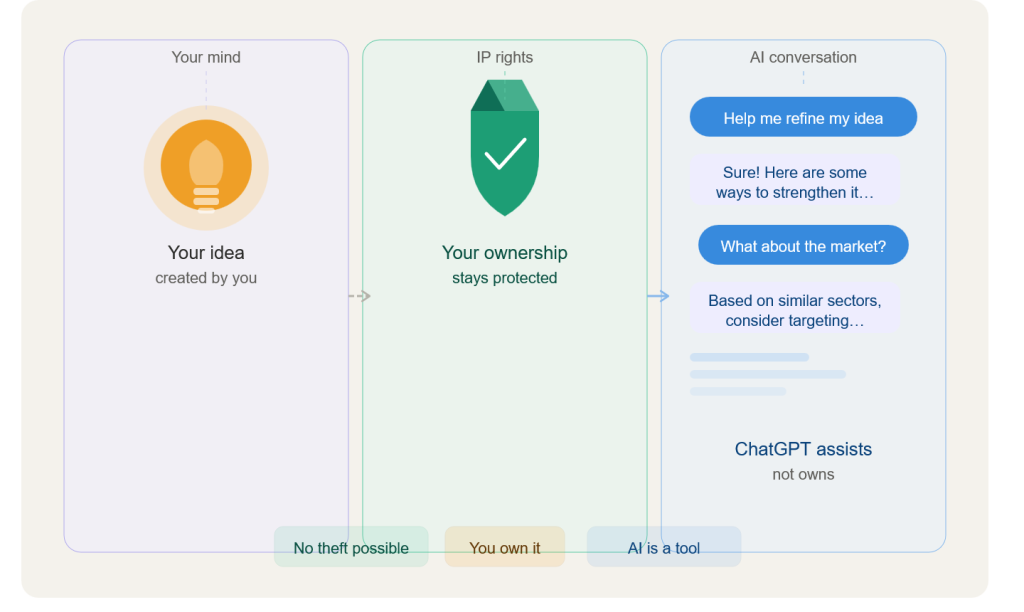
When you type a startup idea or creative concept into ChatGPT, the system processes your input to generate a relevant response. It doesn’t file patents, contact investors, or decide that your idea is worth capitalizing on.
That said, “stealing” in the traditional sense and “privacy concerns” are two different things. The real questions worth asking are: Where does my data go? Can it be used to train future AI models? Could someone else access my conversations? Those concerns are legitimate — and they’re what this article addresses.
What Happens When You Share Information With ChatGPT?
When you type a message into ChatGPT, here’s what happens at a basic level:
Your input is sent to OpenAI’s servers, where the model processes it and generates a response. The conversation may be stored by OpenAI depending on your account settings and whether you have chat history enabled.
By default, OpenAI may use your conversations to improve its models — though they have stated they apply filters and safety reviews to this process. If you’re using the free tier with chat history turned on, your conversations could potentially be reviewed by OpenAI employees or used as training data.
If you use the API directly (as a developer), conversations are not used for training by default. ChatGPT Plus users and Enterprise customers have more control over data retention, which we’ll cover in the privacy settings section.
The key takeaway: your data is processed on OpenAI’s servers, and the default settings may allow it to contribute to model improvements. This isn’t the same as “stealing ideas,” but it’s something to be aware of when sharing sensitive business information.
Does OpenAI Own the Ideas You Enter Into ChatGPT?
No. OpenAI does not claim ownership of the ideas or content you type into ChatGPT.
According to OpenAI’s usage policies, you retain ownership of the content you submit. OpenAI’s terms grant them a license to use your inputs for purposes like operating, maintaining, and improving the service — but that license to process your data is not the same as owning your intellectual property.
If you describe a business idea to ChatGPT, that idea remains yours. ChatGPT didn’t invent it. You did. OpenAI is not in the business of commercializing individual users’ ideas — their business model is AI services, not idea brokering.
A few important clarifications:
- Copyright: Ideas themselves are generally not protected by copyright. The expression of ideas (writing, code, art) can be. If you’re sharing detailed written work, consider that distinction.
- Trade secrets: Sharing a trade secret with a third-party service like ChatGPT could potentially affect its legal protection, depending on jurisdiction and context. Consult a lawyer if this applies to you.
- Patents: ChatGPT cannot file a patent. Only a human or legal entity can do so. Your idea described in a chat session doesn’t automatically put it at risk of being patented by OpenAI.
Bottom line: OpenAI’s license to process your data for service improvement is not the same as ownership of your intellectual property.
Can ChatGPT Share My Ideas With Other Users?
This is one of the most common fears — and it’s largely a misconception.
How ChatGPT Generates Responses
ChatGPT generates responses based on patterns learned during training, not by retrieving content from other users’ private conversations. When someone else asks ChatGPT about a similar topic, the model draws from its training data — not from your chat session.
Your conversation is not used in real-time to answer other users’ questions. ChatGPT doesn’t function like a searchable database of user inputs. Each conversation is processed independently.
Why Users Worry About Information Leakage
The concern often comes from a misunderstanding of how AI models work. Because ChatGPT can produce surprisingly relevant responses to niche topics, users sometimes assume it must be drawing from other people’s private conversations. In reality, it’s drawing from publicly available data used during training.
There was a notable incident in early 2023 where a bug temporarily allowed some users to see titles from other users’ chat histories — but not the full content of those conversations. OpenAI addressed this quickly. It was a technical bug, not a design flaw that enabled idea theft.
The realistic concern isn’t that ChatGPT will directly share your idea with a competitor — it’s that if your conversations are stored and later reviewed (as part of safety or model improvement processes), a human reviewer could theoretically see your input. This is a privacy consideration, not an idea-theft mechanism.
Is It Safe to Share Business Ideas With ChatGPT?
It depends on what you’re sharing and how sensitive it is. Here’s a breakdown by category:
Startup Ideas
Sharing a general concept — “I’m building an app that connects freelance chefs with event hosts” — is generally low-risk. General ideas are not protected intellectual property and exist in a broad space.
However, if you’re sharing highly specific details — your unique technical architecture, proprietary data approach, or unique market research — you’re sharing information that could theoretically be seen by OpenAI employees reviewing conversations for safety or quality purposes. Use judgment about what level of detail is necessary.
Business Plans
Detailed business plans often contain financial projections, market analysis, and strategic roadmaps. Unless you need feedback on the actual numbers and specifics, consider sharing anonymized or generalized versions. “Help me structure a business plan for a subscription-based fitness app” is safer than pasting your full 20-page confidential plan.
Product Concepts
Similar logic applies. ChatGPT can help you brainstorm, structure, or improve a product concept without you sharing every proprietary detail. Give it the shape of your idea without the sensitive core if the concept is not yet protected.
Marketing Strategies
Marketing strategy help is generally lower-risk. Discussing target audiences, messaging frameworks, or content calendars rarely involves trade secrets. Be cautious about sharing unreleased product names, confidential campaign data, or customer PII (personally identifiable information).
What Information Should You Avoid Sharing With ChatGPT?
Regardless of ownership concerns, some categories of information simply shouldn’t go into any third-party AI tool:
- Passwords and login credentials — never, under any circumstances
- Financial account numbers or banking details
- Customer personal data (names, emails, addresses, payment info)
- Confidential contracts or legal agreements under NDA
- Trade secrets that have specific legal protection in your business
- Social Security numbers or government ID numbers
- Sensitive HR information about employees
- Unreleased product plans covered by corporate confidentiality policies
- Patient health information (especially if HIPAA compliance is relevant)
A useful rule: if you wouldn’t email it to a colleague at another company without a confidentiality agreement, don’t paste it into ChatGPT.
ChatGPT Privacy Settings Explained
OpenAI provides meaningful privacy controls that most users don’t fully explore.
Chat history toggle: In ChatGPT’s settings, you can turn off chat history. When disabled, your conversations are not saved and are not used to train OpenAI’s models. They’re retained for a short period (currently 30 days) for abuse monitoring purposes, then deleted.
Data controls: Under Settings → Data Controls, you can manage whether your chats are used for model improvement. Disabling this means your conversations are excluded from training data.
Memory feature: ChatGPT has a memory feature that allows it to remember things across conversations. You can view, edit, or delete what it has stored about you, or turn memory off entirely.
ChatGPT Enterprise and API: Business and Enterprise plans offer stronger data protections. Enterprise customers’ data is not used for training by default, and businesses can negotiate specific data handling agreements with OpenAI.
Exporting your data: You can request an export of all your conversation data from the settings menu.
If privacy is a significant concern for your use case, taking five minutes to review your ChatGPT privacy settings is one of the most practical steps you can take.
Business Owners and Professionals: Best Practices
If you’re using ChatGPT for work — especially in industries with strong confidentiality norms like law, finance, healthcare, or tech — here are practical steps to protect yourself:
Share only what’s necessary. ChatGPT doesn’t need your company’s full revenue figures to help you write a financial summary. Give it the structure, not the sensitive data.
Remove identifying details. Replace client names, company names, and proprietary project names with placeholders. “Help me draft a proposal for Client A, a mid-sized logistics firm” works just as well as naming the actual company.
Use summaries instead of raw documents. Instead of pasting a confidential contract, describe the key points you need help with. The output will be just as useful.
Review your company’s AI usage policy. Many organizations now have explicit policies about which tools employees can use and what data can be shared. Check before using ChatGPT for work projects.
Consider enterprise tools for sensitive workflows. OpenAI’s Enterprise tier, or API-based integrations with stronger data controls, may be more appropriate for business use cases involving truly confidential information.
Know your compliance obligations. If your work involves regulated data — healthcare, finance, legal — understand whether using ChatGPT is compatible with your regulatory requirements (HIPAA, GDPR, SOC 2, etc.).
Common Myths About ChatGPT Stealing Ideas
ChatGPT Takes Startup Ideas
False. ChatGPT cannot register a company, file a patent, contact investors, or take any action in the real world. It has no agency outside the conversation window. Your startup idea, shared or not shared with ChatGPT, remains yours to develop or abandon.
OpenAI Automatically Owns Everything You Type
False. OpenAI’s terms of service do not claim ownership of user inputs. They claim a limited license to use your content for service-related purposes — the same kind of license you grant any web service when you use it. This is standard practice across the internet, not unique to AI.
ChatGPT Sells User Ideas
False. OpenAI’s business model is selling AI services and subscriptions — not brokering user ideas to third parties. There is no mechanism by which your idea is extracted and sold. This misconception conflates data processing with commercial exploitation of ideas.
AI Can Secretly Patent Ideas
False. Patents require a legal applicant — a human inventor or an organization. An AI system cannot file a patent in any major jurisdiction. Even if OpenAI wanted to patent something you described in chat (which their business model gives them no incentive to do), it would require human inventors to be named and a deliberate legal process.
Real Risks to Understand
While the fear of “idea theft” is largely unfounded, there are genuine considerations worth taking seriously:
Privacy of stored conversations: If chat history is enabled, your conversations are stored and may be reviewed by OpenAI staff for safety and quality purposes. This isn’t idea theft, but it is data exposure.
Human error: The biggest risk isn’t what ChatGPT does with your data — it’s what you share unnecessarily. Oversharing detailed confidential information increases exposure, even if that information is never misused.
Regulatory non-compliance: Using ChatGPT with data covered by GDPR, HIPAA, or similar regulations without understanding the compliance implications can create legal risk for your organization.
Third-party business requirements: If you’re under an NDA with a client, sharing their confidential information with ChatGPT could constitute a breach of that agreement, even if ChatGPT never “does anything” with it.
Competitive intelligence gaps: The risk isn’t that ChatGPT steals your idea — it’s that you become complacent about standard security practices because you assume AI tools are like a search engine. They’re not.
How to Use ChatGPT Safely for Business and Creative Work
Here’s a practical framework for using ChatGPT in a way that protects you and your organization:
Before you type: Ask yourself — “Would I be comfortable if a third party could read this?” If the answer is no, anonymize it first.
Remove confidential details: Swap specific names, numbers, and identifiers with generic placeholders before pasting anything into ChatGPT.
Use general examples: “Help me write a pitch deck for a SaaS tool targeting HR teams” is more protective than sharing your actual proprietary slides.
Turn off chat history for sensitive sessions: Go to Settings → Data Controls and disable data training before working on anything sensitive. You can re-enable it afterward.
Understand your organization’s AI policy: If you work for a company, check their guidelines. Many now specify which AI tools are approved and what data can be used with them.
Don’t share customer data: This one is non-negotiable. PII, transaction history, health records, or any customer-specific data should never go into a general AI tool.
Review privacy settings regularly: OpenAI updates its policies and features. Check your settings every few months to make sure they still reflect your preferences.
Conclusion
ChatGPT will not steal your ideas. It has no intentions, no commercial motives related to user inputs, and no ability to act in the world beyond generating text. OpenAI does not claim ownership of the ideas you share, and the model doesn’t relay your private conversations to other users in real time.
The distinction that matters is between idea theft (which isn’t happening) and data privacy (which deserves your attention). Your conversations may be stored, they may be reviewed by OpenAI employees, and depending on your settings, they may contribute to model training. None of this constitutes stealing — but it does mean you should be thoughtful about what you share.
The practical takeaway: use ChatGPT for what it does well — brainstorming, drafting, structuring ideas, getting feedback — but do so with the same awareness you’d bring to any third-party service. Anonymize what you can, understand your privacy settings, know your organization’s policies, and never paste information you’d classify as truly confidential.
Used responsibly, ChatGPT is a powerful thinking partner. The risk isn’t that it takes your ideas. The risk is forgetting that you’re always sharing information with a service, not thinking out loud in private.