Most novels don’t fail because writers run out of ideas. They fail because writers get stuck somewhere in the middle.
You know the feeling. Chapter one is strong. Chapter two is decent. And then somewhere around chapter seven, the story just… stalls. Your characters stop making sense. Your plot loses momentum. You open the document, stare at the cursor, and close the laptop again.
This is where ChatGPT becomes useful. Not as a replacement for your creativity, but as a tool that keeps you moving when you’d otherwise stop.
This article isn’t another list of “50 fun writing prompts.” You can find those anywhere. Instead, you’re going to learn how to use ChatGPT at every stage of writing a novel — from the first spark of an idea to a finished manuscript ready for revision.
If you’ve got a story in you and you’re tired of it staying stuck in your head, this is the resource that gets you unstuck.
Can ChatGPT Help You Write a Novel?
The answer is Yes.
ChatGPT can’t write a great novel on its own. What it can do is help you move faster through the parts of the process that usually slow writers down.
Here’s where it genuinely helps:
- Brainstorming. Generating ideas, twists, and angles you haven’t considered.
- Character creation. Building out backstory, motivation, and voice.
- Plot development. Structuring your story and identifying weak points.
- World building. Creating consistent, believable settings.
- Dialogue. Testing how characters would actually speak in a scene.
- Editing. Spotting pacing issues, plot holes, and inconsistencies.
- Revision. Getting a second opinion on scenes that aren’t working.
Here’s where it falls short.
ChatGPT doesn’t know what makes your story matter to you. It doesn’t have your childhood, your obsessions, or your particular sense of humor. It can suggest a plot twist, but it can’t tell you which twist will make your specific readers feel something.
That part is still yours. It always will be.
Think of ChatGPT less like a co-author and more like a very fast, very patient writing partner who never gets tired of your questions. You bring the vision. It helps you execute it faster.
If you’re already thinking past the first draft — toward whether a book like this could actually get published or sold, that’s a separate question worth answering honestly before you’re deep into chapter ten.
The Best ChatGPT Novel Writing Prompt
If you only take one prompt from this entire article, take this one. It’s designed to work as a starting point for an entire novel — idea, characters, conflict, arc, and outline — in a single conversation.
Act as an experienced novelist and story editor. I want to develop a novel from scratch. Ask me one question at a time about genre, tone, and the kind of story I want to tell. Based on my answers, help me develop: a core story idea, a protagonist with a clear want and a clear wound, a central conflict, a supporting cast, a three-act structure, and a chapter-by-chapter outline. Don’t generate everything at once — build it step by step, checking in with me after each stage so I can guide the direction.
Why It Works
Most people prompt ChatGPT for a finished idea in one shot. That gives you something generic. This prompt instead turns ChatGPT into a collaborator that asks questions first, which forces the story to reflect your instincts instead of the model’s defaults.
When To Use It
Use this at the very beginning, before you’ve committed to anything. It’s also useful if you have a vague idea — “something about a family secret” — but nothing solid yet.
How To Customize It
Add constraints early. If you already know your genre, your target word count, or a scene you can’t stop thinking about, tell ChatGPT upfront. The more specific your constraints, the less generic the output.
Pro Tip
Don’t accept the first version of anything. Once ChatGPT gives you a protagonist or a conflict, ask: “Give me two alternate versions of this that are darker/weirder/more personal.” The second or third option is often better than the first.
The Novel Writing Framework Smart Writers Use
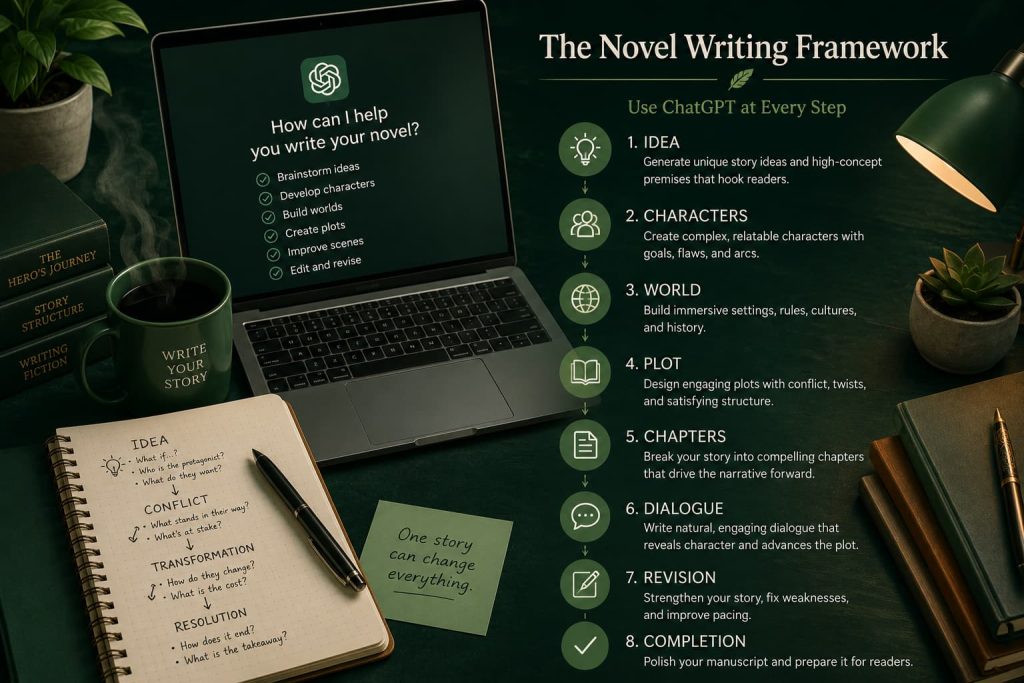
Most writers treat ChatGPT like a vending machine — type a request, get a paragraph, move on. That’s fine for a quick idea. It’s not how you finish a novel.
Instead, use this framework:
IDEA → CHARACTERS → WORLD → PLOT → CHAPTERS → DIALOGUE → REVISION → COMPLETION
Each stage builds on the last. Skipping one usually means paying for it later, in a chapter twelve rewrite you didn’t see coming.
Here’s what ChatGPT can do at each stage:
- Idea — Generate and stress-test concepts before you commit months to one.
- Characters — Build people with real contradictions, not cardboard cutouts.
- World — Establish rules and details that stay consistent for 300 pages.
- Plot — Structure the story so tension actually builds.
- Chapters — Break the outline into scenes you can actually sit down and write.
- Dialogue — Sharpen how characters sound, so every voice is distinct.
- Revision — Catch what you can’t see anymore because you’re too close to it.
- Completion — Push through the last stretch, where most first drafts die.
We’ll go through each of these in detail below, with prompts you can copy, adjust, and use today.
ChatGPT Prompts for Novel Ideas
Every novelist experiences this: dozens of half-ideas, none of them quite strong enough to build a book around. These prompts are designed to pressure-test an idea until it either falls apart or proves itself.
High-Concept Story Ideas
Prompt
Give me 10 high-concept novel ideas in the [genre] space. Each idea should be summarized in one sentence using the “what if” format, and should include a built-in source of ongoing conflict — not just an interesting premise.
What It Does
Forces ChatGPT to generate ideas with conflict already baked in, instead of just a cool setting with nothing happening in it.
Example
“What if a hospice nurse discovered she could hear the last thoughts of the dying — and one of them named her as their killer, ten years in the future.”
Pro Tip
Ask ChatGPT to rank its own list by “which of these sustains 300 pages of conflict, not just one twist.” It’ll often talk itself out of the weakest ideas.
Genre-Specific Ideas
Prompt
I want to write a [genre] novel. Give me 5 story concepts that use classic tropes of this genre in an unexpected way — not by avoiding tropes, but by subverting reader expectations of them.
What It Does
Keeps your book recognizable to genre readers while still feeling fresh, instead of accidentally reinventing the wheel or ignoring reader expectations entirely.
Example
A cozy mystery where the amateur detective is the one everyone suspects — and she has to solve the case to clear her own name.
Pro Tip
Genre readers are loyal but picky. Ask ChatGPT which tropes are “must-haves” for your genre’s readers before you subvert anything.
Character-Driven Stories
Prompt
Give me 5 novel concepts where the plot is driven primarily by a character flaw, not an external event. Describe the flaw, how it creates conflict, and what the character would have to overcome internally to resolve the story.
What It Does
Anchors your story in character psychology, which is what makes readers stay attached for an entire book.
Example
A surgeon whose need for control destroys her marriage, then forces her to make an impossible decision in the operating room.
Pro Tip
If you’re stuck on a plot, look here first. Internal conflict often generates external plot naturally once you know what the character is running from.
Conflict-Based Stories
Prompt
Give me 5 novel ideas built around a moral dilemma with no clean right answer. For each, describe the dilemma, who is forced to face it, and what they stand to lose either way.
What It Does
Generates the kind of tension that keeps readers up at 1 a.m. — situations where there’s no obvious “correct” choice.
Example
A father must choose between reporting his son’s crime or protecting the family that depends on him.
Pro Tip
The strongest dilemmas force a character to choose between two things they genuinely value — not between right and wrong, but between two rights.
If you want to go deeper into any of these directions, see our full guide to ChatGPT prompts for novel ideas.
ChatGPT Prompts for Character Development
Here’s where many stories fall apart: flat characters. Readers forgive a shaky plot far more easily than they forgive a character who feels like cardboard.
Main Characters
Prompt
Help me build a protagonist for my novel. Ask me about the story’s genre and stakes, then generate a character profile including: their core want, their core wound (the thing from their past driving their behavior), a contradiction in their personality, a flaw that will cause real problems in the story, and a believable voice with speech patterns.
What It Does
Builds a character with an internal engine, not just a physical description and a job title.
Example
A firefighter who runs toward danger because he couldn’t save his brother — and whose bravery is actually a form of self-punishment.
Pro Tip
The want and the wound should conflict. That tension is what makes a character feel alive on the page.
Villains
Prompt
Help me create a villain who believes they are the hero of their own story. Give me their backstory, their justification for their actions, and one moment where a reader might almost agree with them.
What It Does
Avoids the “evil for evil’s sake” trap, which is the fastest way to make a villain feel forgettable.
Example
A CEO covering up a safety failure who genuinely believes exposure would cost thousands of jobs — and isn’t entirely wrong.
Pro Tip
Ask ChatGPT to write one paragraph from the villain’s point of view. If it doesn’t make you a little uncomfortable, the villain isn’t strong enough yet.
Supporting Characters
Prompt
Give me 3 supporting characters for my novel who each serve a different narrative function: one who challenges the protagonist’s worldview, one who enables their flaw, and one who represents who they could become. Include a distinct voice for each.
What It Does
Prevents your supporting cast from blending into interchangeable background noise.
Example
A cynical mentor, an enabling best friend, and an idealistic younger sibling — each pulling the protagonist in a different direction.
Pro Tip
If two supporting characters are giving your protagonist the same advice, cut one. Every character should be pulling in a different direction.
Character Arcs
Prompt
Map out a full character arc for my protagonist across a three-act structure. Show me their belief at the start, the events that challenge that belief, their lowest point, and what they believe by the end — and whether this is a positive or negative change arc.
What It Does
Gives you a spine to write toward, so every scene has a clear job to do in the character’s transformation.
Example
Starts believing “trust makes you weak,” ends believing “trust is the only thing that makes you strong” — a positive change arc.
Pro Tip
Pin this arc to your wall, literally or digitally. Every time a scene doesn’t move it forward, ask yourself if the scene needs to exist.
For a deeper toolkit here, check out our dedicated guide to ChatGPT prompts for character development.
ChatGPT Prompts for World Building
Your world doesn’t need to be original. It needs to be consistent. Readers will forgive a familiar setting. They won’t forgive contradictions.
Fantasy Worlds
Prompt
Help me build a fantasy world for my novel. Ask about the tone I want (grim, whimsical, epic, etc.), then help me define: the magic system and its limitations, the political structure, one central cultural conflict, and three details that make this world feel lived-in rather than generic.
What It Does
Prevents the “generic medieval kingdom with dragons” problem by forcing specificity and limits.
Example
A magic system where spellcasting ages the caster prematurely — which creates built-in stakes for every use of magic in the book.
Pro Tip
Always define your magic system’s limitations before its powers. Limitations create tension. Unlimited power creates boredom.
Science Fiction Worlds
Prompt
Help me build a science fiction setting. Ask about the technology level and central “what if,” then help me define: the rules of the technology, who benefits and who suffers under this system, and one piece of worldbuilding that most sci-fi in this subgenre overlooks.
What It Does
Pushes past surface-level tech description into the social and economic consequences that make sci-fi worlds feel real.
Example
A world with immortality technology — but it’s only available to those who can afford ongoing treatments, creating a permanent underclass.
Pro Tip
The best sci-fi worldbuilding answers: “who loses because this technology exists?” That’s usually where your plot lives.
Historical Settings
Prompt
I’m setting my novel in [time period/location]. Help me identify: 3 lesser-known historical details that add authenticity, common misconceptions to avoid, and sensory details (sounds, smells, daily rhythms) that would make this era feel real to a modern reader.
What It Does
Helps you avoid the flattened, movie-set version of history that experienced readers spot immediately.
Example
Instead of generalizing “1920s New York,” specifying the exact sounds of a tenement building at dinnertime.
Pro Tip
Always verify historical facts ChatGPT gives you against a real source. Use it to point you toward research directions, not as your only source.
Realistic Settings
Prompt
Help me make a contemporary, realistic setting feel specific rather than generic. Ask me about the town or city my story is set in, then help me identify small, specific details — local businesses, regional slang, weather patterns, class dynamics — that would only be true of this particular place.
What It Does
Specificity is what separates “a small town” from a place readers can actually picture.
Example
Not “a diner,” but the one diner in town where the booths still have the same cracked vinyl from 1987, and everyone knows which one is Pastor Dale’s.
Pro Tip
Real specificity almost always comes from a place you actually know. Use ChatGPT to prompt your own memory, not to invent from nothing.
Explore this further in our guide to ChatGPT prompts for world building.
ChatGPT Prompts for Plot Development
Imagine you’ve got a great idea but no idea how to sustain it for 80,000 words. This is where plot structure earns its keep.
Story Structure
Prompt
Help me structure my novel using a three-act structure. Given my premise [insert premise], outline: the inciting incident, the first plot point, the midpoint shift, the second plot point/dark moment, the climax, and the resolution.
What It Does
Gives your story a skeleton before you start putting flesh on it, so you’re not discovering the ending on page 250 of a first draft.
Example
A midpoint shift where the protagonist stops running from the antagonist and starts hunting them instead — flipping the story’s energy.
Pro Tip
The midpoint should change the nature of the conflict, not just escalate it. If your midpoint is just “things get worse,” it’s not doing its job.
Plot Twists
Prompt
Give me 5 potential plot twists for my story [insert summary]. For each, explain what clues would need to be planted earlier for it to feel earned rather than random, and at what point in the story it should land.
What It Does
Prevents twists that feel like a cheap trick, by forcing the setup to exist before the payoff.
Example
Revealing the trusted mentor was working against the protagonist all along — but only if earlier scenes show small, deniable inconsistencies.
Pro Tip
A twist should re-contextualize what came before, not contradict it. Ask ChatGPT to check your twist against your outline for contradictions.
Subplots
Prompt
Help me design a subplot for my novel that reinforces the theme of my main plot. Given my main story [insert summary] and theme [insert theme], suggest a subplot involving a secondary character, and explain how it should intersect with the main plot at key points.
What It Does
Keeps subplots from feeling like filler by tying them thematically to the main story.
Example
A main plot about trust between spies, paired with a subplot about the protagonist’s daughter learning to trust a new stepparent.
Pro Tip
If a subplot doesn’t touch the main plot at least twice before the climax, cut it or merge it.
Story Conflict
Prompt
Analyze the central conflict in my novel [insert summary]. Tell me if it’s strong enough to sustain a full-length novel, and suggest ways to raise the stakes at the 25%, 50%, and 75% marks.
What It Does
Catches the most common novel-killer: conflict that’s strong for 100 pages and then quietly fizzles.
Example
Escalating from “will they get caught” to “who will they have to betray to avoid getting caught.”
Pro Tip
Stakes should escalate in kind, not just in size. Bigger explosions aren’t the same as deeper consequences.
Dig deeper with our full breakdown of ChatGPT prompts for plot development.
ChatGPT Prompts for Writing Better Dialogue
If I were starting a novel today, I’d spend as much time on dialogue as on plot. Bad dialogue is the fastest way to lose a reader’s trust, even in an otherwise strong story.
Character Voice
Prompt
Here is a description of my character: [insert description]. Write 3 versions of the same line of dialogue in their distinct voice, adjusting word choice, rhythm, and what they choose to say versus leave unsaid.
What It Does
Helps you find a character’s specific verbal fingerprint instead of generic “book dialogue.”
Example
A guarded ex-soldier’s version of “I’m fine” is shorter and colder than a chatty extrovert’s, who might overexplain instead.
Pro Tip
What a character refuses to say is often more revealing than what they do say. Ask ChatGPT to show you both versions.
Emotional Dialogue
Prompt
Write a dialogue scene between [character A] and [character B] where [character A] is trying to say something difficult without directly saying it. The subtext should be clear to the reader even though the characters don’t state it outright.
What It Does
Trains you to write emotion through subtext instead of characters announcing their feelings directly.
Example
A daughter asking “are you going to the game Saturday?” when what she really means is “do you still care about me at all.”
Pro Tip
If a character says exactly what they feel, ask ChatGPT to rewrite the scene with them saying the opposite of what they mean instead.
Conflict Scenes
Prompt
Write a confrontation scene between two characters who both believe they’re right. Neither should be a villain — show both perspectives as reasonable within the scene’s dialogue.
What It Does
Creates the kind of argument scene that feels real, where readers can see both sides instead of an obvious winner.
Example
Two siblings arguing over a parent’s care, where one prioritizes safety and the other prioritizes dignity — both are right.
Pro Tip
The best conflict scenes end without a clean resolution. Someone should leave the scene still convinced they’re right.
Realistic Conversations
Prompt
Rewrite this dialogue exchange [paste your dialogue] to sound more natural: add interruptions, incomplete sentences, and the small verbal habits real people use, while keeping it readable and purposeful.
What It Does
Fixes the most common beginner dialogue problem — characters speaking in complete, formal sentences like a transcript.
Example
Turning “I don’t think that’s a good idea because it could put us in danger” into “I don’t — that’s not a good idea. We could get hurt.”
Pro Tip
Read dialogue out loud. If you wouldn’t say it that way to a friend, your character probably wouldn’t either.
See more in our complete guide to ChatGPT prompts for writing dialogue.
ChatGPT Prompts for Revising and Editing a Novel
Pacing Analysis
Prompt
Here’s a summary of my chapters [paste chapter summaries or outline]. Identify sections where pacing might drag, where tension might be too consistently high without relief, and where the story might need to slow down or speed up.
What It Does
Gives you an outside read on pacing, which is nearly impossible to judge accurately in your own manuscript.
Example
Flagging three consecutive chase scenes with no breathing room in between for character reflection.
Pro Tip
Vary intensity deliberately. Constant high tension flattens out and stops feeling tense at all.
Plot Hole Detection
Prompt
Here is my novel’s outline [paste outline]. Check for plot holes, inconsistencies, unresolved setups, and character knowledge that doesn’t make logical sense given what’s happened earlier in the story.
What It Does
Catches contradictions that are easy to miss after months of working inside the same story.
Example
Catching that a character knows information in chapter 15 that they weren’t present to learn.
Pro Tip
Do this pass after your first full draft, not before. Fixing plot holes in an outline is faster than fixing them in finished prose.
Character Consistency
Prompt
Here are descriptions of how [character name] behaves in chapters 1, 8, and 15 [paste excerpts]. Check whether their behavior, voice, and decisions are consistent, and flag anything that feels like a contradiction without clear justification.
What It Does
Catches character drift, which happens naturally over the months it takes to write a novel.
Example
A character established as risk-averse suddenly making a reckless decision with no internal justification shown.
Pro Tip
Character growth should be earned on the page. If behavior changes, the reader needs to see why.
Scene Improvements
Prompt
Here’s a scene from my novel [paste scene]. Tell me what’s working, what isn’t landing, and suggest 2-3 specific ways to raise the emotional or narrative stakes without changing the scene’s basic purpose.
What It Does
Gives you targeted, scene-level feedback instead of vague overall notes.
Example
Suggesting a scene land harder by cutting the last line of dialogue and ending on action instead.
Pro Tip
Ask for what’s working first. It’s easy to over-fix a scene that only had one weak line.
How I Would Use ChatGPT to Write a Novel Today
Here’s the actual workflow I’d use, start to finish.
Idea generation. I’d start with the high-concept prompt above, generate ten ideas, and stress-test the top three by asking what happens at the 50% and 90% mark of each story.
Outlining. Once I picked an idea, I’d use the flagship master prompt to build out a three-act structure and chapter breakdown — one stage at a time, not all at once.
Character creation. I’d build my protagonist and antagonist in detail before writing a single scene, focusing on the want/wound contradiction for each.
Drafting. I’d write my own first draft of every scene, using ChatGPT only to unstick specific dialogue exchanges or test alternate plot directions when I got stuck.
Revising. I’d run a full pacing and plot hole pass once the draft was complete, then go scene by scene with the scene improvement prompt on anything that felt weak.
Notice what doesn’t happen here: ChatGPT never writes the whole manuscript. It removes friction at every stage, but the book stays yours.
Frequently Asked Questions
Can ChatGPT write a novel?
ChatGPT can generate scenes, dialogue, and structure, but it can’t independently write a cohesive, original novel that reflects a distinct authorial voice. It works best as a collaborative tool for brainstorming, outlining, and revision, guided by a human writer.
What are the best ChatGPT prompts for novel writing?
The most effective prompts are specific and staged — asking for one element at a time (character, conflict, structure) rather than a whole story at once, and including constraints like genre, tone, and existing story details.
Can ChatGPT help with writer’s block?
Yes. ChatGPT is particularly useful for generating alternate directions when a scene isn’t working, testing different versions of dialogue, and identifying why a stalled plot might have lost momentum.
Can ChatGPT create characters?
ChatGPT can generate detailed character profiles including backstory, motivation, flaws, and voice, especially when prompted for specific elements like a “want vs. wound” contradiction rather than a generic character description.
Can ChatGPT help edit a novel?
Yes, particularly for pacing analysis, plot hole detection, and character consistency checks across chapters. It works best as a second-opinion tool alongside traditional self-editing and human feedback.
Conclusion
ChatGPT won’t write your novel for you, and it shouldn’t. What it can do is remove the friction that stops most novels from ever getting finished — the blank page, the stuck middle, the scene that isn’t working and you don’t know why.
Your creativity, your voice, and your judgment are still the whole point of the book. ChatGPT just helps you get there faster, with fewer dead ends along the way.
A finished, imperfect novel will always matter more than a perfect first chapter that never becomes a book. Pick one prompt from this article, open a blank document, and start today.