The answer is: YES, you can use ChatGPT to write a book and sell it. Thousands of authors are already doing it. But there’s more to the story than a simple yes.
Using ChatGPT doesn’t mean hitting a button and uploading whatever comes out. The authors getting real results treat it as a powerful writing assistant, one that speeds up research, breaks through creative blocks, and handles first drafts while still putting their own knowledge, voice, and judgment into the final product.
Before you start, it’s worth understanding the legal landscape, copyright considerations, platform rules, and where AI genuinely helps versus where it falls short. That’s exactly what this guide covers.
Can ChatGPT Actually Write a Book?
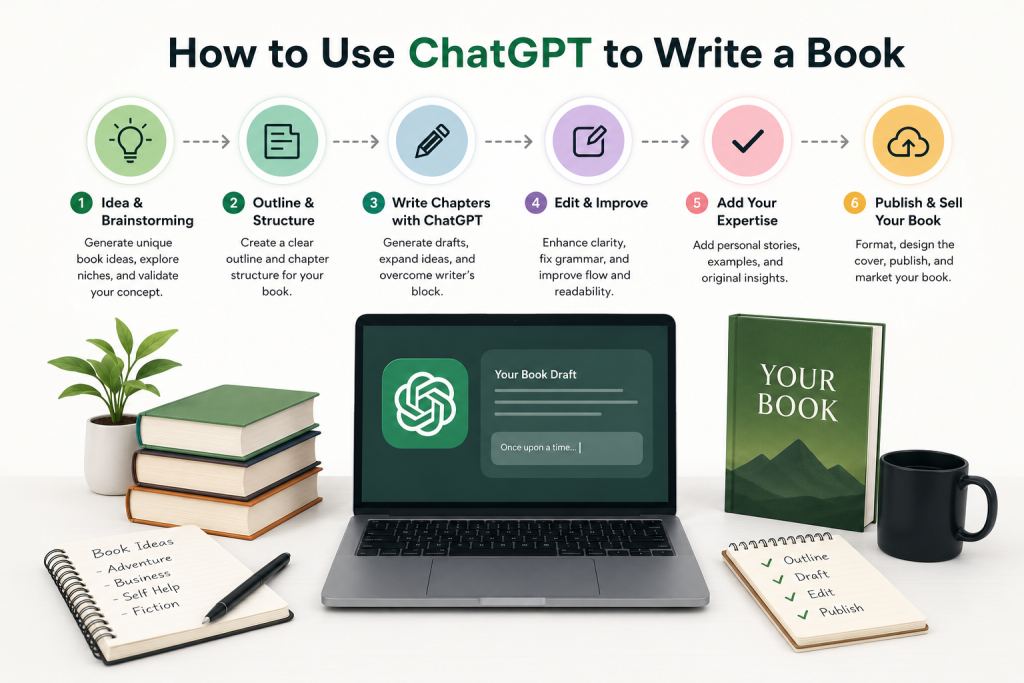
ChatGPT can handle a surprising amount of the heavy lifting involved in writing a book. It can brainstorm ideas, build chapter outlines, generate full draft sections, suggest transitions, clean up prose, and help you push through writer’s block when momentum stalls.
For nonfiction — think business books, how-to guides, productivity titles, travel guides — ChatGPT is particularly effective. You feed it your knowledge and structure; it helps turn that into readable, well-organized prose.
For fiction, it’s more nuanced. ChatGPT can draft scenes, generate dialogue, and suggest plot directions, but character depth, emotional authenticity, and a distinctive narrative voice require a human hand. The AI tends toward the generic when left unsupervised.
Where human involvement is still essential:
- Providing original insight, expertise, or lived experience
- Maintaining a consistent, distinctive voice throughout the book
- Fact-checking claims, statistics, and references
- Making structural decisions about what to include or cut
- Final editing passes for tone, flow, and readability
Think of ChatGPT as a very capable first-draft engine. The author still drives.
Is It Legal to Sell a Book Written With ChatGPT?
Yes, it is legal to sell a book written with ChatGPT assistance. OpenAI’s terms of service permit commercial use of content generated through the platform — meaning you can publish and profit from content produced with ChatGPT.
There are a few things to keep in mind:
- You are responsible for the final content. If your book makes false claims, infringes on another work, or violates platform policies, that responsibility falls on you as the author and publisher.
- Platform rules vary. Amazon KDP, for example, requires authors to disclose AI-generated content at the time of publishing. Failing to disclose when required can result in content removal.
- Genre and audience expectations matter. In some spaces — academic publishing, literary fiction, professional credentials — readers and publishers may have strong views on AI involvement. Know your market.
Selling an AI-assisted book is legal. Doing it well and responsibly requires understanding the rules of each platform you publish on.
Who Owns the Copyright of a ChatGPT-Written Book?
This is where things get genuinely complicated — and where many authors get tripped up.
The U.S. Copyright Office has been clear: copyright protection requires human authorship. Content generated entirely by AI, with no meaningful human creative contribution, is not eligible for copyright protection in the United States.
What this means in practice:
- A book where you provided detailed prompts, structured the outline, rewrote sections, added original expertise, and edited heavily throughout — that book involves substantial human authorship and is much more defensible as your copyrightable work.
- A book where you asked ChatGPT to “write a 200-page novel” and published the output with minimal changes — that content sits in murky territory, and copyright protection may not apply.
The critical factor is the degree of human creative input. The more you shape, transform, and add original expression to what the AI produces, the stronger your claim to authorship.
Practically speaking:
- Use AI-generated content as a starting point, not a finished product
- Document your process (outlines, edits, major revisions) as evidence of authorship
- Add original expertise, anecdotes, frameworks, and perspective that only you can provide
- Consult a copyright attorney for high-stakes projects
The legal landscape here is still evolving. Courts and copyright offices around the world are actively working through these questions. When in doubt, lean toward more human contribution, not less.
Best Ways to Use ChatGPT for Writing a Book
Brainstorming Ideas
ChatGPT excels at generating options. If you’re early in the process — deciding on a topic, exploring a niche, or trying to find a fresh angle on a crowded market — use it as a brainstorming partner.
Try prompts like:
- “Give me 20 book ideas in the personal finance space targeting people in their 30s.”
- “What are underserved niches in the self-help genre right now?”
- “Help me find a unique angle for a book about remote work productivity.”
The goal isn’t to take an idea wholesale — it’s to generate enough options that something clicks.
Creating an Outline
Once you have a concept, use ChatGPT to build a working chapter structure. A strong outline is the backbone of any good book, and AI can help you see the full arc before you start writing.
Prompt example: “Create a detailed 10-chapter outline for a business book about building systems for solopreneurs. Include a brief description of what each chapter covers.”
You’ll likely revise the outline significantly, but having a starting framework saves hours and keeps you from staring at a blank page.
Drafting Chapters
This is where ChatGPT adds the most raw time value. Give it a chapter outline and ask it to write a first draft. The output won’t be publish-ready, but it gives you something to work with — and editing is always faster than writing from scratch.
Be specific in your prompts. The more context you provide about your audience, tone, and the key points to hit, the more useful the draft will be.
Editing and Improving Content
Beyond drafting, ChatGPT is a solid editing assistant. Paste in a paragraph and ask it to:
- Improve clarity and readability
- Simplify jargon for a general audience
- Make the tone more conversational (or more authoritative)
- Tighten up the language and cut filler
It won’t replace a professional editor, but it catches a lot of noise and accelerates your revision process.
Pros of Using ChatGPT to Write a Book
- Speed. What might take weeks to outline and draft can happen in days with AI assistance.
- Beats writer’s block. When you’re stuck, a ChatGPT draft gives you momentum — something to react to, edit, or push against.
- Idea volume. Need 30 possible chapter titles? Ten different opening lines? AI generates options fast.
- Research support. ChatGPT can summarize concepts, explain topics at different levels, and help structure complex information clearly.
- Accessibility. First-time authors who struggle to get started find AI useful for building confidence through early drafts.
Cons of Using ChatGPT to Write a Book
- Generic output. Without specific direction, ChatGPT defaults to average, safe, and predictable. Distinctiveness requires your input.
- Accuracy issues. ChatGPT can confidently state incorrect facts. Every factual claim needs independent verification.
- Repetition. Longer AI-generated pieces tend to loop back and restate points — something a human editor needs to catch and cut.
- No personal experience. The most compelling nonfiction comes from lived experience and hard-won expertise. ChatGPT has neither.
- Copyright uncertainty. As discussed above, heavy reliance on unedited AI output creates legal ambiguity around ownership.
How to Write a High-Quality Book With ChatGPT
Here’s a step-by-step process that balances AI efficiency with human quality:
1. Choose a specific, validated topic. Research demand before you write. Use Amazon KDP, Google Trends, and keyword tools to confirm people are actively searching for your subject.
2. Build a detailed outline. Use ChatGPT to draft a chapter structure, then revise it based on your expertise and knowledge of your audience. Don’t skip this step — it shapes everything that follows.
3. Generate chapter drafts. Work through your outline chapter by chapter, prompting ChatGPT with the specific points each section needs to cover. Generate, then edit — never publish raw.
4. Add your original expertise. This is non-negotiable. Personal stories, proprietary frameworks, professional experience, unique opinions — these are what separate a useful book from a content commodity.
5. Fact-check everything. Go through every specific claim, statistic, and reference. ChatGPT’s training data has a cutoff and it can fabricate details that sound credible but aren’t.
6. Edit heavily. At minimum, do two full revision passes: one for structure and substance, one for language and readability. Use ChatGPT to help, but use human judgment to decide.
7. Get professional proofreading. A human proofreader catches what you and the AI both miss — and signals to readers that you took the work seriously.
8. Prepare for publishing. Format your manuscript, create a cover (hire a professional designer), write your book description, and follow the disclosure requirements of whichever platform you publish on.
Can You Publish a ChatGPT-Written Book on Amazon KDP?
Yes. Amazon KDP allows AI-assisted books. However, Amazon requires publishers to disclose when content has been AI-generated — a policy introduced in 2023 that applies to both text and images.
When uploading your book, KDP will ask whether the content contains AI-generated material. Answer honestly. Failure to disclose is against their policies and can result in your book being removed from sale.
Beyond policy compliance, there’s a practical quality consideration. Amazon’s marketplace is increasingly saturated with low-effort AI content — short, generic ebooks that provide little value. Books with no human editorial voice, no original insight, and obvious AI fingerprints tend to receive poor reviews and low sales.
The books that perform well are the ones where AI handled the mechanics and a human provided the substance.
Examples of Books You Can Create With ChatGPT
Some book types are better suited to AI assistance than others:
| Book Type | AI Usefulness | Key Human Contribution |
|---|---|---|
| Business / How-To | High | Your methodology and expertise |
| Productivity guides | High | Your systems and personal experience |
| Educational books | High | Accuracy checking and pedagogical structure |
| Children’s books | Moderate | Voice, emotional resonance, illustrations |
| Travel guides | Moderate | Real-world accuracy, local knowledge |
| Cookbooks | Moderate | Original recipes, testing, photography |
| Fiction novels | Lower | Voice, character depth, plot originality |
| Memoir / Personal narrative | Very low | Lived experience — AI can’t provide this |
The sweet spot for AI assistance is structured, informational nonfiction where the value comes from organization and clarity, not personal narrative.
Common Mistakes When Using ChatGPT to Write a Book
Publishing without editing. The most common mistake. Raw ChatGPT output is a first draft at best. Publishing it unedited signals low effort to readers — and shows in the reviews.
Relying entirely on AI for substance. AI can structure and articulate, but it can’t provide genuine expertise. Books with no human insight feel hollow because they are hollow.
Skipping fact-checking. ChatGPT gets things wrong — sometimes subtly, sometimes significantly. Statistics, dates, citations, and expert quotes all need verification against primary sources.
Using generic prompts. “Write a chapter about productivity” produces generic content. “Write a 1,200-word chapter for a productivity book targeting time-strapped freelancers, covering the three biggest time-wasting habits and how to eliminate them” produces something usable.
Ignoring the reader experience. AI text often reads smoothly but lacks forward momentum — the sense that every sentence is pulling the reader toward something. Editing for narrative drive is a human skill.
Frequently Asked Questions
Can I legally sell a book written by ChatGPT?
Yes. OpenAI’s terms of service permit commercial use of ChatGPT-generated content. You can publish and sell books that include AI-generated text. You’re responsible for the accuracy and legality of the final content, and platform-specific disclosure requirements (like Amazon KDP’s) must be followed.
Can ChatGPT write an entire novel?
ChatGPT can generate substantial portions of a novel — character profiles, scene drafts, dialogue, plot outlines — but writing an entire novel that reads as a cohesive, emotionally engaging work requires significant human involvement. Most authors using AI for fiction treat it as a co-writer that handles scaffolding and rough drafts.
Who owns a ChatGPT-written book?
Ownership depends on how much human creative contribution went into the work. In the U.S., purely AI-generated content is not eligible for copyright. Content significantly shaped, edited, and transformed by a human author is more likely to qualify. The more original human input, the stronger the authorship claim.
Does Amazon allow AI-generated books?
Yes, Amazon KDP allows AI-assisted books but requires disclosure of AI-generated content at the time of publishing. Authors must indicate whether their book includes AI-generated text or images.
Is it worth using ChatGPT to write a book?
For the right type of book, yes — especially structured nonfiction where speed and organization are more important than deeply personal voice. It’s most valuable as a tool that accelerates the writing process, not replaces it. Authors who treat ChatGPT as an assistant and contribute genuine expertise consistently produce better results than those who treat it as a ghostwriter.
Conclusion
You can absolutely use ChatGPT to write a book and sell it. The legal framework supports it, the platforms allow it, and the technology is capable enough to make a real difference in your writing speed and output.
But the books worth reading — and the ones that sell consistently — still have a human at the center. ChatGPT handles the structure, the drafts, and the editing scaffolding. You bring the expertise, the voice, the judgment, and the original thinking that makes a book worth someone’s time and money.
Use it as the most capable writing assistant you’ve ever had. Just don’t mistake the assistant for the author.