Every time you ask ChatGPT a question, something surprising happens behind the scenes — water gets used. Not by the software itself, but by the massive physical infrastructure that makes AI possible.
ChatGPT doesn’t drink water. But the data centers running it do. And as AI becomes a daily tool for hundreds of millions of people, the conversation around its environmental footprint especially water consumption has grown louder and more complicated.
Here’s what’s actually happening, why the numbers online vary so wildly, and what it means in practical terms.
Why Does ChatGPT Need Water?
Data Centers Generate Massive Heat
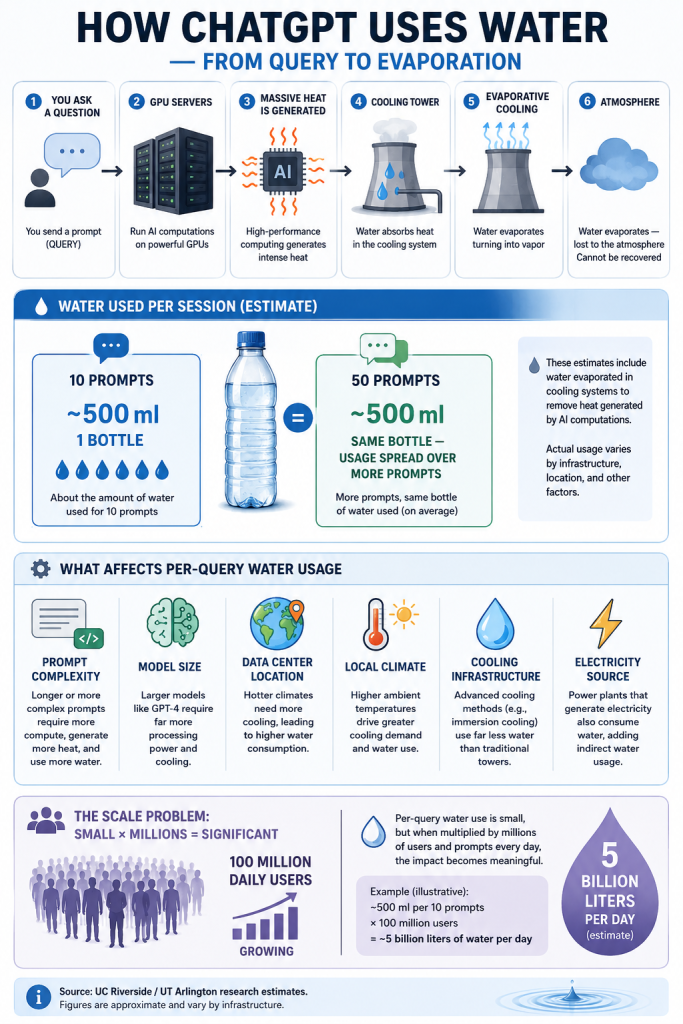
ChatGPT runs on thousands of high-performance GPUs and servers owned by Microsoft and OpenAI. These machines don’t just process your question they perform billions of mathematical operations in milliseconds to generate each response.
All that computation generates enormous heat. Leave a gaming laptop running at full capacity and you’ll feel it within minutes. Now imagine thousands of server racks doing the same thing, around the clock, in a warehouse-sized facility.
Without aggressive cooling, hardware would fail. Data centers need a way to shed heat continuously and water is one of the most efficient tools available.
Water Is Used for Cooling
The most common cooling method in large data centers is evaporative cooling. Here’s how it works:
- Warm air from server rooms is passed over water-saturated pads or into cooling towers
- Water evaporates, absorbing heat in the process
- The cooled air (or chilled water) cycles back to cool the servers
This is the same principle behind sweat cooling your body. It’s highly effective and it consumes real water in the process, water that evaporates into the atmosphere and can’t be recaptured.
Some facilities use water-based chiller systems, where chilled water circulates through pipes near server racks. Others use direct liquid cooling, where coolant flows directly over chips. The exact method varies by data center, but water is almost always part of the equation.
Electricity Production Also Uses Water
There’s a less obvious layer too. Power plants whether coal, gas, or nuclear use water to generate steam, drive turbines, and cool reactors. When ChatGPT draws electricity from the grid, that electricity came from somewhere, and in many cases, producing it required water as well.
This is called indirect water consumption, and it’s a big reason why estimates vary depending on what researchers choose to measure.
How Much Water Does ChatGPT Use Per Query?
The Most Common Estimates
A widely cited research paper from UC Riverside and University of Texas Arlington estimated that ChatGPT uses roughly 500ml of water — about a standard water bottle — for every 10 to 50 prompts, depending on where the query is processed and how complex it is.
Headlines simplified this to “a bottle of water per conversation,” which isn’t always accurate but isn’t wildly off either for longer sessions.
To be clear: these are estimates. OpenAI hasn’t published granular per-query water data. Researchers work from disclosed totals, server configurations, and modeling assumptions — all of which introduce variability.
Is the 500ml Figure Actually Outdated?
Increasingly, yes — and this is worth knowing before you repeat it. The original methodology behind the 500ml number appears to have measured water use per page of output, which later got reinterpreted as per request. Since a typical ChatGPT exchange runs far shorter than a full page, one independent analysis puts realistic usage closer to 5ml per conversation — roughly a tenfold improvement on the popular figure, largely because modern models are smaller and faster than the GPT-3-era systems the original estimate was based on.
Even OpenAI has weighed in: Sam Altman stated in mid-2025 that an average ChatGPT query uses about 0.3ml of water — a figure broadly in the same range as the independent 5ml estimate once you account for differences in assumptions.
So which number is “right”? Probably somewhere between these figures and the original 500ml estimate, depending on the model, session length, and data center — but the takeaway is that the widely-shared 500ml-per-conversation stat is likely a significant overestimate by today’s standards, and treating it as current is misleading.
Water Use by Data Center Location
Because cooling method and local climate matter so much, the same query can cost very different amounts of water depending on where it’s processed. One Washington Post/UC Riverside analysis of a 100-word AI-generated email found:
| Data Center Location | Water Used (100-word email) |
|---|---|
| Washington | 1,468 ml |
| Arizona | 925 ml |
| Illinois | 464 ml |
| Iowa | 462 ml |
| Wyoming | 369 ml |
| Virginia | 353 ml |
| Texas | 235 ml |
(Source: Washington Post / UC Riverside analysis)
The gap between Washington and Texas — over 6x — shows just how much geography and cooling infrastructure affect the final number. It’s a big part of why “how much water does ChatGPT use” doesn’t have one clean answer.
What Affects Water Usage?
Several factors influence how much water any single ChatGPT interaction consumes:
- Prompt length and complexity — A short factual question uses less compute than a request to write a 2,000-word essay
- Model size — Larger, older-generation models require significantly more processing per response than newer, optimized ones
- Data center location — Facilities in hot, dry climates rely more on evaporative cooling than those in cooler regions
- Local climate — Higher ambient temperatures mean more cooling is needed year-round
- Cooling infrastructure — Newer facilities with liquid cooling or dry cooling systems use less water
The per-query figure isn’t fixed. It’s a range that shifts based on all the above — and, as the section above shows, it’s also shifting downward over time as models and infrastructure improve.
Why Are There So Many Different Numbers Online?
Different Studies Measure Different Things
If you’ve Googled this topic and found wildly different numbers, there’s a reason. Researchers don’t always measure the same thing:
- Some studies count only direct water use — what the data center physically consumes for cooling
- Others include indirect water use — the water needed to produce the electricity the data center draws
- Some focus on training (the one-time process of building the model), others on inference (running the model for everyday queries)
Training GPT-4 was an enormously water-intensive event compared to any individual inference. But inference, repeated billions of times, adds up over time in ways training doesn’t.
When a headline says “AI used X liters of water,” it’s worth asking: which measurement? Over what period? Including electricity or not?
Older AI Models vs. Newer Infrastructure
The field is also moving fast. Data centers built two years ago may use dramatically more water than facilities being commissioned today. Chip efficiency has improved, cooling technologies have advanced, and newer AI-optimized hardware runs more compute per watt than previous generations.
This means studies based on 2022 or 2023 data may overstate current consumption — and studies done today may understate future consumption as AI usage scales.
Does ChatGPT Use More Water Than Google Search?
AI Responses Require More Computing Power
Yes, and by a significant margin per query.
A traditional Google search retrieves and ranks pre-existing indexed pages. The computation involved is relatively lightweight: pattern matching, ranking algorithms, fetching cached results.
ChatGPT generates its response from scratch every time. Each token in the output requires a forward pass through a neural network with hundreds of billions of parameters. That’s orders of magnitude more computation than retrieving a search result.
More computation means more heat, which means more cooling, which means more water.
The Scale Problem
Here’s where it gets significant at a societal level. Per query, ChatGPT’s water footprint might seem trivial — a few milliliters. But multiply that across 100 million daily active users, each having multiple exchanges, and the cumulative numbers become substantial.
Google Search processes around 8.5 billion queries per day. If AI-assisted search reaches similar volumes — which is the stated direction of multiple tech companies — the aggregate water demand from AI could meaningfully strain local water supplies in certain regions.
Scale is the variable that turns “interesting fact” into “genuine resource concern.”
Is ChatGPT’s Water Usage Bad for the Environment?
Concerns Around Local Water Supplies
The concern isn’t abstract. Data centers are physical buildings, and they draw water from local aquifers, municipal supplies, or rivers.
Several large data center clusters are located in regions already experiencing water stress — parts of the American Southwest, Arizona, Nevada, and portions of the Pacific Northwest. When a facility consumes millions of gallons annually in a drought-affected area, it competes directly with agriculture and residential supply.
Local governments have begun scrutinizing new data center permits more carefully, and some communities have pushed back on expansions specifically because of water usage.
The Debate Around Sustainable AI
This is where reasonable people disagree.
On one side: AI provides genuine productivity benefits, accelerates scientific research, and — when applied to climate modeling or energy optimization may ultimately reduce environmental harm.
On the other side: those benefits are speculative and unevenly distributed, while the resource costs are immediate and concentrated in specific geographies.
What’s not really debated is that transparency matters. Companies that disclose their water usage, set reduction targets, and publish progress give regulators and communities the data needed to make informed decisions. Companies that don’t make that calculus impossible.
How Are AI Companies Reducing Water Consumption?
More Efficient Cooling Systems
The industry is investing heavily in alternatives to traditional evaporative cooling:
- Direct liquid cooling (DLC) — Coolant is pumped directly to chips, far more efficient than air-based systems
- Immersion cooling — Servers are submerged in non-conductive liquid that absorbs heat directly; virtually eliminates evaporative water loss
- Dry cooling systems — Use air heat exchangers instead of water; less efficient in hot climates but viable in cooler regions
- Recycled/grey water — Some facilities use reclaimed wastewater rather than fresh water for cooling towers
Microsoft, Google, and Amazon have all announced initiatives to adopt these technologies across new and existing facilities.
Smarter Data Center Locations
Placement matters enormously. A data center in Finland or Iceland, where ambient temperatures are low and renewable energy is plentiful, consumes a fraction of the cooling water that a comparable facility in Texas or Arizona would.
Several AI companies are actively expanding capacity in Nordic countries and other cool-climate regions. Some are also exploring underwater data centers (Microsoft’s Project Natick demonstrated viability) and co-location with renewable energy sources to reduce both carbon and water footprints simultaneously.
Frequently Asked Questions
Does ChatGPT literally consume water?
No — ChatGPT is software. It doesn’t consume water directly. Water is consumed by the physical data centers that run the servers ChatGPT operates on, primarily for cooling those servers.
How much water does one ChatGPT prompt use?
It varies. Research estimates suggest roughly 500ml of water per 10–50 prompts, though this depends on prompt complexity, model version, data center location, and cooling methods. There’s no universal fixed figure.
Why do some articles mention a bottle of water?
The “bottle of water” framing comes from research approximations that found water consumption roughly equivalent to a standard 500ml bottle over a typical conversation. It’s a useful illustration, though not a precise measurement.
Is AI water usage increasing every year?
Total AI water consumption is increasing as AI usage scales globally. However, per-query efficiency is also improving due to better hardware and cooling systems. Whether net usage rises depends on how fast adoption grows relative to efficiency gains.
Can AI become more environmentally friendly?
Yes. Advances in chip efficiency, immersion cooling, renewable energy integration, and smarter data center placement are already reducing the per-query environmental footprint. The trajectory is toward improvement, though the pace of adoption matters.
Conclusion
ChatGPT uses water the same way most modern infrastructure does — indirectly, through the physical systems required to keep it running. Data centers generate heat, and cooling that heat requires water. It’s not a design flaw unique to AI; it’s a property of large-scale computing.
What makes AI different is scale and trajectory. Generative AI is more compute-intensive than traditional software, it’s growing rapidly, and it’s being deployed in regions where water is already under pressure.
The honest takeaway: per interaction, the water cost is small. At the scale AI is heading toward, the aggregate is worth taking seriously. The good news is that the industry is aware of this, efficiency is improving, and pressure for transparency is growing.
Water used by AI isn’t a reason to stop using AI. It’s a reason to demand that the companies building it do so responsibly.