When ChatGPT launched in late 2022, it didn’t just go viral — it quietly restructured how certain types of work get done. Writers started producing first drafts in minutes. Marketers built content calendars in an afternoon. Developers used it to debug code faster than any Stack Overflow thread could manage.
That shift created real income opportunities — not because AI can do your job for you, but because it can compress how long certain tasks take.
There’s a misconception worth addressing early: ChatGPT doesn’t replace skilled people. It makes productive people significantly more productive. Someone who understands content marketing and uses ChatGPT well can output what used to take a week in a day or two. That efficiency gap is where the money is.
What ChatGPT cannot do is think strategically for you, build client relationships, understand your specific audience, or guarantee factual accuracy without oversight. The people earning real money with it aren’t treating it as a content machine they press “go” on. They’re using it as a serious work assistant — and staying in the driver’s seat.
Can You Really Make Money With ChatGPT?
Yes, but the realistic version of that answer matters more than the optimistic one.
ChatGPT is a productivity tool, not an income source on its own. You still need a skill, a service, or a product. What changes is the time and effort required to deliver it.
Active income — freelance writing, social media management, virtual assistant work — is where most people start. You’re trading time for money, but with AI assistance you can take on more clients or deliver faster without burning out.
Passive income — digital products, blogs, online courses — takes longer to build but can pay out indefinitely. ChatGPT compresses the creation phase, but the distribution and marketing still require consistent effort.
The skills that separate people who actually earn from those who dabble:
- Writing — Editing and refining AI output requires a good eye and strong writing fundamentals
- Marketing — Understanding what people search for, what converts, and how to position a service
- Research — Knowing how to verify information and build on it rather than blindly republish it
- Communication — Selling your services, managing clients, and setting expectations
- Problem solving — Identifying what a client actually needs versus what they say they need
If you have even one of these skills at a decent level, ChatGPT can help you monetize it faster.
Best Ways to Make Money Using ChatGPT
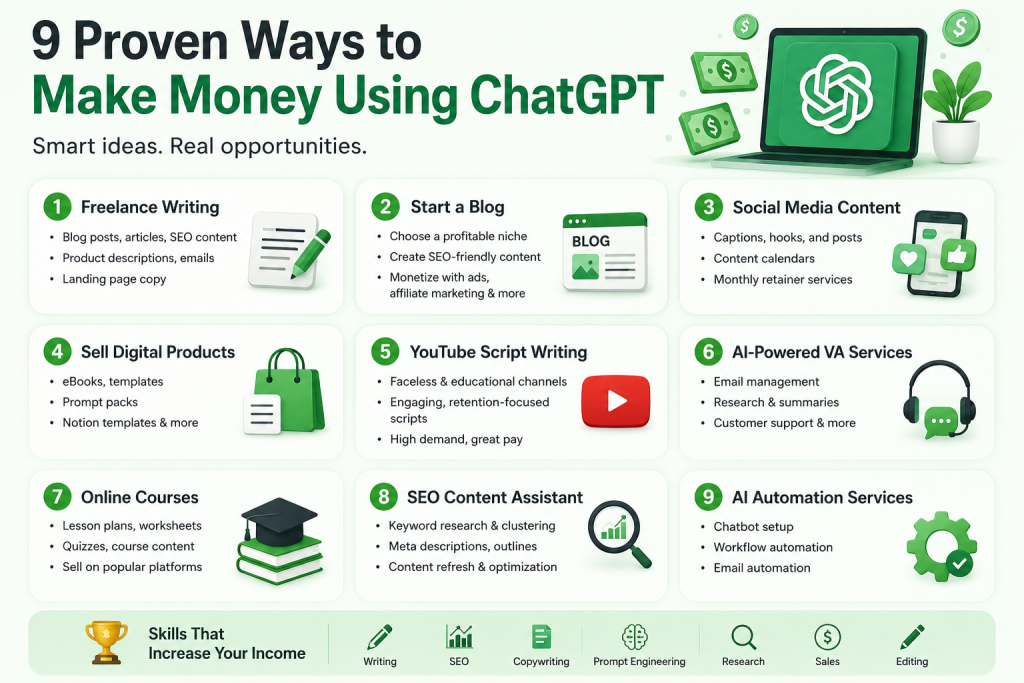
1. Offer Freelance Writing Services
Freelance writing is the most accessible entry point for most people. Businesses constantly need content — blog posts, SEO articles, product descriptions, email sequences, landing page copy — and many of them are already behind on production.
ChatGPT helps you research faster, generate solid first drafts, and handle repetitive formats like product descriptions at scale. The real value you bring is editing, strategic thinking, brand alignment, and knowing what actually works for SEO.
Types of writing work to offer:
- SEO blog posts (typically 1,000–2,500 words)
- Product descriptions for e-commerce
- Email sequences for newsletters or sales funnels
- Landing page copy
- LinkedIn articles and thought leadership pieces
Where to find clients: Start with Upwork and Fiverr for early traction. Once you have samples, cold outreach to SaaS companies, marketing agencies, and e-commerce stores works better and pays significantly more.
Realistic earnings: Beginners typically charge $0.05–$0.10 per word. With experience and a niche, $0.15–$0.30 per word is achievable. Writers running AI-assisted workflows can handle 3–5 articles per week without quality degrading.
2. Start a Blog and Monetize It
Blogging isn’t dead — it’s just more competitive. ChatGPT makes it easier to produce content consistently, which was historically the biggest challenge for solo bloggers.
Niche selection matters more than speed. A blog about “personal finance for freelancers in their 30s” will outperform a generic “make money online” blog every time, because it can actually build a specific audience and rank for specific keywords.
How to use ChatGPT for blogging:
- Generate keyword clusters and content ideas from a seed topic
- Draft outlines based on competitor analysis
- Write first drafts that you edit and improve
- Repurpose posts into social content or email newsletters
Monetization options:
- Display ads (Google AdSense, Mediavine once you hit traffic thresholds)
- Affiliate marketing (promoting products you actually use)
- Digital products sold directly from the blog
- Sponsored content partnerships
Common mistakes: Publishing raw, unedited AI output is the fastest way to build a low-quality site that never ranks. Google’s Helpful Content system penalizes thin, redundant content. The blog posts that rank are the ones that go deeper, add original perspective, and serve the reader — not just the search engine.
3. Create Social Media Content for Businesses
Small and mid-sized businesses need a constant stream of social content and most of them don’t have dedicated staff for it. That’s a gap you can fill.
Using ChatGPT, you can draft captions, write hooks, build out a month’s worth of content calendar entries, and create variations for A/B testing — in a fraction of the time it would take manually.
What clients typically need:
- Instagram and LinkedIn captions
- Short-form content hooks for Reels or TikTok scripts
- Monthly content calendars (30–60 post ideas with suggested formats)
- Email newsletters (some clients bundle this in)
Industries that hire frequently: Real estate, fitness and wellness, legal services, restaurants, e-commerce, and B2B SaaS companies.
Retainer structure: Once you prove value, most clients prefer a monthly retainer. Typical rates range from $500–$2,000/month depending on volume, platform count, and deliverables. With 3–5 retainer clients, this can become a full-time income.
4. Sell Digital Products
Digital products are appealing because you create them once and sell them repeatedly. ChatGPT compresses the creation time dramatically — an ebook that used to take weeks can be drafted, structured, and refined in days.
High-selling digital product types:
- Ebooks and guides on specific, practical topics
- Canva or Notion templates
- Prompt packs (curated collections of effective ChatGPT prompts for specific use cases)
- Swipe files, checklists, and SOPs
- Mini-courses or workbooks
Where to sell:
- Gumroad (low fees, fast setup)
- Etsy (for templates — high organic traffic for digital downloads)
- Payhip
- Your own website once you have an audience
The key with digital products is specificity. “200 ChatGPT prompts for marketers” is more sellable than “the ultimate ChatGPT prompt pack.” Solve a specific problem for a specific person.
5. Write YouTube Scripts
The demand for YouTube scripts is real and growing. Faceless educational channels on topics like finance, health, history, and tech rely entirely on written scripts — and many creators would rather outsource writing than do it themselves.
ChatGPT can generate a solid script structure quickly, but the editing — especially pacing, hooks, retention optimization, and transitions — is where human skill makes the difference. YouTube audiences will click away within 30 seconds if the script doesn’t hold attention.
What to offer:
- Full scripts for 5–15 minute videos
- Hook rewrites and intro optimization
- Batch scriptwriting for channels with a consistent publishing schedule
Finding clients: Check YouTube channels with 10,000–500,000 subscribers that publish consistently. Reach out directly via email or LinkedIn. Channels at this size often have budget but no dedicated writer.
Earning potential: $100–$400 per script is typical depending on length and complexity. A dedicated scriptwriter handling 4–6 scripts per week is earning strong freelance income.
6. Offer AI-Powered Virtual Assistant Services
Traditional VA work — email management, research, scheduling, data entry — is being upgraded with AI. A VA who uses ChatGPT to draft responses, summarize documents, research competitors, or build reports is simply more valuable than one who doesn’t.
Services you can offer with AI assistance:
- Drafting email responses for inboxes you manage
- Summarizing long documents or meeting transcripts
- Research tasks and competitive analysis
- Customer support ticket responses
- CRM data entry and cleanup
Who hires VAs: Founders, executives, consultants, coaches, and agencies. Look for clients on Upwork, LinkedIn, or in online communities for entrepreneurs.
The differentiation here is efficiency. If you can handle tasks that would take a client an hour in 15 minutes, you’re providing real value — and you can justify better rates.
7. Create and Sell Online Courses
If you have expertise in any subject — marketing, design, finance, fitness, cooking, language learning — you can use ChatGPT to build a structured course faster than ever.
ChatGPT is useful for:
- Building course outlines from a topic brain dump
- Writing lesson scripts or transcripts
- Creating quizzes and knowledge checks
- Drafting worksheets, assignments, and templates
- Writing the sales page and email sequence for the launch
Platforms to host your course: Teachable, Podia, and Gumroad are good starting points. Kajabi is better suited for people ready to invest in a full-funnel setup.
The course itself still needs your real expertise and examples. ChatGPT can help you structure and write, but the credibility that makes people buy comes from you.
8. Become an SEO Content Assistant
Agencies and in-house SEO teams often need more hands than they have. As an SEO content assistant, your job is to handle the volume work — outlines, meta descriptions, keyword clustering, content briefs, content refreshes — so strategists can focus on higher-level thinking.
What you can handle using ChatGPT:
- Turning keyword lists into topical clusters
- Writing meta titles and descriptions at scale
- Creating detailed content outlines from briefs
- Identifying gaps in existing content and suggesting improvements
- Reformatting or updating old posts with new information
Basic SEO knowledge required: You don’t need to be an expert, but understanding keyword intent, on-page basics, and what makes content rank will make you significantly more effective and valuable.
This is a strong entry point for people who want to transition into full SEO roles over time.
9. Build Simple AI Automation Services
Businesses are sitting on repetitive workflows that could easily be automated — but most business owners don’t know how to set them up. If you’re comfortable with tools like Zapier, Make (formerly Integromat), or even basic ChatGPT API integrations, you can charge to build these systems.
Common automation projects:
- Custom chatbots for customer support or lead capture
- Email automation sequences triggered by specific actions
- Lead qualification workflows
- Document generation (invoices, reports, summaries) from form inputs
Target clients: Local businesses, e-commerce stores, real estate agents, and coaches. These clients often have budget, visible bottlenecks, and no technical staff.
You don’t need to be a developer. Zapier and Make are no-code tools. Learning them takes days, not months.
Skills That Increase Your Income With ChatGPT
The ceiling on what you can earn grows with your skill stack. The most valuable combinations:
- SEO + writing — Allows you to create content that ranks, not just content that reads well
- Copywriting — Converts readers and helps clients sell. Highly paid and always in demand
- Prompt engineering — The ability to get consistently useful, structured output from AI tools
- Editing — Knowing what to cut, what to rewrite, and what to keep
- Sales — Finding clients and closing them is where most freelancers leave money on the table
- Research — Building original, defensible insights that AI cannot fabricate
You don’t need all of these. Even one skill developed to a professional level, combined with consistent AI-assisted output, puts you ahead of most.
Mistakes to Avoid
Publishing raw AI content. This is the most common mistake and the most damaging. ChatGPT produces generic, safe, averaged content by default. It needs to be edited, sharpened, and grounded in real examples before it’s worth publishing.
Relying fully on AI for accuracy. ChatGPT will confidently state things that are wrong. Any content that involves facts, statistics, or advice in regulated areas (health, finance, legal) needs to be fact-checked against real sources.
Chasing passive income too early. Most people who try to monetize a blog or course without any existing audience or skill spend months with nothing to show for it. Active income first — it builds faster, generates cash flow, and teaches you what the market actually wants.
Poor niche selection. Trying to compete in oversaturated niches as a beginner is a slow path to burnout. Narrow the scope until it feels too specific — then narrow it again. Specificity wins.
Ignoring quality for quantity. Ten mediocre blog posts will not outperform three genuinely useful ones. The same applies to client deliverables. Volume matters eventually, but quality is what builds reputation.
Best Tools to Use Alongside ChatGPT
ChatGPT works best as part of a broader toolkit:
- Canva — Design social graphics, ebook layouts, and digital product templates. Pairs well with any content-based service.
- Notion — Organize client work, build knowledge bases, and create templates you can sell.
- Grammarly — Catch errors and improve readability in edited content before delivery.
- Surfer SEO — Optimize blog posts for on-page SEO, competitive benchmarks, and keyword density.
- Zapier — Automate repetitive workflows between tools — a core skill if you offer automation services.
None of these are required to start. Pick the ones relevant to your chosen monetization method and learn them well.
How Much Money Can You Realistically Make?
Honest answer: it depends heavily on your starting skill level, the service you offer, and how consistently you work.
Beginner (0–6 months): $500–$2,000/month is achievable with active income services like freelance writing or social media content. This range assumes consistent client acquisition effort and quality work delivery.
Intermediate (6–18 months): $3,000–$6,000/month becomes realistic as you build a portfolio, increase rates, and move toward retainer clients or productized services.
Full-time income: Possible, but it requires treating this like a business — not a side project. Writers, consultants, and automation specialists using AI-assisted workflows regularly earn $5,000–$15,000/month once they have a client base and a refined service offering.
Digital products and blogs take longer to generate meaningful income but can supplement or replace active income over 12–24 months of consistent effort.
FAQ
Do I need any experience to make money with ChatGPT?
No prior AI experience is required, but some foundational skill in writing, marketing, or tech will significantly speed up your results. If you have no background in any professional service, expect a learning curve.
Is making money with ChatGPT legal?
Yes. Using AI tools to assist with professional services, content creation, or product development is entirely legal. If you’re writing for clients, be transparent about your process where contracts or platform policies require it.
Can beginners realistically earn money using ChatGPT?
Yes — especially through freelance writing and social media management, which have lower barriers to entry. The key is starting with one service, building samples, and landing early clients before trying to scale.
How is freelancing with ChatGPT different from regular freelancing?
The core skills and client relationships are the same. What changes is output speed and capacity. A writer using ChatGPT can produce more polished drafts per day than one working from scratch. The quality ceiling is still determined by human editing and judgment.
Do I need to disclose that I used AI to create content?
Policies vary by platform and client. Some clients explicitly allow AI assistance; others prohibit it in contracts. When in doubt, ask upfront. Transparency builds trust and avoids disputes.
Will AI tools like ChatGPT replace freelancers?
Not in any near-term scenario that’s playing out right now. What’s happening is that AI is replacing the slow, manual parts of freelance work — not the judgment, creativity, client communication, or strategic thinking. Freelancers who adapt will become more valuable, not less.
What’s the best service to start with if I have zero clients?
Freelance writing is the lowest barrier entry point — start with blog posts or product descriptions, build 3–5 samples using your own published work or spec pieces, and list on Upwork or Fiverr. Social media content management is a close second.
Do I need a paid version of ChatGPT?
For serious work, yes. ChatGPT Plus (or access to GPT-4 level models) produces noticeably better output than the free tier. The cost is worth it once you’re earning from the work.
Conclusion
Every method covered in this article works. None of them work overnight, and none of them work without effort on your end.
The most common mistake people make is reading lists like this one and trying to do three or four things at once. Pick one method that matches your existing skills, spend 60–90 days executing it properly, and build from there.
The fundamentals haven’t changed: clients pay for quality and reliability, audiences engage with content that’s genuinely useful, and income follows from consistently delivering real value. ChatGPT compresses the time it takes to do that — but it doesn’t change what “that” is.