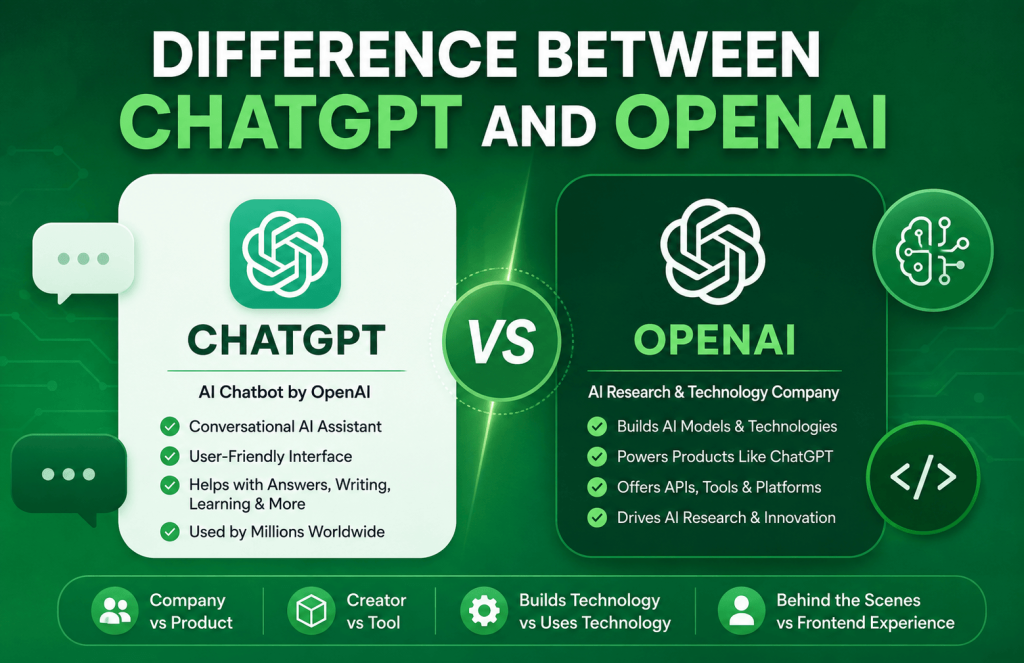
If you’ve ever typed a question into ChatGPT and wondered, “Wait — is this OpenAI?” you’re not alone. Most people use these two names interchangeably. But ChatGPT and OpenAI are not the same thing — they’re closely related, but they play very different roles.
The simplest way to put it: OpenAI is the company. ChatGPT is one of its products. Think of it like Google and Gmail — Google built Gmail, but Gmail isn’t Google.
This article breaks down exactly what each one is, how they’re connected, and which one you should actually be using depending on your needs.
What Is OpenAI?
OpenAI is an artificial intelligence research and technology company. Founded in 2015, its core mission is to build AI systems that are safe and beneficial for humanity.
OpenAI is responsible for researching, developing, and deploying AI technologies. It doesn’t just build chatbots — it builds the underlying models, infrastructure, and tools that power a wide range of AI applications.
What OpenAI does:
- Researches and develops large language models (LLMs)
- Builds APIs that let developers integrate AI into their own products
- Creates AI tools for text, images, voice, and code
- Sets safety and policy standards around AI development
ChatGPT is just one of the many things OpenAI has built. OpenAI is the engine room; ChatGPT is one of the vehicles.
What Is ChatGPT?
ChatGPT is a conversational AI assistant created by OpenAI. It was launched in November 2022 and quickly became one of the fastest-growing consumer applications in history.
You interact with ChatGPT through a chat interface — you type a message, it responds. It can answer questions, write content, summarize documents, generate code, translate languages, brainstorm ideas, and much more.
What you can do with ChatGPT:
- Get answers to questions in plain, easy-to-understand language
- Write emails, essays, reports, and social media posts
- Debug and write code
- Translate text between languages
- Summarize long articles or documents
- Brainstorm ideas and get creative suggestions
ChatGPT is powered by OpenAI’s GPT models (like GPT-4o), but the app itself — the interface, the user experience, the conversation flow — is ChatGPT.
Difference Between ChatGPT and OpenAI at a Glance
| Feature | OpenAI | ChatGPT |
|---|---|---|
| What it is | An AI research company | A conversational AI product |
| Type | Organization | Application / tool |
| Purpose | Build and research AI systems | Help users via conversation |
| Who uses it | Researchers, developers, businesses | General users, professionals |
| Examples | GPT-4o, DALL·E, Whisper, Sora | Chat interface at chat.openai.com |
| Ownership | Independent company (with Microsoft investment) | Owned and operated by OpenAI |
| Relationship | Creator | Product |
ChatGPT lives inside OpenAI the way a car lives inside an automaker. You drive the car; you don’t drive the factory.
Is ChatGPT the Same as OpenAI?
No — but it’s easy to see why people think so.
ChatGPT became so popular so fast that many people encountered OpenAI’s technology through ChatGPT first. So when they hear “OpenAI,” they picture the chatbot. But OpenAI is the organization behind the chatbot — not the chatbot itself.
Why the confusion happens:
- ChatGPT was one of the first major AI products most people used
- The OpenAI brand is featured prominently inside ChatGPT
- Both names appear together constantly in news and media
Real-world analogies that make it click:
| Company | Product | Analogy |
|---|---|---|
| Gmail | Google made Gmail, but Gmail ≠ Google | |
| Microsoft | Word | Microsoft built Word, but Word ≠ Microsoft |
| Adobe | Photoshop | Adobe made Photoshop, but they’re different things |
| OpenAI | ChatGPT | OpenAI made ChatGPT, but ChatGPT ≠ OpenAI |
Once you see it through this lens, the distinction becomes obvious. OpenAI is the company. ChatGPT is the product.
How ChatGPT and OpenAI Work Together
OpenAI Builds the Technology
OpenAI does the heavy lifting behind the scenes. Its research teams train large language models on massive datasets, develop safety techniques, and build the computational infrastructure needed to run AI at scale.
When OpenAI releases a new model — like GPT-4o — it becomes available as an API (a programming interface) that developers and products can use. ChatGPT uses these models to power its conversations.
OpenAI also manages:
- Model research and safety testing
- Policy decisions around how AI can be used
- Developer tools and documentation
ChatGPT Delivers the User Experience
ChatGPT takes the raw power of OpenAI’s models and wraps it in a clean, accessible interface. It’s the layer between the AI model and the person using it.
When you open ChatGPT and start typing, ChatGPT sends your message to an OpenAI model, gets a response, and displays it back to you in a conversational format. ChatGPT also handles features like memory, custom instructions, file uploads, image generation, and plugins.
In short: OpenAI builds the brain. ChatGPT is the face.
What Other Products Does OpenAI Offer?
ChatGPT is OpenAI’s most recognized product, but it’s far from the only one.
Other notable OpenAI products and technologies:
- GPT models — The underlying language models (GPT-3.5, GPT-4, GPT-4o) that power ChatGPT and many third-party applications
- OpenAI API — Lets developers build their own AI-powered apps using OpenAI’s models
- DALL·E — An AI model that generates images from text descriptions
- Whisper — An AI model for transcribing and translating spoken audio
- Sora — OpenAI’s text-to-video AI model
- Codex — An AI model for understanding and writing code (now integrated into GPT-4)
- OpenAI Playground — A developer tool for experimenting with AI models directly
All of these come from OpenAI. ChatGPT is just one of many ways the company makes its technology accessible.
Who Owns ChatGPT?
ChatGPT is owned by OpenAI. It was created, developed, and is operated entirely by OpenAI.
OpenAI itself is a “capped-profit” company, meaning it operates under a non-profit parent organization but allows limited investment returns. Microsoft has made significant investments in OpenAI and has integrated OpenAI’s technology into its own products (like Microsoft Copilot and Azure OpenAI Service) — but that doesn’t make Microsoft the owner of ChatGPT.
Key ownership facts:
- ChatGPT is a product of OpenAI
- OpenAI controls ChatGPT’s development and policies
- Microsoft is an investor and partner, not the owner
- No individual person “owns” ChatGPT
So if someone asks “who owns ChatGPT?” — the answer is OpenAI.
Should You Use ChatGPT or OpenAI?
This depends on what you’re trying to do. Here’s a quick guide:
For Everyday Users
If you want to have conversations with AI, get writing help, answer questions, or explore what AI can do — ChatGPT is what you want. Just go to chat.openai.com, create a free account, and start chatting.
You don’t need to understand OpenAI’s technology to use ChatGPT effectively.
For Developers
If you want to build AI-powered applications, integrate AI into a website or app, or run custom AI models — you want the OpenAI API. This gives you programmatic access to GPT-4o, DALL·E, Whisper, and other models.
Visit platform.openai.com to access developer tools, documentation, and usage-based pricing.
For Businesses
If you’re a business looking to integrate AI into your workflows or customer experience, you have two main options:
- ChatGPT Enterprise — A version of ChatGPT built for business use with stronger privacy controls and higher usage limits
- OpenAI API — For custom integrations and building your own AI-powered tools
The right choice depends on how much customization your team needs.
Common Misconceptions About ChatGPT and OpenAI
Myth: ChatGPT is a company. ChatGPT is not a company — it’s a product. OpenAI is the company.
Myth: OpenAI is a chatbot. OpenAI is an AI research organization. It doesn’t talk to you. ChatGPT does.
Myth: ChatGPT and OpenAI are competitors. They’re not competing — they’re the same organization. OpenAI built ChatGPT.
Myth: ChatGPT operates independently. ChatGPT is fully owned and managed by OpenAI. Every policy, update, and capability decision comes from OpenAI.
Myth: Using ChatGPT means you’re using “OpenAI.” Technically, yes — ChatGPT runs on OpenAI’s technology. But “using OpenAI” more specifically refers to accessing the API or developer platform directly.
Frequently Asked Questions
What is the difference between ChatGPT and OpenAI?
OpenAI is an AI research company. ChatGPT is one of the products OpenAI has built. OpenAI creates the AI technology; ChatGPT is the conversational interface that makes that technology accessible to everyday users.
Is ChatGPT owned by OpenAI?
Yes. ChatGPT is entirely owned and operated by OpenAI. Microsoft is an investor in OpenAI but does not own ChatGPT.
Is OpenAI a chatbot?
No. OpenAI is a company, not a chatbot. It develops AI research, models, and products — including ChatGPT, which is the chatbot.
Can I use OpenAI without ChatGPT?
Yes. Developers can access OpenAI’s models directly through the OpenAI API without ever using the ChatGPT interface. The API gives more control and flexibility for building custom applications.
Why do people confuse ChatGPT and OpenAI?
ChatGPT was the first AI product many people encountered, and the OpenAI name appears prominently within the app. This close association — plus heavy media coverage linking both names — leads many people to treat them as interchangeable.
Conclusion
OpenAI and ChatGPT are not the same thing — but they are inseparable. OpenAI is the company that does the research, builds the models, and sets the direction for AI development. ChatGPT is the product that brings OpenAI’s technology to life in a way millions of people can use every day.
The easiest way to remember it: OpenAI = company. ChatGPT = product.
If you want to chat with AI, use ChatGPT. If you want to build with AI, explore the OpenAI platform. Either way, you’re tapping into the same powerful technology — just through different doors.