ChatGPT has quietly become one of the most useful tools millions of people rely on every single day. Whether you are a student trying to get through a tough subject, a professional racing against deadlines, or someone who just wants to plan a better week — ChatGPT can genuinely help.
But most people only scratch the surface. They ask it a quick question and move on. The truth is, ChatGPT is capable of far more than that.
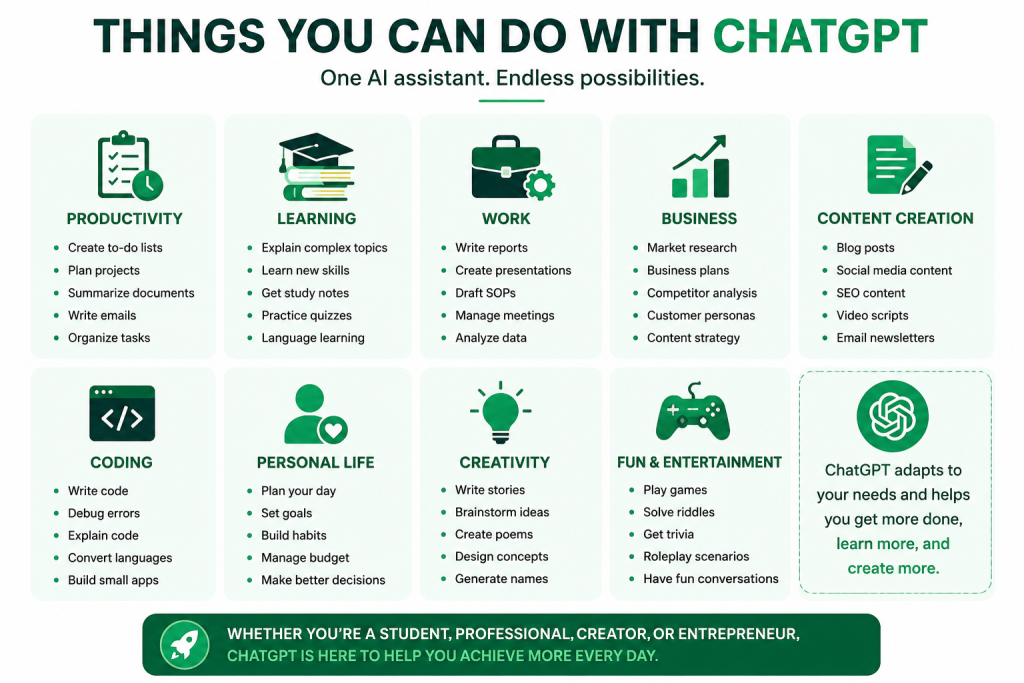
This guide covers 101 practical, real-world things you can do with ChatGPT across productivity, learning, work, business, creativity, and everyday life. Everything here is actionable. No fluff, no filler.
What Can ChatGPT Actually Do?
Before diving into examples, it helps to understand what ChatGPT is capable of at a high level.
ChatGPT can:
- Answer questions — from factual lookups to nuanced explanations
- Generate content — articles, emails, scripts, social posts, and more
- Solve problems — help you think through challenges, decisions, and plans
- Assist with learning — explain concepts, quiz you, and create study materials
- Automate repetitive tasks — templates, outlines, summaries, rewrites
Think of it as a highly capable assistant that is always available, never impatient, and endlessly adaptable. The better your prompts, the better your results.
Things You Can Do With ChatGPT for Productivity
If you feel overwhelmed by tasks and to-dos, ChatGPT can help you get organized fast.
- Create a daily to-do list — give it your goals and let it prioritize them
- Build a project plan — break any project into phases, milestones, and tasks
- Summarize long documents — paste in text and ask for a concise summary
- Write meeting notes — describe what was discussed and get clean notes
- Draft a weekly schedule — tell it your commitments and it builds the plan
- Create SOPs (Standard Operating Procedures) — useful for team workflows
- Write email templates — for recurring situations like follow-ups or requests
- Set up a task prioritization system — using frameworks like Eisenhower Matrix
- Create checklists for any process — onboarding, launches, travel, and more
- Turn messy notes into structured summaries
- Write professional Slack or Teams messages quickly
- Automate repetitive writing tasks by creating reusable prompt templates
- Create a habit tracker plan with accountability questions
- Outline a decision-making framework for a tough choice you are facing
- Summarize a lengthy email thread to catch up fast
Quick prompt: “I have these 10 tasks for today: [list]. Prioritize them by urgency and importance and create a schedule for an 8-hour workday.”
Things You Can Do With ChatGPT for Learning
ChatGPT is one of the most powerful self-learning tools ever created. You have a patient tutor available 24/7.
- Learn a new programming language — ask it to explain concepts and give examples
- Study for exams — have it quiz you with practice questions
- Understand complex topics — ask it to explain anything “like I’m 12”
- Create a custom study plan — give it your timeline and goals
- Translate and learn a foreign language — practice vocabulary and grammar
- Get explanations with analogies — for abstract or technical ideas
- Summarize academic papers or textbooks
- Generate flashcard-style Q&A for memorization
- Ask for a breakdown of historical events, scientific theories, or philosophies
- Learn about a topic from multiple perspectives
- Practice conversational English or any language
- Get explanations of legal, financial, or medical concepts in plain language
- Ask it to act as a tutor and walk you through a problem step by step
- Request further reading recommendations on any subject
- Create mock exams for certification prep
Quick prompt: “I am studying for a Python coding interview in 2 weeks. Create a 14-day study plan covering the most important concepts, with daily goals and practice exercises.”
Things You Can Do With ChatGPT for Work
ChatGPT fits seamlessly into almost any professional role. Here are ideas across different functions.
Marketing
- Write ad copy for Google, Meta, or LinkedIn campaigns
- Create a content calendar for a month
- Draft a brand positioning statement
- Write landing page copy
Sales
- Write cold outreach emails that convert
- Create a sales script for calls or demos
- Draft follow-up sequences
- Build objection-handling responses
Customer Support
- Write FAQ pages
- Draft response templates for common customer queries
- Create escalation scripts
HR & Operations
- Write job descriptions
- Create interview question banks
- Draft onboarding documents
- Write performance review templates
Management
- Summarize team reports
- Draft internal announcements
- Prepare presentation outlines
- Write agendas for meetings
Quick prompt: “Write a professional cold outreach email for a SaaS company targeting small business owners. The email should be under 150 words, focus on saving time, and include a soft CTA.”
Things You Can Do With ChatGPT for Business
Whether you are launching a startup or scaling an existing business, ChatGPT can accelerate your thinking.
- Write a business plan outline — with sections for market, product, financials, and team
- Conduct market research questions — build survey frameworks and interview guides
- Identify startup ideas for a specific niche or skill set you have
- Create customer personas — detailed profiles of your ideal buyers
- Do a basic SWOT analysis — give it your business details and ask
- Analyze competitors — ask for a framework to evaluate competitor strengths and gaps
- Create a go-to-market strategy outline
- Write investor pitch deck bullet points
- Draft partnership outreach emails
- Create a pricing strategy based on your product and market
- Generate taglines or brand names for a product or service
- Build a content marketing strategy framework
- Write terms and conditions or privacy policy drafts (always verify with a lawyer)
- Create a launch checklist for a new product or service
- Brainstorm revenue stream ideas for your business model
Quick prompt: “I am starting a freelance graphic design business targeting e-commerce brands. Create a go-to-market strategy with the top 5 channels I should use, my unique value proposition, and a 90-day action plan.”
Things You Can Do With ChatGPT for Content Creation
Content creators get enormous value from ChatGPT as a daily writing partner.
- Generate blog post ideas — give it your niche and audience, get dozens of angles
- Write full article outlines with H2s, H3s, and key points
- Draft blog introductions that hook readers immediately
- Rewrite weak sentences to improve clarity or punch
- Optimize content for SEO — ask for keyword suggestions and meta descriptions
- Write YouTube video scripts — intro, main content, and CTA included
- Create social media captions for Instagram, LinkedIn, X, or TikTok
- Write compelling email subject lines and email newsletters
- Repurpose a blog post into a LinkedIn post, tweet thread, and email
- Write product descriptions for e-commerce listings
- Create lead magnet content — checklists, guides, and mini eBooks
- Draft podcast show notes and episode descriptions
- Write video titles and thumbnail text ideas
- Build a content repurposing plan from a single long-form piece
- Generate headline variations to A/B test
Quick prompt: “I wrote a 1,500-word blog post about productivity tips for remote workers. Repurpose it into: 1) a LinkedIn post under 300 words, 2) a 5-tweet thread, and 3) an email newsletter under 200 words.”
Things You Can Do With ChatGPT for Coding
Developers and non-developers alike can use ChatGPT to build, fix, and understand code.
- Debug code — paste your code and describe the error, it finds the fix
- Explain what a piece of code does in plain English
- Generate boilerplate code for projects in any language
- Write functions for specific tasks — sorting, filtering, API calls
- Create regex patterns for text parsing
- Convert code from one language to another — Python to JavaScript, etc.
- Learn programming concepts with simple explanations and examples
- Write SQL queries — just describe what data you need
- Create a small web scraper or automation script
- Write unit tests for existing functions
- Set up file structures for new projects
- Get code review feedback on readability and best practices
- Build simple web pages with HTML, CSS, and JavaScript
- Create data visualizations with chart.js or Python matplotlib
- Understand error messages and get step-by-step fix instructions
Quick prompt: “I am getting this Python error: [paste error]. Here is my code: [paste code]. Explain what is causing the error and give me the corrected version with comments explaining what you changed.”
Things You Can Do With ChatGPT for Personal Life
ChatGPT is just as useful at home as it is at work.
- Plan weekly meals — give it your dietary needs and it builds a full menu
- Create a grocery list based on your meal plan
- Plan a trip — itineraries, packing lists, local recommendations
- Set financial goals and get a basic budgeting framework
- Create a workout plan tailored to your fitness level and schedule
- Build a morning routine designed around your goals
- Write a personal journal prompt to reflect on your day
- Get advice on difficult conversations — it helps you plan what to say
- Create a reading list on topics you want to explore
- Plan a birthday party, event, or celebration
- Write a personal bio for social profiles or websites
- Get help with gift ideas for specific people and occasions
- Create a home decluttering plan room by room
- Draft a personal mission statement
- Build a 30-day challenge for any habit you want to build
Quick prompt: “Create a 4-week beginner workout plan for someone with no gym equipment who can exercise 30 minutes a day, 5 days a week. Include warm-up, exercises with sets/reps, and cool-down.”
Creative Things You Can Do With ChatGPT
ChatGPT is a powerful creative partner for writers, artists, and idea generators.
- Write short stories — give it a genre, characters, and setting
- Generate poetry in any style — haiku, sonnet, free verse
- Brainstorm ideas for any creative project
- Invent brand names for businesses, products, or projects
- Create fictional world-building details for novels or games
- Write dialogue between characters
- Generate creative writing prompts to beat writer’s block
- Develop a video series concept with episode ideas
- Create game concepts — rules, storylines, and mechanics
- Write song lyrics in a specific style or mood
- Develop a children’s story with a moral or theme
- Create a script for a short film or YouTube video
- Brainstorm metaphors and analogies for complex ideas
- Develop plot twists for your story
- Generate art prompt descriptions for AI image tools
Quick prompt: “Write a 500-word short story about a time traveler who can only go back 10 minutes into the past. Make it suspenseful with an unexpected ending.”
Fun Things You Can Do With ChatGPT
Not everything has to be productive. ChatGPT is also genuinely entertaining.
- Play trivia — ask it to quiz you on any topic
- Solve riddles and brain teasers — or ask it to create hard ones
- Roleplay as a historical figure and interview them
- Debate a topic — take opposing sides and argue it out
- Create a fictional universe and explore it together
- Ask it to write a roast about your profession or habits
- Play 20 questions — it guesses what you are thinking
- Request a “What type of person are you?” quiz on any theme
- Build a choose-your-own-adventure story
- Ask it to write a funny parody of a famous speech or song
- Test your knowledge with a mock pub quiz
- Have it describe your personality based on your answers to 5 questions
- Get it to improvise a stand-up comedy set on a topic you choose
- Create a fictional newspaper front page for a made-up event
- Ask it to write the plot of a movie in the style of your favorite director
Best ChatGPT Prompts to Get Started
Productivity
Prompt: “I have the following goals this week: [list goals]. Create a day-by-day schedule that balances deep work, meetings, and personal time. I work 9am–6pm.”
Why it works: It forces prioritization and gives you a plan you can actually follow.
Customize it: Add specific constraints like school pickups, gym time, or team calls.
Learning
Prompt: “Explain [topic] to me as if I have no background in it. Use a real-world analogy and then give me 5 questions to test my understanding.”
Why it works: It combines explanation with active recall — the most effective learning method.
Customize it: Replace [topic] with anything from quantum computing to content marketing.
Business
Prompt: “I am building a [type of business] targeting [audience]. Identify the top 3 competitors, what they do well, where they fall short, and what gap I could fill.”
Why it works: It structures competitive thinking without requiring expensive research tools.
Customize it: Be specific about geography, price point, or business model.
Content Creation
Prompt: “Write 10 blog post title ideas for [niche] that would rank on Google, appeal to [audience], and have low competition. Format them as click-worthy headlines.”
Why it works: It combines SEO thinking with audience psychology.
Customize it: Add tone preferences — professional, funny, provocative, etc.
Personal Development
Prompt: “I want to build the habit of [habit] in the next 30 days. Create a realistic plan with daily actions, weekly check-ins, and a way to measure my progress.”
Why it works: It breaks a vague goal into a concrete, trackable system.
Customize it: Add obstacles you typically face to get a more personalized plan.
Tips for Getting Better Results From ChatGPT
Give More Context
The more ChatGPT knows about your situation, the better its response. Instead of “write an email,” try “write a follow-up email to a potential client who attended my webinar last week but hasn’t responded to my first outreach.”
Be Specific
Vague prompts produce vague results. Specify tone, length, format, audience, and goal in your prompt whenever possible.
Ask Follow-Up Questions
ChatGPT’s first answer is rarely its best. Reply with:
- “Make this more concise”
- “Give me a more formal version”
- “Add three more examples”
- “Rewrite the intro to be more engaging”
Request a Format
Tell ChatGPT exactly how you want the output structured:
- “Give me this as a table”
- “Format this as a numbered list”
- “Write this as an action plan with deadlines”
- “Present this as a template I can reuse”
Limitations of ChatGPT
ChatGPT is powerful, but it is not perfect. Knowing its limits makes you a smarter user.
- Accuracy issues — it can confidently state incorrect information. Always verify facts, statistics, and legal or medical claims.
- Knowledge cutoff — it does not have real-time information unless connected to the web. News, prices, and current events may be outdated.
- No personal knowledge — it does not know you, your business, or your specific context unless you tell it each time.
- Human judgment is still required — especially for sensitive decisions, creative direction, and anything that needs empathy or lived experience.
- Hallucinations — it may fabricate sources, names, or details. Do not cite ChatGPT output without independent verification.
Use it as a powerful starting point — not a final authority.
Frequently Asked Questions
What are the best things to do with ChatGPT?
The best use cases depend on your needs, but the highest-value applications include writing and editing content, summarizing documents, learning new skills, coding assistance, brainstorming ideas, and building plans and templates. Most users find the biggest gains in tasks that are repetitive or require a structured first draft.
What can ChatGPT help with?
ChatGPT can help with almost any text-based task — writing, research, planning, analysis, coding, creative work, and learning. It works across industries and roles, from marketing professionals to students to developers to small business owners.
Can ChatGPT improve productivity?
Yes, significantly. It reduces the time spent on drafting emails, creating documents, planning projects, and searching for information. Users who build prompt workflows report saving several hours per week on routine tasks.
Is ChatGPT useful for business?
Absolutely. Businesses use it for market research, content creation, customer communication, HR documentation, sales scripts, and strategic planning. It is particularly valuable for small teams that need to do more with limited resources.
What are some fun things to do with ChatGPT?
ChatGPT is great for trivia games, storytelling, roleplay, creative writing, debates, and generating humor. It can write comedy, build fictional worlds, quiz you on obscure topics, and improvise elaborate scenarios — making it as entertaining as it is useful.
Conclusion
ChatGPT is one of the most versatile tools available today — and most people are only using a fraction of what it can do.
From boosting productivity and accelerating learning, to building businesses and creating content, the 101 use cases in this guide are just the beginning. The real power comes when you start combining these ideas into workflows that save you time, sharpen your thinking, and unlock new possibilities.
The key takeaway: better prompts lead to dramatically better results. Be specific, give context, and always push for a follow-up if the first response misses the mark.
Start with one section that matters most to you right now. Try the prompts. Experiment. Iterate. ChatGPT rewards curiosity — and the more you explore, the more useful it becomes.