Ask ten people who owns AI and you’ll get ten different answers. Some will say OpenAI. Others will say Google, or Microsoft, or “the government,” or only half-jokingly “whoever has the most GPUs.” All of them are a little bit right, and all of them are missing the bigger picture.
Here’s the uncomfortable truth: nobody owns AI. Not in the way you own a car, or a company owns a patent, or a publisher owns a book. AI isn’t a single thing with a single owner. It’s a stack — layers of infrastructure, research, code, data, and deployment and different players own different pieces of that stack. Some of those pieces are fiercely protected. Others are given away for free. Understanding who controls what is far more useful than looking for one name on a deed.
This article breaks down exactly who owns each layer of modern AI, why the ownership structure is messier than most explainers admit, and what it actually means for you if you use, build on, or worry about AI.
Why “Who Owns AI” Is the Wrong First Question
Before getting into names and companies, it helps to separate two very different questions people usually blend together:
Who owns the technology behind AI?
Who controls how AI gets used?
These aren’t the same thing. Nvidia doesn’t “own AI,” but it makes the chips almost every major model runs on. OpenAI doesn’t own the concept of a transformer model — that came from a 2017 Google research paper — but it owns the specific weights, code, and business built on top of that idea. Meta gives away some of its most powerful models for free, yet still tightly controls the terms under which you’re allowed to use them commercially.
Ownership in AI is fragmented on purpose. That fragmentation is actually the most important thing to understand about the entire industry.
The Five Layers of AI Ownership
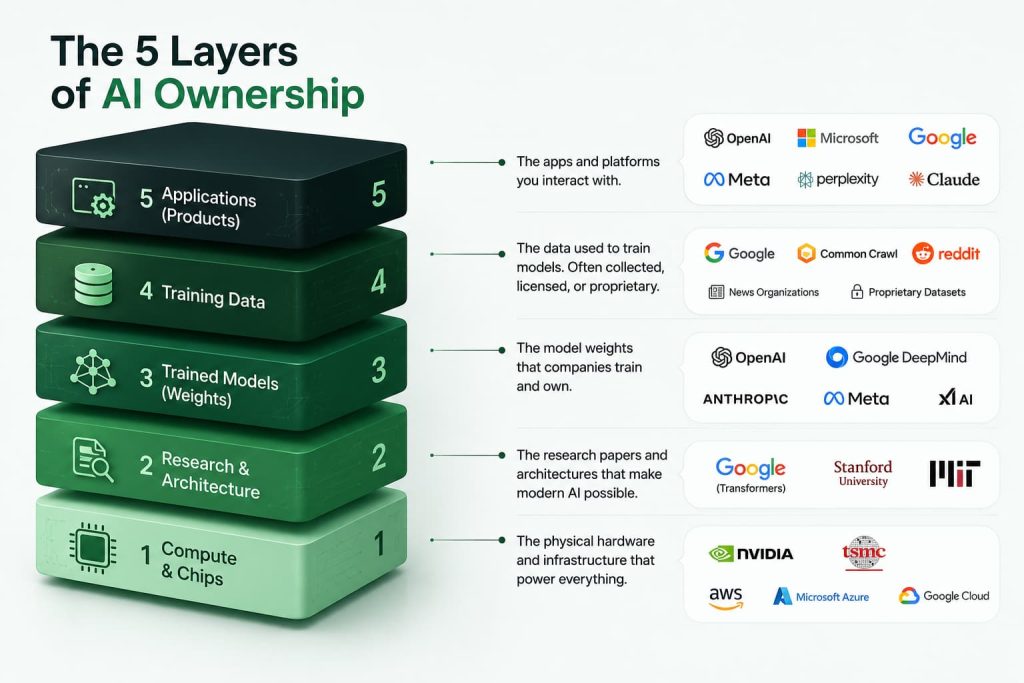
I’ve found it easier to think about AI ownership as a stack of five layers, from the physical hardware at the bottom to the app you interact with at the top.
1. Compute and Chips
Nothing in modern AI happens without massive computing power, and that layer is dominated by a small number of players.
Nvidia designs the GPUs that train and run the vast majority of large AI models. It doesn’t manufacture the chips itself — that’s largely TSMC in Taiwan — but Nvidia’s chip architecture and software ecosystem (CUDA) give it an enormous grip on who can train competitive models at all.
Cloud providers own the data centers where that compute lives. Microsoft Azure, Amazon Web Services, and Google Cloud each run enormous fleets of AI-specific hardware, and increasingly they’re designing their own custom chips too, partly to reduce dependence on Nvidia.
What many people overlook is that this layer is arguably the biggest bottleneck in the entire industry right now — not talent, not data, but access to enough chips and enough electricity to run them.
2. The Underlying Research and Model Architecture
The mathematical ideas that make modern AI possible — transformers, attention mechanisms, diffusion models — aren’t owned by anyone. They’re published research, mostly free to read, and mostly came out of universities and corporate research labs that chose to publish rather than patent.
This is one of the stranger facts about the AI boom: the foundational breakthrough behind ChatGPT, Gemini, Claude, and nearly every other major model — the transformer architecture — was published openly by Google researchers in 2017 and is not owned by anyone in any exclusive sense. Google benefited from being first, but it didn’t lock the idea away.
That openness is exactly why a handful of well-funded labs were able to build competing models so quickly. The idea was free. What wasn’t free was everything needed to turn that idea into a product.
3. Trained Models (The Weights)
This is where real ownership starts to matter. A trained AI model is essentially a massive file of numbers — the “weights” — produced by feeding an architecture enormous amounts of data and computing power over weeks or months.
This is the layer companies actually own and protect.
- OpenAI owns GPT’s weights and licenses access to Microsoft, its largest investor and infrastructure partner.
- Google DeepMind owns Gemini and controls it end-to-end, since Google also owns the infrastructure it runs on.
- Anthropic owns Claude’s weights and trains its models with Amazon and Google as major investors and cloud partners.
- Meta trains the Llama family and — unusually — releases the weights publicly under its own license, letting anyone download and run the model.
- xAI owns Grok, built and trained largely on X’s infrastructure and data.
Ownership at this layer isn’t just about pride of authorship. It determines who can legally sell access to the model, who can fine-tune it, and who’s liable when it produces something harmful or wrong.
One distinction trips people up constantly: releasing a model’s weights isn’t the same as putting it in the public domain. Meta calls Llama “open,” but its license restricts certain commercial uses. That’s not open source in the traditional software sense — it’s closer to a very generous but conditional license. Genuinely open-source models, like those from Mistral or various academic labs, come with fewer strings attached.
4. Training Data
Here’s where ownership gets genuinely contentious, and where lawsuits are actively being fought right now.
AI models are trained on enormous datasets scraped from the public internet — books, articles, images, code, forum posts. Almost none of that data was created by the companies training on it. The New York Times is suing OpenAI and Microsoft over this exact issue. Getty Images sued Stability AI. Authors, musicians, and visual artists have filed similar suits against multiple labs.
The legal question at the center of all of it: does training an AI model on copyrighted material count as fair use, or is it infringement? Courts in the US and elsewhere are still working this out, and the answer may end up different depending on the country, the type of content, and how the output is eventually used.
What’s clear already is this: the people who created the training data rarely have any ownership stake in the resulting model. A novelist whose books helped train GPT doesn’t own any part of GPT. That imbalance — visible, deeply felt, and legally unresolved — is the single biggest ownership controversy in AI today, more than who owns OpenAI’s board seats.
5. The Application Layer
The last layer is the one most people actually interact with: the chat interface, the app, the API wrapper. This layer is far more crowded and far less consolidated than people assume.
Thousands of companies build products on top of models they don’t own at all. A customer service startup might use Claude’s API, a coding tool might use GPT-4, a design app might use a Stability AI image model — none of them own the underlying intelligence, but they own the product experience wrapped around it.
This is actually the layer where ownership is most democratized. You don’t need to train a foundation model to build a valuable AI business. You need a good idea, a smart integration, and an API key.
Who Actually Owns the Big AI Companies?
Pull back the technical layers and there’s still a simpler, more familiar version of the ownership question: who owns the companies themselves?
OpenAI has an unusual structure. It started as a nonprofit, restructured into a “capped-profit” company, and now operates with a for-profit arm controlled by that nonprofit’s mission-focused board, with Microsoft holding a large minority stake through its investment rather than traditional equity ownership in the early years.
Google DeepMind is fully owned by Alphabet, Google’s parent company, after merging with Google Brain in 2023.
Anthropic is an independent public benefit corporation, with major investment from Google and Amazon, though both act primarily as investors and cloud partners rather than owners with operational control.
Meta AI is simply a division of Meta, owned entirely by the publicly traded company Mark Zuckerberg controls through majority voting shares.
xAI is privately owned by Elon Musk, and merged with X (formerly Twitter) in 2025, consolidating ownership under one umbrella.
None of these ownership structures is a monopoly in the traditional sense. But they do reveal a pattern: AI at the frontier level requires such enormous capital that only a handful of organizations — mostly backed by trillion-dollar tech companies — can compete at all. That’s a very different kind of concentration than “one company owns AI.” It’s closer to an oligopoly of capital.
Common Misconceptions About AI Ownership
“The government owns AI.” Not directly, in most countries. Governments regulate AI, fund some research, and increasingly invest in “sovereign AI” infrastructure — but the leading models are privately owned. That said, national security concerns around AI chips and models are pushing governments toward more direct involvement than they’ve had in most other tech sectors.
“If a model is open source, it belongs to everyone.” Not quite. Open-weight models let you download and run them, but the license terms still matter enormously, and the company that trained the model usually retains rights over how it’s branded, and sometimes how it’s used commercially at scale.
“Whoever pays for ChatGPT owns the AI.” No — a subscription buys you access to use the product, not any ownership of the underlying model, code, or infrastructure. This confuses a lot of people who are used to thinking of software purchases as ownership rather than licensed access.
“AI companies own everything their models produce.” This one’s murkier than most people assume. In several jurisdictions, purely AI-generated output without meaningful human authorship may not be copyrightable at all — meaning nobody owns it in the traditional sense. Ownership of AI-assisted output generally depends on how much human creative input shaped the final result.
What This Actually Means for You
If you’re building a business on top of AI, the practical takeaway is this: you don’t need to own a model to build something valuable, but you do need to understand exactly what you’re licensing and what you’re not. Read the terms of service. Know whether the model you’re using is open-weight or fully closed, because that affects your flexibility if the provider changes pricing or shuts off access.
If you’re a writer, artist, or creator worried about your work training these systems, the honest answer is that the legal landscape is still being written in real time, through court cases that will take years to resolve. Opt-out tools exist from some providers, though their effectiveness varies.
And if you’re just trying to make sense of the news, the most useful mental model is the one this article laid out: AI isn’t a single thing owned by a single entity. It’s a stack, and ownership shifts depending on which layer you’re looking at — chips, research, model weights, training data, or the app on your phone.
The Bottom Line
Nobody owns AI the way someone owns a house or a car. What exists instead is a tightly held set of very expensive, very specific pieces — chips, trained models, cloud infrastructure — controlled by a small number of companies with the capital to compete at the frontier, sitting on top of research and ideas that, ironically, were mostly given away for free.
The next time someone tells you a single company “owns AI,” the more accurate response is to ask: which layer are you talking about? Because the honest answer changes depending on where you look — and that’s exactly what makes this moment in technology so strange, and worth paying attention to.