Want a personalized workout plan without paying for a personal trainer? ChatGPT can help. But only if you know how to ask. The right chatgpt workout plan prompt makes the difference between a generic, useless routine and a detailed, personalized fitness plan that actually works.
This guide gives you everything: the best prompts, proven frameworks, expert tips, and real copy-paste examples. Whether you’re a gym beginner, a busy professional, or a seasoned fitness enthusiast, you’ll leave knowing exactly how to use ChatGPT as your personal fitness strategist.
⚠️ Disclaimer: This article is for informational purposes only and does not constitute medical advice. Always consult a qualified healthcare provider or certified personal trainer before starting any new exercise program, especially if you have a medical condition or injury.
Can ChatGPT Create a Good Workout Plan?
Short answer: Yes — with the right input.
ChatGPT has been trained on an enormous range of fitness literature, exercise science research, training methodologies, and health content. It understands concepts like progressive overload, periodization, training splits, RPE (Rate of Perceived Exertion), and recovery protocols.
Here’s what ChatGPT can realistically do for your fitness planning:
| What ChatGPT Can Do | What ChatGPT Cannot Do |
|---|---|
| Create structured weekly workout routines | Physically watch and correct your form |
| Explain exercise techniques and cues | Replace a certified personal trainer |
| Build personalized plans based on your goals | Diagnose injuries or medical conditions |
| Adjust plans for equipment availability | Guarantee results |
| Suggest rep schemes, sets, and rest times | Account for hormonal or metabolic testing |
| Explain the science behind each recommendation | Provide real-time feedback |
| Generate meal plan suggestions | Replace a registered dietitian |
The key insight is this: ChatGPT is only as good as the information you give it. A vague prompt produces a vague plan. A detailed, well-structured prompt produces a genuinely useful, personalized workout routine.
Why Most ChatGPT Workout Prompts Fail
Most people type something like: “Give me a workout plan.”
That’s the equivalent of walking into a restaurant and saying, “Give me food.” You might get something edible — but it won’t be what you actually wanted.
Here are the most common reasons workout prompts fall short:
1. Too Vague
No goals, no timeline, no context. ChatGPT defaults to a generic 3-day full-body plan that works for no one in particular.
2. Missing Personal Details
Fitness is deeply individual. Age, weight, training history, available equipment, injuries — these all change what a good plan looks like.
3. No Constraints Defined
Without knowing your available days, time per session, or equipment, ChatGPT can’t build something you can actually follow.
4. Single-Turn Thinking
People expect one prompt to do everything. In reality, the best plans come from a short conversation — an initial prompt followed by refinements.
5. Not Specifying the Format
If you don’t ask for a weekly schedule in table format with sets, reps, and rest periods, you might get a wall of text.
The Ultimate ChatGPT Workout Plan Prompt
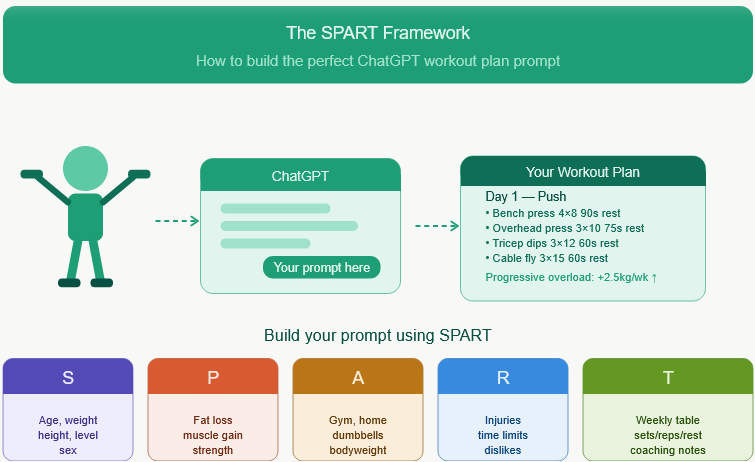
This is the master-template prompt — the one you can customize for almost any situation. It follows the SPART framework (covered in Section 6) and gives ChatGPT everything it needs to produce a genuinely useful plan.
Act as an expert personal trainer and exercise scientist with 10+ years of experience.

Create a detailed, personalized workout plan based on the following information:

**Personal Profile:**
- Age: [your age]
- Sex: [male/female/other]
- Weight: [your weight in lbs or kg]
- Height: [your height]
- Fitness level: [beginner / intermediate / advanced]

**Goals (choose one or more):**
- [ ] Lose weight / burn fat
- [ ] Build muscle / hypertrophy
- [ ] Improve strength
- [ ] Increase endurance / cardio fitness
- [ ] Improve overall health and fitness
- [ ] Athletic performance

**Schedule & Equipment:**
- Available training days per week: [3 / 4 / 5 / 6]
- Time per session: [30 / 45 / 60 / 90 minutes]
- Equipment available: [gym with full equipment / home with dumbbells / bodyweight only / resistance bands / barbell + rack]

**Limitations & Notes:**
- Injuries or physical limitations: [none / describe any]
- Exercises to avoid: [list any]
- Preferred training style: [strength training / HIIT / circuit / traditional bodybuilding / powerlifting / functional fitness]

**Output Format:**
- Provide a weekly workout schedule in table format
- For each session, list: exercise name, sets, reps/duration, rest period, and coaching notes
- Include a warm-up and cool-down for each session
- Explain the logic behind the program structure
- Include progressive overload suggestions for weeks 2–4
- Add recovery and nutrition tips at the end
Why this prompt works: It gives ChatGPT a complete picture of who you are, what you want, what you have access to, and what format you need. Every variable that matters is accounted for.
Customization tip: You don’t need to fill every field. Even filling 60–70% of this template will produce a far better plan than a one-line prompt.
The 15 Best ChatGPT Workout Plan Prompts
These prompts are organized by goal and user type. Each one is copy-paste ready.
1. The Beginner Full-Body Starter Prompt
Best for: People who have never followed a structured program before.
Act as a certified personal trainer. I am a complete beginner to working out.
I am [age] years old, [weight], and have no gym experience. I have access to a
commercial gym and can train 3 days per week for 45 minutes per session. My
goal is to build a fitness habit and improve my overall health.

Create a 4-week beginner full-body workout plan. Use simple exercises with clear
form cues. Include warm-up and cool-down. Explain what each exercise does and why
it's in the program. Format the plan as a weekly table with sets, reps, and rest times.
Expected result: A gentle, structured 3-day full-body routine using foundational movements (squats, deadlifts, rows, presses) with progressive difficulty built in.
2. The Weight Loss Workout Prompt
Best for: Anyone whose primary goal is fat loss and calorie burning.
You are an expert fitness coach specializing in fat loss. Create a weight loss
workout plan for a [age]-year-old [male/female] who weighs [weight] and wants
to lose [X lbs/kg] in [timeframe].

I can train [X] days per week for [X] minutes. I have access to [equipment].
I [do/do not] enjoy cardio. Include both strength training and cardio components.
Explain how the program creates a calorie deficit and preserves muscle mass.
Format as a weekly schedule with sets, reps, and rest times.
Expected result: A combination of strength training and cardiovascular work, structured to maximize calorie burn while preserving lean muscle tissue.
Customization tip: If you hate running, say so. Add “I prefer low-impact cardio options” and ChatGPT will suggest cycling, rowing, or elliptical alternatives.
3. The Muscle Building Prompt
Best for: Intermediate lifters focused on hypertrophy (muscle growth).
Act as a strength and hypertrophy coach. Create a muscle-building workout plan
for an intermediate lifter with 1–2 years of training experience.

My stats: [age], [weight], [height]. I train [X] days per week and have access
to a full gym. My goal is to maximize muscle growth over the next 12 weeks.

Include: training split (push/pull/legs or upper/lower), volume per muscle group
per week, progressive overload strategy, and deload week recommendations.
Format the full week as a detailed table with exercise, sets, reps, tempo, and
rest periods.
Expected result: A structured hypertrophy split (such as PPL or upper/lower) with appropriate volume (10–20 sets per muscle group per week), rep ranges (8–15), and clear progression guidance.
4. The Home Workout No-Equipment Prompt
Best for: Home workout users, travelers, or anyone without gym access.
Create a complete home workout plan that requires zero equipment. I am [fitness level]
and can train [X] days per week for [X] minutes. My goal is [fat loss / muscle
toning / general fitness / strength].

Include a variety of bodyweight exercises — not just push-ups and squats.
Structure it as a weekly plan with warm-up, main workout, and cool-down.
Show sets, reps, and rest times. Add progression options so I can make it
harder as I get stronger.
Expected result: A creative, challenging bodyweight program using movements like pike push-ups, Bulgarian split squats, glute bridges, bear crawls, and isometric holds — with built-in progression.
5. The Busy Professional Prompt (30-Minute Workouts)
Best for: People with tight schedules who can only commit 30 minutes per session.
I am a busy professional who can only dedicate 30 minutes, 4 days per week to
working out. I have access to [gym / dumbbells at home / bodyweight only].
My goal is to stay fit, maintain muscle, and manage stress.

Create a time-efficient workout plan with minimal rest periods. Prioritize
compound movements and supersets to maximize results in minimal time.
Include specific rest times and transitions to keep each session under 30 minutes.
Expected result: High-efficiency circuit or superset-based sessions using compound lifts, with no wasted time — perfect for lunch breaks or early mornings.
6. The Strength Training Plan Prompt
Best for: Anyone focused on getting stronger, not just bigger or leaner.
Act as a powerlifting coach. Create a strength-focused training program centered
on the three main lifts: squat, bench press, and deadlift.

My current maxes: Squat [X], Bench [X], Deadlift [X]. Training experience:
[beginner / intermediate / advanced]. I can train [X] days per week.

Design a linear or undulating periodization program. Include accessory work to
support the main lifts, warm-up protocols, and a strategy for testing my new maxes
after 8 weeks. Format as a full weekly plan.
Expected result: A structured strength program using progressive loading, proper periodization, and targeted accessory work for weak points.
7. The Women’s Fitness Prompt
Best for: Women who want a plan tailored to their specific goals and preferences.
Create a workout plan designed for women with the goal of [toning / building
curves / fat loss / strength]. I am [age], [fitness level], and can train
[X] days per week with access to [equipment].

Emphasize glute, hamstring, and core development. Include a mix of strength
training and cardio. Avoid any assumptions — I am not afraid of lifting heavy.
Provide sets, reps, rest times, and coaching notes for each exercise.
Note: ChatGPT will produce the same quality plan for any gender — this prompt simply focuses it on the specific muscle groups and goals common among women seeking this type of training.
8. The Senior/Over-50 Workout Prompt
Best for: Adults over 50 looking for safe, effective exercise programming.
Create a workout plan for a [age]-year-old [male/female] who wants to stay
active, maintain muscle mass, and improve joint mobility. I have [minor knee
pain / no injuries / a history of back issues — describe yours].

I can train [X] days per week for [X] minutes. Available equipment: [list].
Prioritize low-impact options, mobility work, and exercises that support
healthy aging. Avoid high-impact movements. Include balance and flexibility work.
Expected result: A safe, joint-friendly routine focusing on functional strength, mobility, and longevity — incorporating resistance training without unnecessary strain.
9. The Athletic Performance Prompt
Best for: Athletes training for a sport or specific physical performance goal.
Act as a sports performance coach. I am a [sport] athlete training in the
[off-season / pre-season / in-season]. My physical profile: [age, weight,
fitness level]. I train [X] days per week and have access to [equipment].

Design a performance-focused workout plan that improves [speed / power /
endurance / agility / strength — pick what applies]. Integrate sport-specific
movement patterns. Include periodization appropriate for my competition schedule.
10. The Workout Plan for Specific Injuries
Best for: People returning from injury or working around physical limitations.
I am recovering from [injury: e.g., rotator cuff strain / knee surgery /
lower back pain]. I have been cleared by my doctor to exercise with modifications.

Create a workout plan that: avoids all overhead pressing / avoids knee flexion
beyond 90 degrees / keeps the spine in neutral [adjust for your injury].
My goal is [maintaining fitness / rehab-focused strengthening / upper body only].
I can train [X] days per week.
⚠️ Always consult your physician or physical therapist before following any exercise plan if you have an existing injury or medical condition.
11. The 6-Day PPL (Push/Pull/Legs) Prompt
Best for: Intermediate to advanced gym-goers who can train 6 days per week.
Create a 6-day Push/Pull/Legs workout split for muscle building. I am an
intermediate lifter, [age], [weight], training for hypertrophy. I have full
gym access.

Structure: Push (chest, shoulders, triceps), Pull (back, biceps), Legs (quads,
hamstrings, glutes, calves) — repeated twice per week. Include 4–5 exercises
per session, 3–4 sets each, rep ranges of 8–15, and rest periods. Add a
deload week protocol for every 4th week.
12. The HIIT Workout Prompt
Best for: People who prefer intense, short-duration cardio workouts.
Design a 4-week HIIT (High-Intensity Interval Training) program for fat loss
and cardiovascular improvement. I am [fitness level] and can do [X] sessions
per week, each lasting [20–30] minutes.

Available equipment: [bodyweight / cardio machines / kettlebells]. Vary the
workouts each day to prevent adaptation. Include work-to-rest ratios,
exercise descriptions, and safety reminders for each session. Explain how
to track progress and when to increase intensity.
13. The Dumbbell-Only Home Gym Prompt
Best for: Home gym users with a set of dumbbells.
Create a complete workout plan using only dumbbells. I have a pair of adjustable
dumbbells that go up to [X lbs/kg]. I am [fitness level] and train [X] days
per week. My goal is [muscle building / fat loss / general fitness].

Design a full-body or split routine that maximizes dumbbell-only training.
Include unilateral exercises to correct imbalances. Format as a weekly table
with sets, reps, tempo, and rest times.
14. The Workout + Nutrition Combo Prompt
Best for: People who want both a training plan and basic nutrition guidance together.
Act as both a personal trainer and a nutrition coach. Create a 4-week workout
plan AND basic nutrition guidelines for my goal of [fat loss / muscle building /
performance].

My profile: [age, weight, height, activity level, dietary preferences — e.g.,
vegetarian, no dairy]. I can train [X] days per week.

For the nutrition section, provide: estimated daily calorie target,
macronutrient breakdown, meal timing recommendations, and 5 sample meal ideas.
Do not provide medical dietary advice.
15. The Personal Trainer Client Assessment Prompt
Best for: Personal trainers who want to use ChatGPT to draft client programs faster.
You are assisting a certified personal trainer. Based on the following client
profile, create a 6-week progressive workout plan:

Client: [age], [sex], [weight], [height]
Fitness history: [describe]
Goals: [describe]
Available days: [X] per week
Equipment: [describe]
Limitations: [describe]

Format the plan week by week, showing progression each week. Include coaching
notes, warm-up protocols, and assessment benchmarks for weeks 3 and 6.
Use professional terminology appropriate for a personal trainer reviewing the plan.
Advanced ChatGPT Fitness Prompts
Once you’re comfortable with the basics, these advanced prompts take your ChatGPT fitness planning to the next level.
Periodization Planning Prompt
Design a 12-week periodized training program using the following structure:
- Weeks 1–4: Hypertrophy phase (high volume, moderate intensity)
- Weeks 5–8: Strength phase (moderate volume, high intensity)
- Weeks 9–11: Peaking phase (low volume, maximum intensity)
- Week 12: Deload

My profile: [insert SPART details]. Format each phase as a separate weekly plan
with clear progression markers.
Plateau-Busting Prompt
I have been following the same workout routine for [X months] and have stopped
making progress. Here is my current plan: [paste your current plan].

Analyze what might be causing my plateau and redesign my program to break
through it. Consider: exercise variation, volume adjustment, intensity techniques
(drop sets, supersets, rest-pause), and deload requirements.
Exercise Substitution Prompt
I cannot do [exercise — e.g., barbell back squat] due to [reason — e.g.,
lower back pain / no barbell available].

Provide 5 alternative exercises that target the same muscle groups with similar
training stimulus. For each alternative, explain how to perform it, what muscles
it targets, and how to program it with similar sets and reps.
Workout Tracking and Progress Analysis Prompt
Here are my workout logs from the past [X weeks]: [paste your log data].

Analyze my progress. Identify: which muscle groups are underperforming,
where I'm making the most gains, whether my volume is appropriate,
and suggest adjustments for the next training block.
Mind-Muscle Connection and Technique Prompt
I struggle to feel [muscle group — e.g., my lats / my glutes] during
[exercise].

Explain: the correct muscle activation cues, common form mistakes that reduce
activation, 3 isolation exercises to improve mind-muscle connection,
and how to warm up this muscle group before my main lifts.
Common Mistakes When Using ChatGPT for Fitness
Even with good prompts, people make these recurring errors:
Mistake 1: Treating ChatGPT as a Doctor
ChatGPT cannot diagnose injuries, interpret pain, or provide medical clearance. If you have joint pain, chronic conditions, or are recovering from surgery — see a professional first.
Mistake 2: Following a Plan Without Understanding It
Blindly following a ChatGPT plan without understanding the exercises, rep schemes, or progression logic is risky. Always ask ChatGPT to explain what each exercise is for and how to do it safely.
Mistake 3: Ignoring Recovery
Many people ask for 6-day or 7-day workout plans, ignoring the biological need for rest. Muscle is built during recovery, not during the workout. Ask ChatGPT to specifically address recovery in every plan.
Mistake 4: Never Updating the Plan
A plan that worked 3 months ago won’t keep working indefinitely. Use ChatGPT to create fresh training blocks every 4–8 weeks, or when you notice adaptation (plateaus, boredom, reduced challenge).
Mistake 5: Skipping the Warm-Up
Always ask for warm-up protocols. Dynamic stretching, mobility work, and activation exercises before lifting reduce injury risk significantly.
Mistake 6: Not Providing Honest Information
If you tell ChatGPT you’re intermediate when you’re actually a beginner, or claim you have no injuries when you do — the plan won’t be appropriate. Be honest and specific.
Mistake 7: Copying Plans Without Customization
The prompts in this guide are templates, not finished products. Every person has a different body, schedule, and history. Customize every prompt with your real data.
Is ChatGPT Better Than Workout Apps?
This is one of the most common questions in the ChatGPT fitness plan space. Here’s an honest, direct comparison:
| Feature | ChatGPT | Workout Apps (e.g., Fitbod, Hevy, Nike Training) |
|---|---|---|
| Personalization | ★★★★★ (with good prompts) | ★★★☆☆ |
| Exercise tracking | ✗ | ✓ |
| Video demonstrations | ✗ | ✓ |
| Progress logging | ✗ | ✓ |
| Plan generation flexibility | ★★★★★ | ★★★☆☆ |
| Scientific reasoning | ★★★★☆ | ★★★☆☆ |
| Cost | Free or low-cost | Often $10–$20/month |
| Adaptability | ★★★★★ | ★★★☆☆ |
| Real-time feedback | ✗ | Limited |
| Community/accountability | ✗ | Sometimes |
The verdict: ChatGPT is not a replacement for a good workout app — it’s a complement to one. Use ChatGPT to design your program, then use an app like Hevy or Strong to log your workouts and track progress.
Or, use ChatGPT for program design and keep a simple spreadsheet for tracking. That combination is free, flexible, and highly effective.
FAQ
Can I trust ChatGPT to create a safe workout plan?
ChatGPT can create a safe, appropriate workout plan when given accurate information. However, it doesn’t know your real-time physical state, can’t see your form, and cannot account for factors only a professional could observe. Use it as a starting point, not an absolute authority. Always consult a certified personal trainer or physician when in doubt.
How often should I ask ChatGPT to update my workout plan?
Most fitness experts recommend changing your program every 4–8 weeks to prevent adaptation and maintain progress. Use ChatGPT to build a new training block whenever you notice plateaus, boredom, or significantly improved fitness.
Can ChatGPT help me lose weight?
ChatGPT can design a weight loss workout routine and provide general nutrition guidelines. However, sustainable fat loss also depends on caloric intake, sleep, stress, and hormonal health. Use ChatGPT as one piece of the puzzle, not the whole solution.
Is ChatGPT good for building muscle?
Yes — ChatGPT is well-versed in hypertrophy science. With a good muscle building workout prompt that includes your training history, available equipment, and volume preferences, it can produce a legitimate muscle-building program.
What’s the difference between ChatGPT-4 and ChatGPT-3.5 for fitness planning?
GPT-4 models produce more nuanced, detailed, and contextually accurate fitness plans. If you’re serious about using ChatGPT for fitness planning, the paid version (ChatGPT Plus) offers meaningfully better output quality.
Can ChatGPT replace a personal trainer?
No. A certified personal trainer provides real-time feedback, form correction, accountability, motivation, and professional expertise that ChatGPT cannot replicate. ChatGPT is an excellent supplement — especially for people who can’t afford regular training sessions — but it’s not a replacement.
What’s the best ChatGPT model to use for workout planning?
As of 2025, GPT-4o is the most capable model available in ChatGPT. It provides the most detailed and contextually appropriate fitness plans. Claude models (like Claude Sonnet) are also excellent for structured fitness content planning.
Can I use these prompts with other AI tools?
Yes. The SPART framework and all prompts in this guide work with any large language model — including Google Gemini, Claude, Microsoft Copilot, and others. The principles of good prompt engineering apply universally.
Conclusion
ChatGPT is a genuinely powerful tool for fitness planning, but its power is entirely unlocked by the quality of your prompts.
Here’s what you’ve learned:
- Why vague prompts fail — and exactly how to fix them
- The SPART framework — your template for any workout prompt
- 15 copy-paste prompts covering every goal, experience level, and scenario
- Advanced strategies for periodization, plateau-busting, and program design
- The honest limitations of AI-generated fitness plans
The next step is simple: take the prompt that best fits your situation, fill in your real details, paste it into ChatGPT, and start building your plan today.
Then — and this is the part most people skip — actually do the workouts.
The best workout plan is the one you follow consistently. Use ChatGPT to remove the planning barrier, then put in the real work.
Final reminder: If you have any health conditions, injuries, or concerns — consult a licensed healthcare provider or certified fitness professional before starting a new exercise program. AI tools are powerful aids, but they are not a substitute for qualified human expertise.
Found this guide useful? Share it with someone who’s been struggling to find the right workout plan. The right prompt might be the only thing standing between them and a fitness routine that actually works.