Running a business means wearing a lot of hats.
One day you’re the marketer. The next you’re doing sales, ops, or customer support.
AI can’t replace you. But it can save you hours every week.
This guide gives you a system, not just a list of prompts. You’ll learn how to use AI at every stage of building a business: Think, Validate, Build, Market, and Scale.
Let’s get into it.
How Entrepreneurs Can Use AI
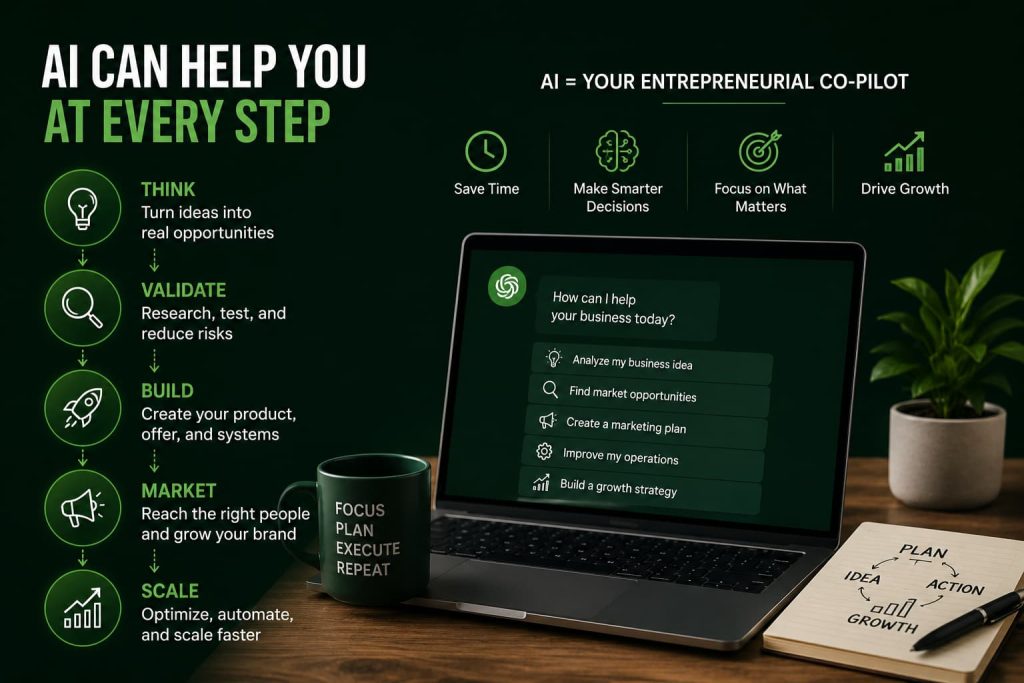
Short answer: AI helps you think faster and work faster.
You can use it to:
- Test business ideas before you spend money
- Research your market and competitors
- Write marketing copy and social posts
- Draft sales emails and follow-ups
- Plan your day and build simple SOPs
AI doesn’t make the decisions. You still do that. It just gets you to a good first draft faster, so you spend your time on judgment calls instead of blank pages.
Think of AI as a very fast, very well-read intern. Smart, but you still have to check its work.
Most entrepreneurs already use AI for one or two things, like writing an email or brainstorming a headline. Few use it across the whole business.
That’s the gap this guide fills. Instead of a random list of prompts, you’ll get a system tied to the actual stages of building a business.
The Best AI Prompt for Entrepreneurs
If you only save one prompt from this article, save this one.
It’s a master prompt you can use on any business idea, at any stage. It forces the AI to think like a strategist, not a cheerleader.
Act as a business strategist with 20 years of experience across startups and small businesses. I’m going to describe a business idea. I want you to:
- Identify the strongest opportunity in this idea
- List the top 3 risks that could kill it
- Suggest one way to test the idea in the next 7 days for under $100
- Give me a simple action plan with weekly milestones for the next 30 days
Here’s my idea: [describe your business idea in 2-3 sentences]
Be direct. Don’t just tell me what I want to hear.
Why It Works
Most people ask AI “is this a good idea?” That’s a bad question. AI will usually say yes, because it’s trying to be helpful.
This prompt forces structure. It asks for opportunity, risk, a cheap test, and a plan. That’s the same thinking process a good advisor uses.
When To Use It
Use it any time you have a new idea. A new product. A new service. A new market to enter.
Also use it when you’re stuck and not sure what to do next. It resets your thinking.
Pro Tip
Add “be direct, don’t just tell me what I want to hear” to almost every prompt you write. It cuts down on AI’s habit of being overly agreeable.
AI Prompts for Business Ideas and Validation
Before you build anything, you need to know if people actually want it.
These prompts help you generate and stress-test ideas.
Startup Ideas
Prompt
I have skills in [your skills, e.g. graphic design, cooking, coding]. I have [your budget] to start a business. Suggest 5 business ideas that use my skills, need low upfront cost, and can get their first customer within 30 days.
What It Does
Turns your existing skills and budget into concrete business ideas, instead of generic “start a blog” advice.
Example
A graphic designer with $500 and 10 hours a week might ask this and get ideas like a niche Canva template shop, a local small-business logo package, or a paid Discord community for beginner designers.
Pro Tip
Always add a real number for budget and time. Vague inputs get vague ideas back.
Once you’ve picked an idea worth pursuing, the next step is putting it on paper, see our guide to ‘AI prompts for Business‘ for a full walkthrough.
Market Gaps
Prompt
I’m looking at the [your industry] industry. Based on common customer complaints, unmet needs, and outdated solutions, identify 5 gaps in this market that a small, focused business could fill.
What It Does
Points you toward problems that existing companies are ignoring or doing badly.
Example
Someone in the fitness industry might get gaps like “no affordable coaching for people over 50” or “no simple app for tracking home workouts without a gym.”
Pro Tip
Follow up by asking “which of these gaps would be hardest for a big company to copy?” That tells you where your advantage is.
Customer Problems
Prompt
My target customer is [describe them: age, job, situation]. List their top 10 daily frustrations related to [your industry or topic]. Rank them by how painful and how frequent each one is.
What It Does
Gets you inside your customer’s head before you write a single word of copy or build a single feature.
Example
A prompt about busy parents and meal planning might surface frustrations like “no time to plan meals,” “kids won’t eat the same thing,” and “grocery bills keep climbing.”
Pro Tip
The frustrations that are both painful and frequent are your best product opportunities. Start there.
Business Validation
Prompt
Here’s my business idea: [describe it]. Act as a skeptical investor. Ask me the 5 hardest questions you would ask before funding this. Then tell me which question I’m least prepared to answer.
What It Does
Simulates tough questioning so you’re not blindsided by real customers or real investors later.
Example
For a subscription box idea, the AI might push on churn, shipping costs, and why customers wouldn’t just buy the items directly.
Pro Tip
Actually answer the questions out loud or in writing. Don’t just read them. The value is in forcing yourself to respond.
AI Prompts for Market Research
Good research used to take days. Now it takes an hour, if you ask the right questions.
Competitor Analysis
Prompt
List the top 5 competitors for a business selling [your product/service] to [your target customer]. For each one, summarize their pricing model, their main selling point, and one weakness based on public reviews or complaints.
What It Does
Gives you a fast competitive landscape so you know where to position yourself.
Example
A local coffee subscription business might learn that competitors are strong on variety but weak on delivery speed or customer support.
Pro Tip
Ask a follow-up: “Where’s the pricing gap? Is there room for a premium or budget option?”
Customer Research
Prompt
I sell [product/service] to [target customer]. Write 10 interview questions I could ask real customers to understand why they buy, what almost stopped them, and what would make them buy again.
What It Does
Preps you for real conversations with real people, which is still the best market research there is.
Example
Questions might include “what almost made you not buy this?” and “what would make you recommend this to a friend?”
Pro Tip
AI can help you write the questions. It can’t replace actually talking to customers. Do both.
Industry Trends
Prompt
Summarize the 5 biggest trends currently shaping the [your industry] industry. For each trend, explain what’s driving it and one way a small business could take advantage of it.
What It Does
Keeps you from building a business around something that’s already fading.
Example
In e-commerce, trends might include AI-powered product recommendations, shorter return windows, and rising demand for local delivery.
Pro Tip
Cross-check anything AI tells you about trends against a recent search. Trend data can be outdated depending on the model.
Opportunity Analysis
Prompt
Based on the trends and gaps in [your industry], suggest 3 specific opportunities a solo entrepreneur or small team could pursue in the next 6 months. Rank them by speed to launch and startup cost.
What It Does
Turns broad research into a short, ranked list you can actually act on.
Example
For someone in online education, this might rank “cohort-based course” above “self-paced course platform” because it launches faster with less tech overhead.
Pro Tip
Always ask for ranking. A list of 10 unranked ideas is just more decision fatigue.
AI Prompts for Marketing
Marketing is where most entrepreneurs waste the most time. These prompts speed up the writing without making it sound robotic.
Content Marketing
Prompt
Write a content plan for [your business type] covering the next 4 weeks. Suggest 8 blog post or video topics that answer real questions my target customer is searching for. For each topic, include the main question it answers.
What It Does
Gives you a month of content ideas built around real search intent, not random topics.
Example
A pet grooming business might get topics like “how often should I bathe my dog” and “signs your dog needs a haircut.”
Pro Tip
Pick topics that match questions customers actually ask you. Those convert better than generic trending topics.
Social Media
Prompt
Write 5 social media post ideas for [platform] promoting [your product/service] to [target audience]. Each post should have a hook in the first line and a clear call to action.
What It Does
Gets you past the blank-page problem when you need to post consistently.
Example
A hook like “Most people ruin their sourdough with this one mistake” works better than “Check out our bread class.”
Pro Tip
Ask AI to write 3 versions of the hook only, then pick the strongest one yourself. Hooks matter more than the rest of the post.
Email Marketing
Prompt
Write a 3-email welcome sequence for new subscribers to [your business]. Email 1 should build trust, email 2 should provide value, email 3 should include a soft offer. Keep each email under 150 words.
What It Does
Builds a relationship with new leads automatically, instead of leaving them cold after signup.
Example
Email 1 might share your founder story, email 2 a quick tip, and email 3 a discount on the first purchase.
Pro Tip
Always add a word limit. Without one, AI tends to write long, over-explained emails that lose readers.
Marketing Strategy
Prompt
I run a [business type] targeting [audience]. My monthly marketing budget is [amount]. Suggest a simple 90-day marketing strategy that focuses on 2 channels, not 6. Explain why those 2 channels fit my budget and audience.
What It Does
Stops you from spreading yourself thin across too many platforms at once.
Example
A local service business with a small budget might get a plan focused on local SEO and referral incentives, skipping paid social entirely.
Pro Tip
Fewer channels done well beats many channels done badly. Push back if AI suggests more than 2-3 channels for a small budget.
AI Prompts for Sales and Growth
Sales is where the business actually makes money. These prompts help you sell without sounding pushy.
Lead Generation
Prompt
I sell [product/service] to [target customer]. Suggest 5 low-cost ways to generate qualified leads in the next 30 days, without paid ads. For each method, explain the first step to take this week.
What It Does
Gives you concrete lead-gen tactics that don’t require an ad budget.
Example
Ideas might include partnering with a complementary local business, running a small referral program, or offering a free mini-consultation.
Pro Tip
Pick one method and commit to it for 2 weeks before switching. Most people quit lead-gen tactics too early to see results.
Sales Outreach
Prompt
Write a cold outreach message to [describe your ideal prospect] introducing [your product/service]. Keep it under 100 words, no hard sell, and end with a low-pressure question, not a pitch.
What It Does
Creates outreach that sounds like a person, not a template, which gets more replies.
Example
Instead of “Buy our software,” it might end with “Would it be worth a quick 10-minute call to see if this fits?”
Pro Tip
Always personalize the first line by hand after AI drafts it. Generic openers get ignored.
Customer Retention
Prompt
My customers are [describe them]. Suggest 5 ways to increase retention and reduce churn for a business like mine, without discounting the price. Focus on relationship and experience, not price cuts.
What It Does
Helps you keep customers without training them to expect discounts every time.
Example
Suggestions might include a simple check-in email at 30 days, a small surprise perk, or a quick feedback call after purchase.
Pro Tip
Retention ideas work best when they feel personal. Avoid anything that looks like a mass-blast discount code.
Upselling Opportunities
Prompt
Here’s my current product/service lineup: [list them]. Suggest 3 natural upsell or cross-sell opportunities based on what a customer would need next after their first purchase.
What It Does
Finds logical next purchases instead of random add-ons that feel forced.
Example
A web design client might be a natural fit for an ongoing maintenance plan or SEO add-on after the site launches.
Pro Tip
The best upsell solves a problem the first purchase created or revealed. Look for that connection first.
AI Prompts for Productivity and Operations
This is the part most guides skip. But operations is where good businesses fall apart if you ignore it.
Daily Planning
Prompt
Here’s my task list for today: [list your tasks]. Sort them into “must do today,” “can wait until tomorrow,” and “delegate or drop.” Base the sorting on impact on revenue and urgency.
What It Does
Turns a messy to-do list into a clear plan in seconds.
Example
A task like “reply to a customer complaint” would land in “must do today,” while “redesign the logo” might land in “can wait.”
Pro Tip
Do this at the start of every day, not the end. It changes how you spend the whole day, not just tomorrow.
Process Improvement
Prompt
Here’s how I currently handle [a specific process, e.g. onboarding new clients]: [describe the steps]. Identify where this process wastes time or creates friction. Suggest a simpler version with fewer steps.
What It Does
Finds the clunky parts of a process you’re too close to see yourself.
Example
A 7-step onboarding process might get cut to 4 steps by combining forms or automating a manual email.
Pro Tip
Run this on any process you repeat more than once a week. Small time savings add up fast.
SOP Creation
Prompt
Write a simple step-by-step standard operating procedure for [a task, e.g. responding to customer support tickets]. Assume the person following it has never done this task before. Keep steps short and numbered.
What It Does
Turns knowledge in your head into a document someone else, or future you, can follow.
Example
An SOP for responding to reviews might include steps like “thank the customer,” “address the specific issue,” and “offer a way to make it right.”
Pro Tip
Test the SOP by having someone else follow it exactly. If they get stuck, the SOP is missing a step.
Team Communication
Prompt
I need to tell my team [describe the situation or change]. Write a short, clear message that explains what’s changing, why, and what they need to do. Keep the tone direct but not harsh.
What It Does
Helps you communicate change without sounding vague or overly formal.
Example
A message about a new tool rollout might explain the reason in one line, then list exactly what each person needs to do by when.
Pro Tip
Always end team messages with a clear next action. “Let me know if you have questions” is not a next action.
How I Would Use AI as an Entrepreneur Today
If I were starting today, here’s the order I’d go in.
Idea validation. Run my idea through the master prompt above. Get the risks and a cheap test on the table before spending real money.
Research. Use the competitor and customer research prompts to understand who I’m up against and who I’m actually selling to.
Marketing. Build a simple content and social plan for the first 4 weeks, focused on 2 channels max.
Sales. Draft outreach messages and a short retention plan before I even have customers, so I’m ready when they show up.
Operations. Write SOPs for anything I do more than once. Future me will thank present me.
None of this replaces judgment. It just clears the busywork so judgment is all that’s left.
Frequently Asked Questions
Can entrepreneurs use AI?
Yes. Entrepreneurs can use AI for idea validation, market research, marketing copy, sales outreach, and daily planning. It works best as a thinking and writing partner, not a decision-maker.
What are the best AI prompts for entrepreneurs?
The best prompts are specific. They include your audience, budget, and goal, and ask AI to be direct instead of just agreeable. A strong starting point is a master prompt that asks for opportunities, risks, a cheap test, and an action plan.
Can AI help start a business?
Yes. AI can help validate an idea, research the market, and draft a basic plan. It can’t replace talking to real customers or making the final call on what to build.
Can AI help with market research?
Yes. AI can summarize competitors, industry trends, and likely customer frustrations quickly. Always verify facts and numbers before using them in a real strategy.
Can AI help grow a business?
Yes. AI can help with marketing content, sales outreach, retention ideas, and process improvements. Growth still depends on execution, not just prompts.
Conclusion
AI won’t build your business for you. But it will save you hours every week on research, writing, and planning.
Start small. Pick 2-3 prompts from this guide that match what you’re working on right now. Use them this week.
Once they’re part of your routine, add more. That’s how a real AI workflow gets built, one useful prompt at a time.