Running a small business often means wearing ten different hats before 10 a.m.
One minute you’re answering a customer complaint. The next you’re trying to write a social media post, figure out why sales slowed down last month, or draft an email to a supplier. And somewhere in between, you’re supposed to be actually running your business.
That’s the reality most small business owners live in. Not enough hours. Too many tasks. And rarely enough help.
That’s where ChatGPT comes in.
Not as some magic solution that runs your business for you — but as a genuinely useful tool that can handle the time-consuming writing, thinking, and planning tasks that eat up your day. When you know how to use it, ChatGPT can function like a capable assistant who’s always available, never complains, and costs a fraction of a hire.
This guide gives you the exact prompts to make that happen.
Why Small Business Owners Are Using ChatGPT
Let’s be honest — most small business owners don’t have a marketing department, a content team, or an operations consultant on speed dial. You figure things out yourself, with whatever time you have left after serving customers and keeping the lights on.
ChatGPT fills that gap in a few important ways:
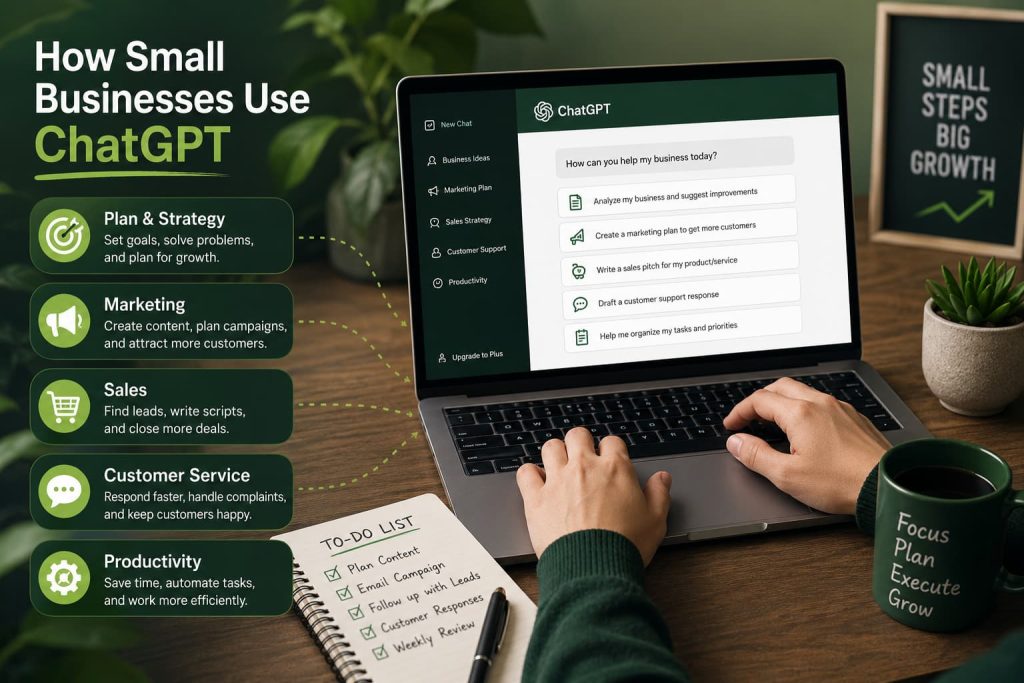
Marketing: Writing social media posts, email campaigns, blog content, and local ad copy.
Customer service: Drafting replies to reviews, complaints, and common questions.
Sales: Creating scripts, follow-up messages, and lead nurturing sequences.
Planning: Thinking through business decisions, identifying opportunities, and setting goals.
Productivity: Building SOPs, prioritizing tasks, and improving workflows.
The tool isn’t perfect. It doesn’t know your customers the way you do, and it can occasionally get facts wrong or produce generic outputs. That’s why every prompt in this guide is built to give ChatGPT enough context to produce something actually useful — not just filler.
The Best ChatGPT Prompt for Small Business Owners
If you only use one prompt from this entire guide, use this one.
Prompt:
“I run a [type of business] in [city/region] that serves [target customer]. My biggest current challenge is [specific problem]. My goals for the next 90 days are [list goals]. Based on this, give me: (1) an honest analysis of the challenge, (2) three actionable strategies to address it, (3) any quick wins I can implement this week, and (4) one question I should be asking myself that I probably haven’t considered.”
Why It Works
It forces you to articulate the real problem before ChatGPT responds. Vague inputs produce vague outputs. This prompt gives the AI enough context to produce something tailored.
When To Use It
Use it at the start of any week when you feel stuck, overwhelmed, or like you need a sounding board. It works especially well for quarterly planning.
Pro Tip
Run this prompt every 90 days as a business review ritual. Swap in your updated goals and challenges. You’ll start building a pattern of reflection that most small business owners skip.
The Small Business Productivity Framework
Before jumping into specific prompts, it helps to have a mental map of where ChatGPT fits in your business.
Think of it this way: PLAN → MARKET → SELL → SERVE → IMPROVE
PLAN: Use ChatGPT to set goals, analyze your situation, and think through decisions.
MARKET: Use it to create content, campaigns, and ideas that attract customers.
SELL: Use it to craft pitches, scripts, and follow-up messages that convert.
SERVE: Use it to respond to customers faster and more consistently.
IMPROVE: Use it to review what’s working, build better processes, and reduce friction.
This framework keeps you from using ChatGPT randomly. Every prompt you use should map to one of these five stages.
ChatGPT Prompts for Business Planning
Goal Setting
Prompt
“I run a [business type] and I want to grow revenue by [X%] over the next 12 months. Help me break this goal down into quarterly milestones, identify the three biggest levers I should focus on, and flag any risks I should plan for.”
What It Does
Turns a vague ambition into a structured plan with clear priorities.
Example
A freelance photographer wants to grow revenue by 40%. ChatGPT might identify the three levers as raising package prices, adding referral incentives, and targeting corporate clients for headshots.
Pro Tip
After you get the output, push back. Ask: “What if I could only focus on one of these levers for 90 days? Which should it be and why?”
Business Growth Planning
Prompt
“My [business type] has been stable for [X years] but growth has plateaued. Analyze three potential growth paths for a business like mine and help me evaluate each one based on cost, time to revenue, and risk level.”
What It Does
Forces structured thinking about growth options instead of guessing.
Example
A local bakery might explore catering, wholesale to cafes, or an online store. ChatGPT can help map out the tradeoffs of each path.
Pro Tip
Use this alongside your ChatGPT prompt to build a business for a complete strategic picture.
Opportunity Analysis
Prompt
“I run a [business type] serving [customer type]. Based on current trends in small business and my industry, what underserved opportunities might I be missing? Give me five ideas with a brief explanation of why each one could work for my type of business.”
What It Does
Gets you thinking about adjacent revenue streams or market gaps.
Example
A personal trainer might discover underserved demand for corporate wellness programs or online coaching subscriptions.
Pro Tip
Pair this with your own ChatGPT prompt for market research to validate the opportunities with real data.
Problem Solving
Prompt
“I’m dealing with [specific problem] in my business. Walk me through the likely root causes, give me three solutions at different investment levels (low cost, medium cost, high cost), and tell me what you’d recommend first and why.”
What It Does
Structures your thinking when you’re too close to a problem to see it clearly.
Example
A retail shop owner dealing with high foot traffic but low conversion can use this to unpack whether the issue is pricing, layout, staff training, or something else.
Pro Tip
Describe the problem in detail. The more specific you are, the more useful the output.
ChatGPT Prompts for Marketing
Content Marketing
Prompt
“I run a [business type] targeting [customer profile]. Create a one-month content plan with 12 post ideas — four educational, four trust-building, and four promotional. For each idea, include the topic, the core message, and which stage of the buying journey it targets.”
What It Does
Eliminates the “what do I post?” problem for an entire month in one shot.
Example
A home cleaning service gets 12 post ideas covering cleaning tips, before-and-after stories, and booking promotions — without spending hours brainstorming.
Pro Tip
Ask ChatGPT to prioritize the list by which topics tend to drive the most engagement for local service businesses.
Social Media Content
Prompt
“Write five social media posts for a [business type] targeting [customer type]. Each post should have a strong hook in the first line, a practical or entertaining body, and a clear call to action. Tone should be [friendly/professional/casual]. Platform: [Instagram/Facebook/LinkedIn].”
What It Does
Gets you ready-to-post content in minutes instead of hours.
Example
A yoga studio owner needs five Instagram posts. ChatGPT drafts them, ready to edit with real names, dates, or local references.
Pro Tip
Build a library of 30–40 posts over a few sessions, then schedule them in batches. See the full workflow in our guide to ChatGPT prompts for social media content for business.
Email Marketing
Prompt
“Write a three-email welcome sequence for new customers of a [business type]. Email 1 should make them feel welcomed and set expectations. Email 2 should provide one genuinely useful tip related to [product/service]. Email 3 should invite them to take a next step, like booking again, leaving a review, or referring a friend.”
What It Does
Automates your new customer onboarding without needing a copywriter.
Example
A pet grooming salon gets a welcome sequence that warms up new clients, offers a grooming tip, and asks for a Google review — all on autopilot.
Pro Tip
For more email prompt options, check out our collection of ChatGPT prompts for business email.
Local Marketing Ideas
Prompt
“I own a [business type] in [city]. Give me ten low-budget local marketing ideas specifically suited to a small business in this type of market. Focus on ideas that build community connections and word-of-mouth rather than paid advertising.”
What It Does
Generates hyperlocal ideas that big marketing blogs never cover.
Example
A local bookstore gets ideas like hosting author meet-and-greets, partnering with nearby coffee shops, or running a neighborhood reading challenge.
Pro Tip
Tell ChatGPT the size of your town and whether you’re in a tourist area, residential neighborhood, or commercial strip. Context sharpens the output.
ChatGPT Prompts for Sales
Lead Generation
Prompt
“I run a [business type] and my ideal customer is [customer description]. Give me ten specific lead generation strategies suited to finding and attracting this type of customer, ranked from easiest to implement to most resource-intensive.”
What It Does
Creates a prioritized lead generation plan you can start working through immediately.
Example
A freelance bookkeeper finds that warm referrals from accountants and LinkedIn outreach to startups rank as the two easiest wins to start with.
Pro Tip
Ask ChatGPT to help you write the outreach message for whichever strategy you pick first.
Sales Scripts
Prompt
“Write a sales script for a [business type] reaching out to [customer type] for the first time. The script should open with empathy, acknowledge a common problem this customer faces, explain how we solve it, and close with a low-pressure next step. Keep it under 90 seconds when read aloud.”
What It Does
Gives you a tested structure for sales calls or videos without hiring a sales consultant.
Example
A web designer reaching out to local restaurants gets a script that opens with a comment about how hard it is to keep a website updated while running a busy kitchen.
Pro Tip
Record yourself reading it, then refine based on how natural it sounds. Scripts that feel forced won’t convert.
Sales Follow-Ups
Prompt
“Write a three-message follow-up sequence for a prospect who showed interest in [product/service] but hasn’t responded in [X days]. Message 1 should check in gently. Message 2 should add value. Message 3 should close the loop respectfully without burning the relationship.”
What It Does
Keeps deals alive without being pushy or spammy.
Example
A landscaping company follows up with a homeowner who got a quote two weeks ago but went quiet. The sequence revives the conversation.
Pro Tip
Space the messages 3–5 days apart. Any faster feels aggressive. Any slower loses momentum.
Customer Acquisition Ideas
Prompt
“My [business type] currently gets most of its customers through [current channel]. Suggest five alternative customer acquisition channels that have worked well for similar small businesses, with a practical first step I can take to test each one.”
What It Does
Reduces your dependence on one channel before it dries up.
Example
A massage therapist who relies entirely on word-of-mouth discovers that corporate chair massage events and employee wellness partnerships are two channels worth testing.
Pro Tip
Don’t try all five at once. Pick one, test it for 60 days, then evaluate before moving to the next.
ChatGPT Prompts for Customer Service
Customer Support Responses
Prompt
“A customer sent me this message: [paste message]. Write three response options — one that addresses the issue directly, one that offers a make-good, and one that escalates with empathy. My business tone is [friendly/professional].”
What It Does
Saves you from drafting responses under emotional pressure.
Example
A customer is upset about a delayed order. ChatGPT gives you three options from a simple apology to a discount offer — so you can choose what fits the situation.
Pro Tip
Never copy-paste without reading. Add your real customer’s name and any specific details the template leaves out.
Complaint Handling
Prompt
“Write a response to a negative online review for a [business type]. The customer complained about [specific complaint]. The response should: acknowledge the experience, avoid being defensive, explain what we’re doing to improve, and invite them to give us another chance. Keep it under 100 words.”
What It Does
Handles the most dreaded task in small business — the negative review — in a way that protects your reputation.
Example
A restaurant owner dealing with a one-star review about slow service gets a professional, empathetic reply that future customers will see and appreciate.
Pro Tip
Review responses are public. They’re not just for the unhappy customer — they’re for everyone who reads them next. Write with that in mind.
FAQ Creation
Prompt
“Based on the following information about my business — [paste business description] — generate 10 FAQ questions and answers that my customers most likely have before buying. Make the answers clear, confident, and helpful.”
What It Does
Creates your FAQ page from scratch without guessing what customers ask.
Example
A boutique fitness studio gets 10 FAQ answers covering class schedules, cancellation policies, what to bring, and membership options.
Pro Tip
Share the FAQ with a real customer and ask them what question you missed. There’s always at least one.
Customer Retention Strategies
Prompt
“I run a [business type] and want to improve customer retention. Give me five retention strategies that are practical for a small business with limited resources, and for each one, give me a specific first action I can take this week.”
What It Does
Shifts your focus from chasing new customers to keeping the ones you already have.
Example
A hair salon implements a birthday discount, a loyalty stamp card, and a re-booking reminder text — all from one ChatGPT session.
Pro Tip
Retention is cheaper than acquisition. Most small business owners underinvest here.
ChatGPT Prompts for Business Productivity
Task Prioritization
Prompt
“Here is my task list for this week: [paste tasks]. Help me prioritize them using an urgency and impact framework. Flag anything I should delegate or drop entirely, and suggest a rough daily schedule to get through the high-priority items.”
What It Does
Turns a chaotic to-do list into a structured weekly plan.
Example
A business owner with 22 items on their list discovers that 8 of them can wait, 3 can be delegated, and only 4 actually matter this week.
Pro Tip
Do this every Monday morning. It takes five minutes and changes how you feel about the entire week.
Workflow Improvement
Prompt
“Here is how I currently handle [business process — e.g., onboarding new clients, processing orders, scheduling appointments]: [describe process]. Identify any inefficiencies, suggest how to simplify it, and recommend any tools or automations that might help.”
What It Does
Gets an outside perspective on processes you’ve never questioned.
Example
A freelance consultant discovers their onboarding process has six steps that could be compressed into two with a simple intake form and automated confirmation email.
Pro Tip
Record yourself doing the process once, transcribe it, and paste that into the prompt. You’ll catch things you didn’t even realize you were doing.
SOP Creation
Prompt
“Write a Standard Operating Procedure for [specific task] in my [business type]. The SOP should include: an overview of the task, the tools required, step-by-step instructions, quality checkpoints, and what to do if something goes wrong. Write it so a new employee could follow it on their first day.”
What It Does
Gets critical business knowledge out of your head and into a document.
Example
A small retail store gets a clear SOP for end-of-day closing procedures — ready to hand to any new hire.
Pro Tip
Create one SOP per week for your most repeated tasks. After three months, you’ll have a basic operations manual.
Time Management
Prompt
“I’m a [business type] owner and I regularly run out of time before completing important work. Here’s how I currently spend my typical day: [describe your day]. Identify where I’m likely losing time, suggest a restructured daily schedule, and give me two habits I can start this week to protect focus time.”
What It Does
Treats your time like a resource that deserves as much attention as your money.
Example
A freelance designer discovers they’re spending 90 minutes a day on email — and that batching email to twice a day would recover nearly an hour of creative work time.
Pro Tip
Track your actual time for three days before running this prompt. Your perception of how you spend time is almost always wrong.
Common Mistakes Small Business Owners Make With ChatGPT
You’ve probably experienced this: you ask ChatGPT something and get back a bland, generic response that’s completely useless. That’s almost never ChatGPT’s fault. It’s a prompt problem.
Using vague prompts. “Help me with marketing” produces nothing useful. “Write five Instagram posts for a local coffee shop targeting young professionals who work from home” produces something you can actually use.
Not providing context. ChatGPT doesn’t know your business, your customers, or your market unless you tell it. Always share the basics before asking for help.
Trusting AI output blindly. ChatGPT can get facts wrong, make up statistics, or produce advice that doesn’t fit your specific situation. Always review the output before using it.
Ignoring customer feedback. The best prompts are informed by what real customers say. Mine your reviews, emails, and conversations for the exact language your customers use — then build that into your prompts.
Skipping human review. AI-generated content sounds like AI-generated content when nobody edits it. Your voice, your personality, and your judgment should always be the final layer.
How I Would Use ChatGPT If I Were Running a Small Business Today
Here’s what a practical ChatGPT routine would look like in a real small business.
Morning planning (5 minutes). Paste that week’s task list into ChatGPT. Get a prioritized view. Decide what the top three outcomes for the day are.
Marketing tasks (20 minutes, twice a week). Use ChatGPT to draft social posts, emails, and content in batches. Review, edit for voice, schedule. Done.
Customer communication (as needed). Any complaint, tricky reply, or review response — draft it in ChatGPT first. Edit it before sending. The emotional buffer alone is worth it.
Sales activities (weekly). Use ChatGPT to prep for sales calls, draft follow-up sequences, and brainstorm ways to re-engage cold leads.
Weekly business review (30 minutes on Friday). Use the universal prompt at the top of this guide. Assess what worked, what didn’t, and what to focus on next week.
None of this requires hours. It requires 30–45 minutes spread across the week — and it replaces work that used to eat whole days.
Frequently Asked Questions
Can ChatGPT help run a small business?
Yes — but it works best as an assistant, not an autopilot. ChatGPT is excellent at drafting content, analyzing problems, and generating ideas. The decisions, relationships, and judgment calls still belong to you.
What are the best ChatGPT prompts for small business owners?
The most useful prompts are specific. Include your business type, your customer, and the exact outcome you want. The universal business analysis prompt in this guide is a strong starting point for almost any situation.
Can ChatGPT help with marketing?
Absolutely. It can write social media posts, email sequences, blog content, ad copy, and local marketing ideas. The key is to give it enough context about your audience and brand voice.
Can ChatGPT help with customer service?
Yes. It’s particularly useful for drafting replies to complaints and negative reviews, creating FAQ pages, and building customer retention strategies. Always review outputs before sending.
Is ChatGPT useful for business productivity?
Significantly. The biggest wins are task prioritization, workflow simplification, and SOP creation. Small business owners often get the most value here because they’re managing everything alone.
Conclusion
Running a small business is hard. Using every tool available to make it a little less hard is just smart.
ChatGPT won’t replace your expertise, your relationships, or your judgment. But it can take a meaningful chunk of the time-consuming writing, thinking, and planning tasks off your plate — so you can spend more of your day on the work that actually moves the needle.
Start with one area. Maybe it’s customer service replies. Maybe it’s social media content. Maybe it’s that weekly planning prompt.
Get comfortable with one use case before adding more. Within a few weeks, you’ll wonder how you managed without it.